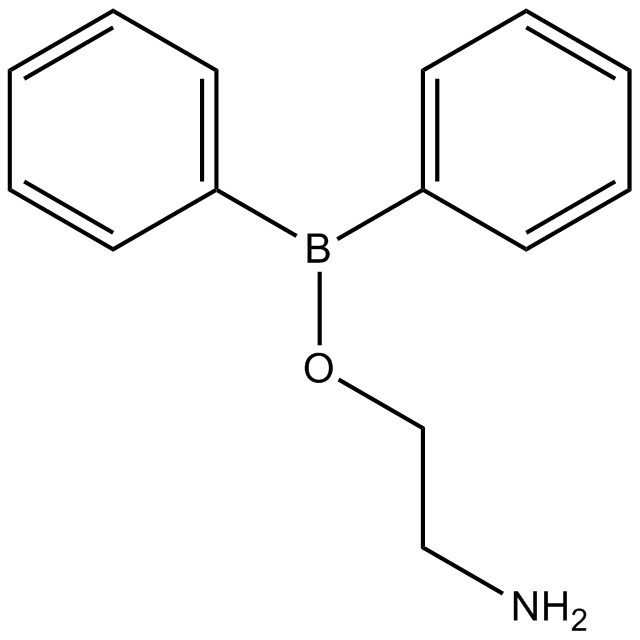

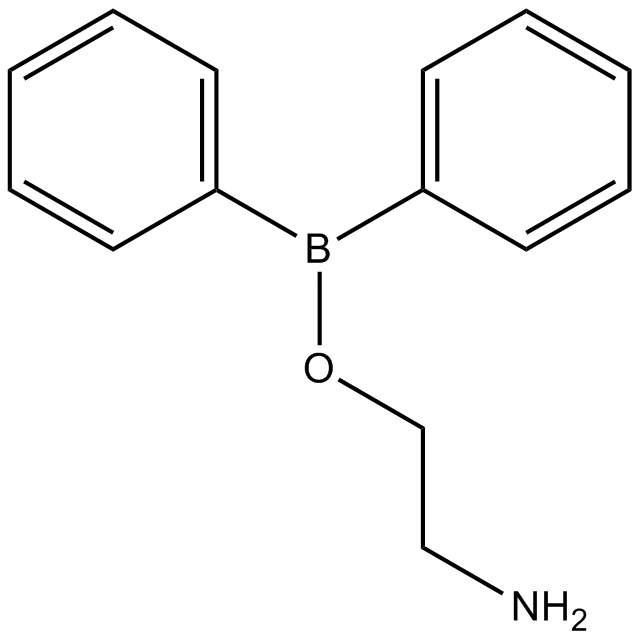
2-APB (Synonyms: 2-Aminoethoxydiphenyl borate, 2-APB, NSC 17107)
Catalog No.GC17562
2 APB is a nonspecific antagonist of calcium channels, commonly used in studies of calcium signaling, such as in apoptosis, muscle contraction, and neural transmission.
Products are for research use only. Not for human use. We do not sell to patients.
Product has been cited by 4 publications
Int J Biol Sci 19.8 (2023):2475.PMID:37215981Mbio (2024).PMID:38349129Neurochem Res 47.2 (2022):264-278.PMID:34468932Acta Biomater 169 (2023):192-208.PMID:37541606
Description
2-APB is a nonspecific antagonist of calcium channels, commonly used in studies of calcium signaling, such as in apoptosis, muscle contraction, and neural transmission. It is a membrane-permeable inhibitor of the inositol-1,4,5-trisphosphate (InsP3) sensitive Ca2+ channels, with an IC50 value of 42μM when the concentration of InsP3 is 100nm[1]. Additionally, 2-APB has been found to affect the activity of TRP channels at certain concentrations [2].
In vitro, 2-APB can inhibit the increase in intracellular Ca2+ induced by thrombin in human platelets and neutrophils, as well as angiotensin II (AII)-induced contraction of the thoracic aorta [1]. In HEK-293 cells, 2-APB blocks the TRPC5 channel with an IC50 value of 20 μM [3]. In mouse pancreatic acinar cells, low concentrations of 2-APB significantly inhibit calcium store-operated calcium influx, while high concentrations inhibit direct stimulation-induced Ca2+ release and InsP3-induced Ca2+ release [4].
In vivo, when 2-APB is administered intravenously at 10 mg/kg to mice in an I/R model, it significantly reduces the infarct size, accompanied by a reduction in ROS levels and neutrophil infiltration, demonstrating potential cardioprotective effects [5]. Additionally, in I/R rats, 2-APB significantly increases superoxide dismutase (SOD), total antioxidant capacity (TAC), and glutathione (GSH), while reducing malondialdehyde (MDA) and DNA fragmentation, indicating that 2-APB has anti-apoptotic and antioxidative effects [6].
References:
[1]. Maruyama T, Kanaji T, Nakade S, et al. 2APB, 2-aminoethoxydiphenyl borate, a membrane-penetrable modulator of Ins(1,4,5)P3-induced Ca2+ release. J Biochem, 1997, 122(3): 498-505..
[2]. Togashi K , Inada H , Tominaga M .Inhibition of the transient receptor potential cation channel TRPM2 by 2-aminoethoxydiphenyl borate (2-APB)[J].British Journal of Pharmacology, 2008.
[3].Xu SZ, Zeng F, Boulay G, et al. Block of TRPC5 channels by 2-aminoethoxydiphenyl borate: a differential, extracellular and voltage-dependent effect. Br J Pharmacol, 2005, 145(4): 405-414.
[4]. Choi KJ, Kim KS, Kim SH, et al. Caffeine and 2-Aminoethoxydiphenyl Borate (2-APB) Have Different Ability to Inhibit Intracellular Calcium Mobilization in Pancreatic Acinar Cell. Korean J Physiol Pharmacol, 2010, 14(2): 105-111.
[5]. Hirofumi M , Masanori O , Shota T ,et al.2-aminoethoxydiphenyl borate provides an anti-oxidative effect and mediates cardioprotection during ischemia reperfusion in mice[J].Plos One, 2017, 12(12).
[6]. Sari E, Aksit H, Erken HA, et al. Protective effect of 2-APB on testicular ischemia-reperfusion injury in rats. J Urol, 2015, 193(3): 1036-1041.



























Sign in to leave a comment.