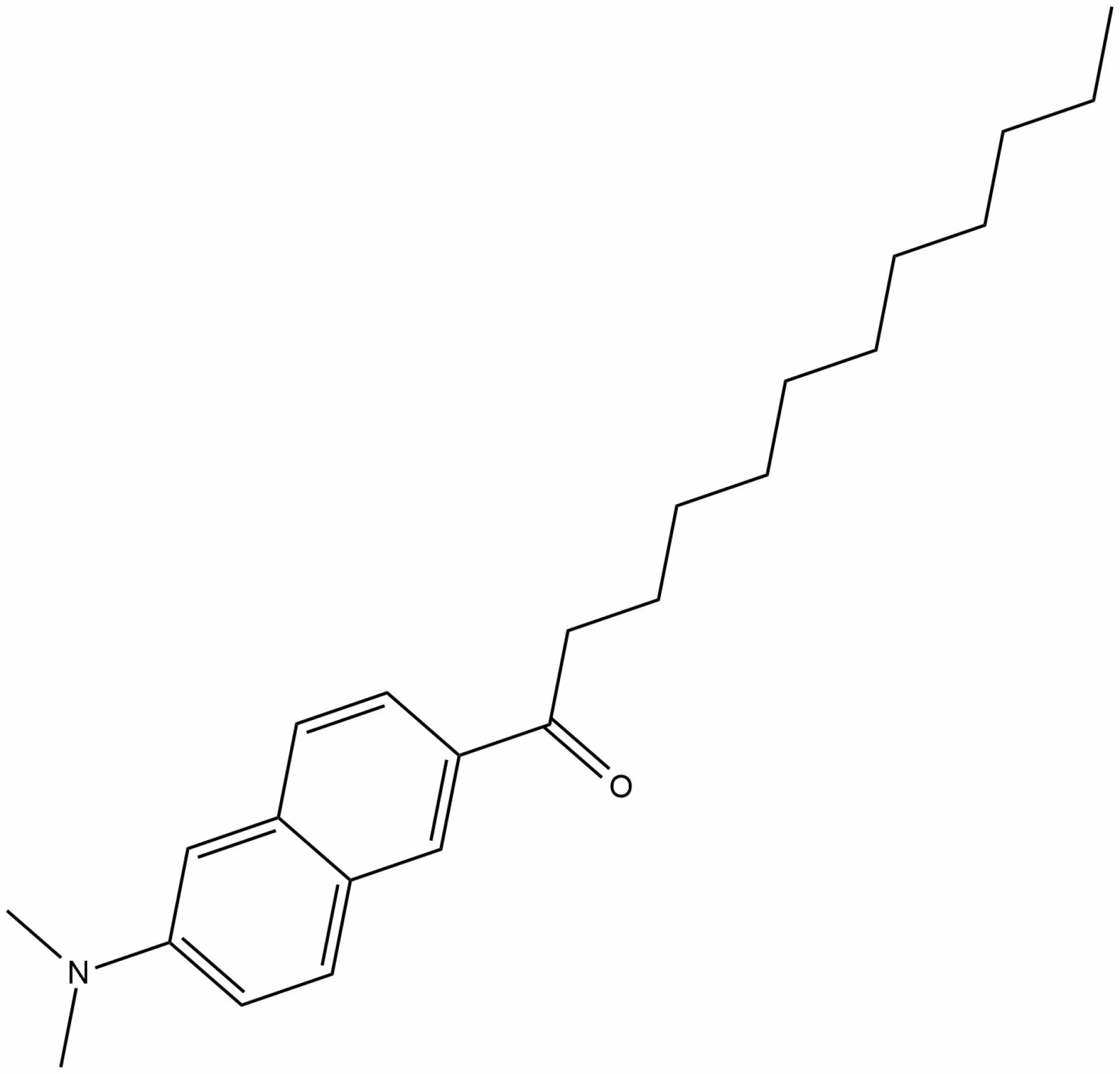

Catalog No.GC18338
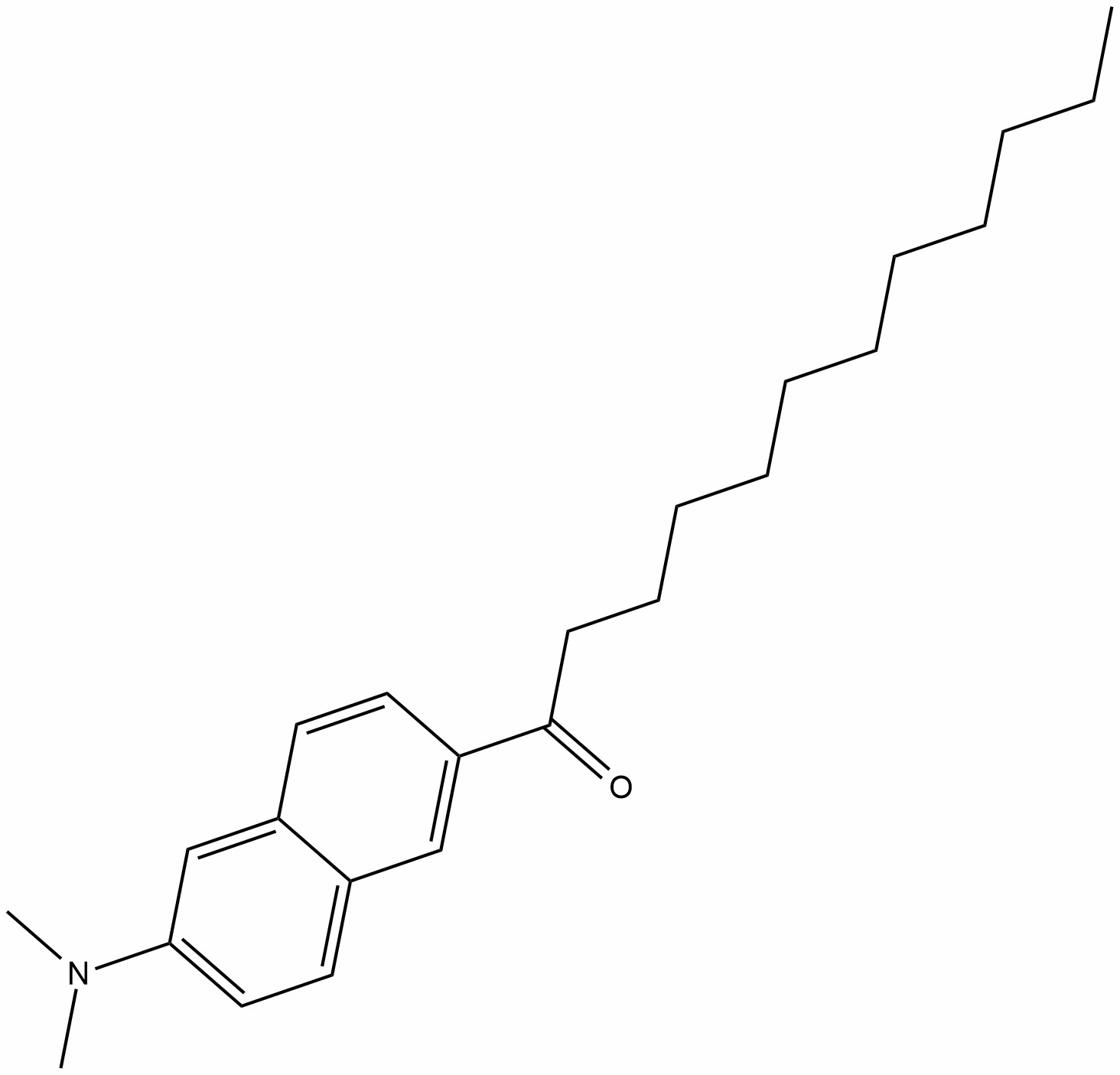
Laurdan is a polarity-sensitive lipid membrane fluorescent probe used to image lipid rafts (also known as lipid microdomains) in cell membranes, the absorption wavelength of Laurdan is 340-380nm and the emission wavelength is 440-490nm.
Products are for research use only. Not for human use. We do not sell to patients.
Size Price Stock Qty
10mM (in 1mL DMSO)
$32.00
In stock
0
5mg
$28.00
In stock
0
10mg
$45.00
In stock
0
25mg
$74.00
In stock
0
50mg
$104.00
In stock
0
100mg
$146.00
In stock
0
Product has been cited by 8 publications
Cell Rep Med (2026).PMID:41666924J Adv Res (2025).PMID:39921055J Agr Food Chem (2023).PMID:37929595Eur J Med Chem (2024):116714.PMID:39096819J Antimicrob Chemoth (2024):dkae051.PMID:38412335J Ethnopharmacol (2024):119284.PMID:39725364
Description
Laurdan is a polarity-sensitive lipid membrane fluorescent probe used to image lipid rafts (also known as lipid microdomains) in cell membranes, the absorption wavelength of Laurdan is 340-380nm and the emission wavelength is 440-490nm[1, 2, 3]. Laurdan is membrane-embedded.Laurdan staining's hydrophobic tail inserts into the phospholipid bilayer of the cell membrane, while the polar head remains near the membrane surface, which can detect polarity changes and the presence of water molecules inside the membrane [4]. Laurdan is phase-sensitive. Laurdan staining’s fluorescence emission in the liquid crystal phase will show a large redshift, while it will show a small red shift in the gel phase, which can detect the phase state and fluidity of the membrane [5]. Laurdan staining can measure the generalized polarization (GP) of the cell membrane. High GP is usually associated with low fluidity, low polarity, or high cholesterol content of the membrane, while low GP is the opposite [6].
References:
[1] Horváth Á, Erostyák J, Szőke É. Effect of Lipid Raft Disruptors on Cell Membrane Fluidity Studied by Fluorescence Spectroscopy[J]. International Journal of Molecular Sciences, 2022, 23(22): 13729.
[2] Alvares S M, Dunn C A, Brown T A, et al. The role of membrane microdomains in transmembrane signaling through the epithelial glycoprotein Gp140/CDCP1[J]. Biochimica et Biophysica Acta (BBA)-General Subjects, 2008, 1780(3): 486-496.
[3] Goldys E M. Fluorescence applications in biotechnology and life sciences[M]. John Wiley & Sons, 2009.
[4] Jay A G, Hamilton J A. Disorder amidst membrane order: standardizing laurdan generalized polarization and membrane fluidity terms[J]. Journal of fluorescence, 2017, 27: 243-249.
[5] Bianchetti G, Azoulay-Ginsburg S, Keshet-Levy N Y, et al. Investigation of the membrane fluidity regulation of fatty acid intracellular distribution by fluorescence lifetime imaging of novel polarity sensitive fluorescent derivatives[J]. International Journal of Molecular Sciences, 2021, 22(6): 3106.
[6] Yu W, So P T, French T, et al. Fluorescence generalized polarization of cell membranes: a two-photon scanning microscopy approach[J]. Biophysical journal, 1996, 70(2): 626-636.
Protocol
This plan only provides a guide, please modify it to meet your specific needs.
1. Solution preparation
(1) Storage solution: Dissolve Laurdan in DMSO or chloroform to a final concentration of 5 mM.
Note: After unused storage solution is aliquoted, store it at -20℃ in the dark to avoid repeated freezing and thawing.
(2) Working solution: Dilute the storage solution with experimental buffer (e.g. cell culture medium) to the required working concentration, usually in the range of 1-10 µM.
Note: Please adjust the optimal working concentration according to the actual situation or refer to the literature to set the gradient concentration by yourself. The working solution must be prepared and used immediately.
2. Steps for measuring the generalized polarization (GP) of Bacillus subtilis cell membrane by Laurdan [1] (from the literature, for reference only)
(1) Cell treatment: Cultivate cells to the middle of the logarithmic growth phase, wash them four times in PBS containing 2% glucose and 1% DMF, resuspend them in the same buffer, and adjust the OD600 to 0.3.
(2) Liposome preparation: Bacillus subtilis polar lipid extract was prepared by detergent dialysis, and the prepared liposome solution was squeezed through a 0.4μm filter membrane 20 times. The 10mg/ml liposome stock solution was diluted to a concentration of 1 mg/ml with Tris buffer (5mM, pH 7.4).
(3) Liposome labeling: Add Laurdan solution to the cell suspension to a final concentration of 10 μM and incubate in the dark for 30 minutes.
(4) Fluorescence measurement: Laurdan fluorescence measurement was performed using a BioTek Synergy MX plate reader. The excitation wavelength was 350 nm, the emission wavelengths were 460 nm and 500 nm, and readings were taken every 2 minutes.
(5) Laurdan fluorescence polarization calculation: Laurdan generalized polarization (GP) value was calculated using the following formula: (I460-I500)/(I460+I500).
Note: This experimental protocol only provides a reference for a Laurdan generalized polarization (GP) measurement experiment of cell membrane. Please modify the working concentration and staining time according to experimental needs or refer to the literature.
References:
[1]Saeloh D, Tipmanee V, Jim K K, et al. The novel antibiotic rhodomyrtone traps membrane proteins in vesicles with increased fluidity[J]. PLoS pathogens, 2018, 14(2): e1006876.























Sign in to leave a comment.