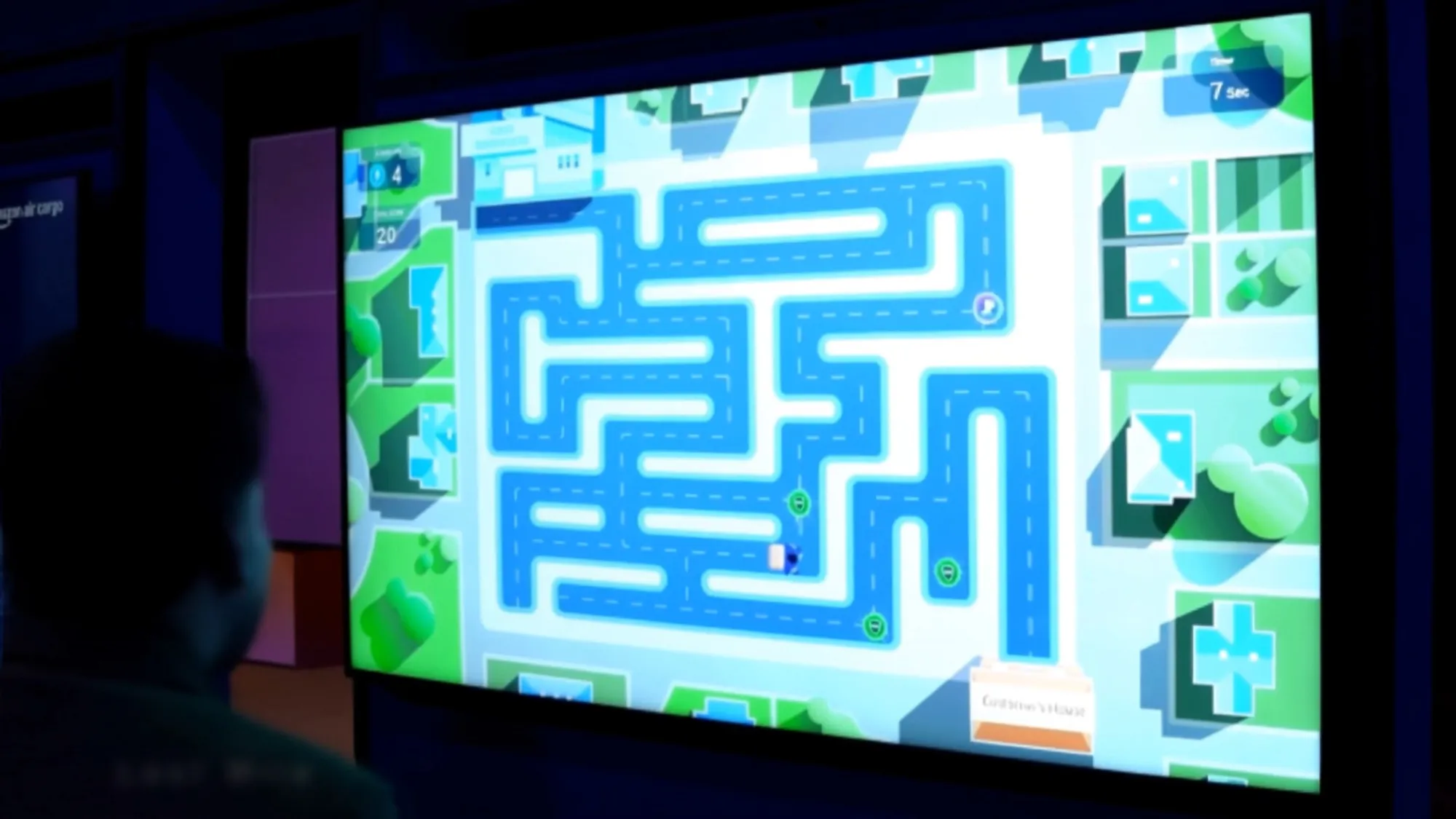

Most brands, when they think about an experience center for product showcase, think big. Permanent installations. Large physical spaces. Six-figure budgets. Long timelines. It is a legitimate approach, but it is not the only one.
What Amazon did at Sambhav 2025 is a useful counterpoint — a sharp, fast, purpose-built showcase that took 14 to 16 days from brief to live, ran for the duration of a trade event, and saw only 4 to 5 people leave before finishing it. In a busy event environment full of competing attractions, that near-zero drop-off is a remarkable number.
Here is what happened, and what it means for any brand trying to make a complex product story land with a business audience.
The Challenge: Making Logistics Interesting
Amazon's shipping and logistics infrastructure is extraordinary in its complexity and efficiency. It is also, to most people, completely invisible. When you order something and it arrives the next day, you experience the outcome — not the fulfilment centres, the last-mile routing, the warehouse automation, or the carrier integrations behind it.
At Sambhav 2025 — Amazon's flagship seller summit — the objective was to help Indian sellers understand this infrastructure, appreciate what it does for their business, and feel genuinely connected to a system they normally interact with only through a dashboard.
A traditional product demo or presentation would be accurate but forgettable. The audience is at a busy event, surrounded by stimulation, and being pitched by dozens of brands. You need something that cuts through, holds attention, and creates genuine comprehension — not just awareness.
The Solution: A Three-Layer Interactive Shipping Game
IIC Lab built a three-layer interactive AR game that turned Amazon's shipping journey into a playable experience. Visitors were not watching the logistics story — they were navigating it.
The game mirrored the actual shipping lifecycle in three stages:
- Layer 1 — Seller onboarding and inventory management: players made decisions about how to list and prepare products for fulfilment, learning the system's logic by doing rather than reading
- Layer 2 — Warehouse and routing: players saw their virtual orders move through a simulated fulfilment centre, experiencing the speed and accuracy of Amazon's internal processes
- Layer 3 — Last-mile delivery: players tracked their shipments through final delivery, encountering the real variables — traffic, weather, address complexity — that the system handles automatically
The 19+ interaction points across the three layers were not cosmetic. Each one mapped to a genuine feature of Amazon's logistics infrastructure. Playing the game was, effectively, learning the product.
Why 200 to 250 Unique Plays With Near-Zero Drop-Off Matters
At a trade event, 200 to 250 unique plays is a strong number for a single installation. But the more telling figure is that only 4 to 5 people left before completing the experience.
In event marketing, partial engagement is the norm. People start something, get distracted, wander off. The fact that near-complete completion rates were maintained — in a busy, loud, competitive environment — says something specific about the design.
The game structure created commitment. Once someone started Layer 1 and saw their virtual shipment created, they wanted to see it through. That narrative pull — the same thing that keeps you reading a story even when you planned to stop — is what IIC Lab built into the game mechanics.
The 14 to 16 Day Build: What Fast Really Means
The Amazon Sambhav game went from brief to live in 14 to 16 days. This challenges a common assumption about experiential technology.
Many brands assume high-quality interactive experiences require months of development time. The Sambhav project demonstrates that with the right team — one that has built similar systems before and has the component architecture to move quickly — a genuinely impressive, technically solid experience is achievable on event timelines.
What makes this possible is not shortcuts. It is the depth of prior work. IIC Lab's experience across dozens of interactive installations means they are not solving from scratch — they are adapting proven systems to new contexts. That is the difference between a specialist and a generalist in this space.
What This Model Means for Your Product Showcase
Not every brand needs a permanent, fully built experience center. Some of the highest-value showcase moments happen at trade events, partner summits, industry conferences, and pop-up activations.
For these settings, the relevant questions are:
- What does my audience most misunderstand or undervalue about my product?
- What is the fastest path from passive observer to active participant?
- What single experience, if done right, would create the strongest lasting impression?
The Amazon Sambhav game answered all three cleanly. It took the most abstract part of the Amazon seller proposition — invisible logistics infrastructure — and made it tangible, navigable, and memorable in under three minutes of play.
The Broader Principle
People do not retain what they are told. They retain what they do. An experience center for product showcase that makes your audience active participants in the product story will always outperform one that asks them to sit and watch.
IIC Lab (Ink In Caps) has built this kind of work for Amazon, Godrej, Rustomjee, Protean, and others — across categories, contexts, and timelines. The common thread is the same: start with what the audience needs to understand, and build the experience backwards from there.
Planning a showcase experience for an upcoming event, launch, or sales activation? IIC Lab builds experience center solutions from permanent installations to rapid-deployment event activations.






















Sign in to leave a comment.