Why the 2D vs 3D Animation Decision Is a Growth Lever, Not a Creative Preference
Most companies think animation is a visual decision.
High-growth companies know it’s a strategic one.
The 2D vs. 3D animation choice affects how:
- Fast users understand your offer.
- Confident they feel about your brand
- Likely they are to convert
When the wrong animation style is used, businesses experience:
- High bounce rates
- Low engagement
- Confused messaging
- Poor ROI
Animation doesn’t just tell a story; it removes doubt. And doubt is the biggest conversion killer.
2D Animation Meaning: Why Simplicity Wins the Attention War
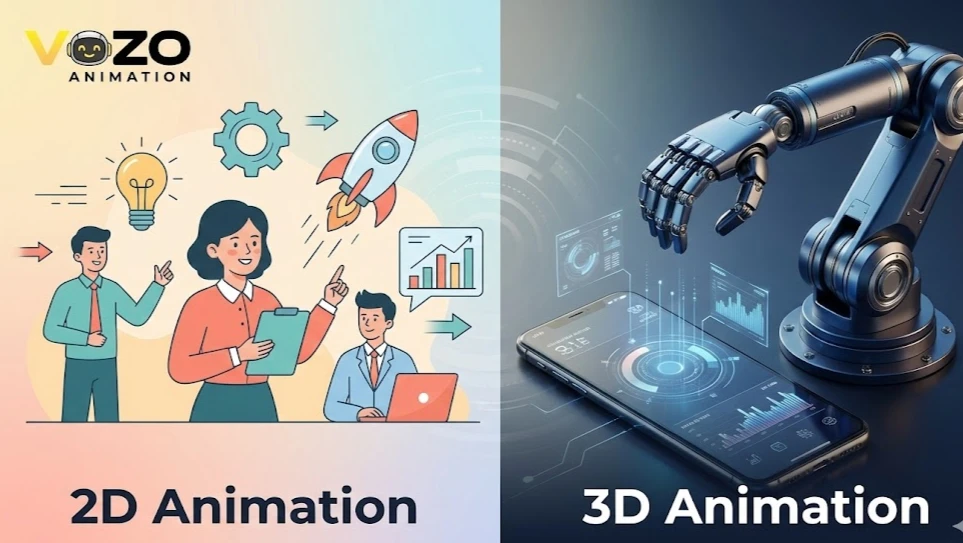
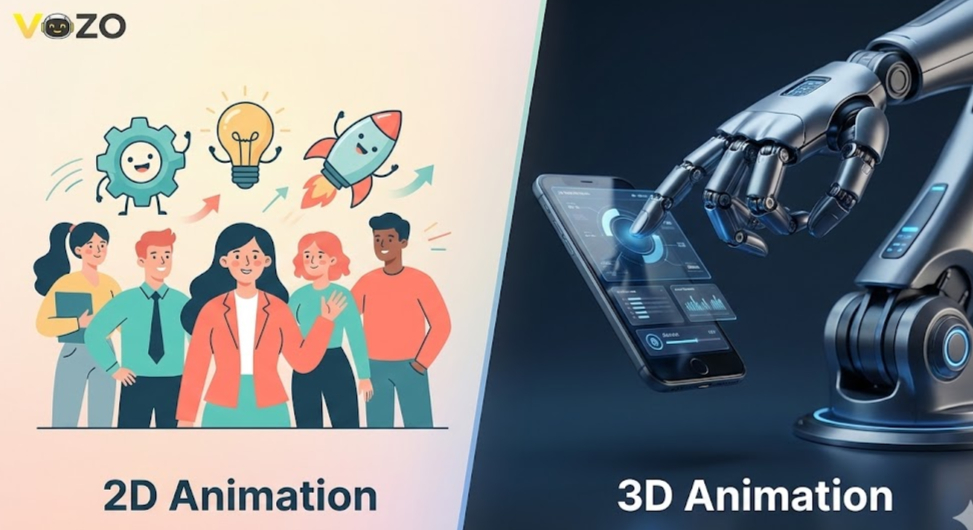
2D animation uses flat, frame-by-frame animation to communicate ideas quickly and emotionally.
Why 2D animation remains powerful:
- Minimal cognitive load
- Fast comprehension
- Strong narrative focus
- Shorter production timeline
This is why 2D animation for explainer videos dominates SaaS, startup, and service-based marketing. It answers the user’s first question:
“What does this company actually do?”
When clarity is the priority, 2D animation wins.
3D Animation Meaning: When Visual Proof Becomes Non-Negotiable
3D animation creates realism using CGI animation, modeling, rigging, lighting, and high-end rendering.
It becomes essential when:
- Products are complex.
- Features must be seen to be believed
- Trust directly impacts purchasing.
Brands that invest in professional 3D animation, especially through specialists like VOZO Animation’s 3D animation services, reduce buyer hesitation because realism builds instant credibility.
In short:
2D explains.
3D convinces.
Difference Between 2D and 3D Animation (From a Buyer’s Brain)
| Factor | 2D Animation | 3D Animation |
|---|---|---|
| Visual Depth | Flat | Realistic |
| Ease of Understanding | Very High | Medium |
| Trust Signal | Moderate | High |
| Production Time | Faster | Longer |
| Best Use Case | Education | Validation |
2D vs 3D Animation Cost Comparison: The Real Cost Is Misalignment
Yes, 2D animation is cheaper than 3D animation.
But the real cost isn’t production; it’s lost conversions.
- Using 2D when users need realism → low trust
- Using 3D when users need simplicity → confusion
Smart brands don’t ask, “Which is cheaper?”
They ask, “Which removes friction faster?”
Which Is Better: 2D or 3D Animation for Marketing?
There’s no universal winner. The best animation style for marketing depends on the funnel stage.
Choose 2D Animation. When:
- You’re building awareness.
- Your offering is abstract.
- Speed and clarity matter.
Choose 3D Animation When:
- You’re selling a physical or technical product.
- Buyers compare features visually.
- Trust determines the final decision.
High-performing brands align animation style with user intent, not trends.
2D vs 3D Explainer Video: What Actually Holds Attention?
- 2D explainer videos keep users watching by simplifying complexity.
- 3D explainer videos keep users engaged by visualizing reality.
The highest-converting brands use a layered strategy:
- 2D to educate
- 3D to validate
This improves customer engagement and shortens the decision cycle.
3D Animation for Product Demos: A Silent Salesperson
3D animation for product demos allows businesses to:
- Show internal mechanisms
- Demonstrate features without physical prototypes
- Create reusable sales assets
For B2B, manufacturing, tech, and eCommerce brands, 3D animation acts as a 24/7 product expert, without human limitations.
How Animation Style Shapes Brand Authority
Users judge brands emotionally before logically.
- 2D animation feels friendly and approachable
- 3D animation feels premium and authoritative.
If your animation style doesn’t match your positioning, users hesitate, even if your offer is strong.
That’s why strategy-first studios like VOZO Animation design animation around business goals, not just visuals.
Common Business Mistakes in the 2D vs. 3D Animation Decision
- Choosing based on trend
- Prioritizing cost over clarity
- Ignoring buyer intent
- Treating animation as decoration
Animation should reduce friction, not add it.
Frequently Asked Questions (FAQs)
1. Which animation style converts better?
It depends; 2D improves understanding, and 3D improves trust.
2. Is 3D animation only for large companies?
No. Many startups use it for product validation.
3. Can animation improve SEO metrics?
Yes, better engagement improves dwell time and CTR.
4. How long does animation production take?
2D is faster; 3D requires a longer rendering time.
5. Is animation worth the investment?
Yes, when aligned with user psychology.
6. Can both 2D and 3D be used together?
Absolutely. Hybrid strategies often outperform single-style approaches.
Final Verdict: Animation Is a Growth Decision
The 2D vs 3D animation debate isn’t about visuals; it’s about decision speed and confidence.
- Use 2D animation to explain
- Use 3D animation to persuade
Brands that treat animation as a growth engine, not a design asset, partner with experts like VOZO Animation, where visuals are engineered to convert, not just impress.























Sign in to leave a comment.