

Most Workplace Investigations Australia are not won or lost in the Fair Work Commission; they are won or lost in the first seven days of the internal process. By the time an employee calls us for help, they have often already made a mistake that has significantly damaged their leverage.
If you are currently "in the thick of it," here are the three fatal errors you must avoid to protect your career.
Mistake 1: Resigning in Heat or Shame
When you’re suspended and accused of misconduct, the impulse to "just quit and walk away" is overwhelming. You might think, "If I resign now, I can keep my record clean."
Reality check. It doesn't work that way. If you resign while under investigation, the employer can still record that you "resigned pending a disciplinary matter." In many industries, this is a red flag for future employers.
Worse, by resigning, you lose your leverage. You can't negotiate a "Deed of Release" (which includes confidentiality and a statement of service) if you've already walked out the door. Stay put, follow the process, and only resign if it’s part of a negotiated exit strategy.
Mistake 2: Confessing to "Nuance"
During the "informal chat" stage, investigators will often act as your friend. They’ll say, "Look, we know you’re a hard worker. We just want to understand why you were firm with Sarah."
In your desire to be a "good employee," you might say, "I was under a lot of stress and I probably shouldn't have raised my voice."
In the investigator’s final report, that becomes. "The employee admitted to aggressive and unprofessional behaviour." In Workplace Investigations Australia, admissions of "nuance" are treated as admissions of guilt. Do not offer self-reflections to HR. Provide factual, objective responses in writing.
Mistake 3: Relying on Verbal Assurances
"Don't worry, this is just a formality." "We just need to tick some boxes for the auditors." "Your job isn't at risk; we just need a statement."
If you hear these phrases from HR or your manager during a workplace investigation, ignore them. Unless it is in writing, it didn't happen. Verbal assurances have no weight in the Fair Work Commission. If they say your job isn't at risk, ask them to put that in the investigation letter. If they won't, then your job is at risk.
The Strategic Alternative - The Negotiated Exit
Sometimes, an investigation reveals that the relationship between you and your manager is beyond repair. Even if you "win" the investigation, going back to work might be impossible.
This is where a "Deed of Release" comes in. This is a legal agreement where you agree to leave the company in exchange for:
- A financial settlement (often several months' pay).
- A neutral Statement of Service.
- Mutual confidentiality and non-disparagement (meaning they can't bad-mouth you).
This is often a far better outcome than "winning" an investigation but living under the shadow of a manager who wants you gone. But remember, you can only negotiate a Deed if you haven't already made the mistakes listed above.
Don't let a botched investigation follow you to your next job. Learn how to negotiate a clean exit and protect your professional reputation.
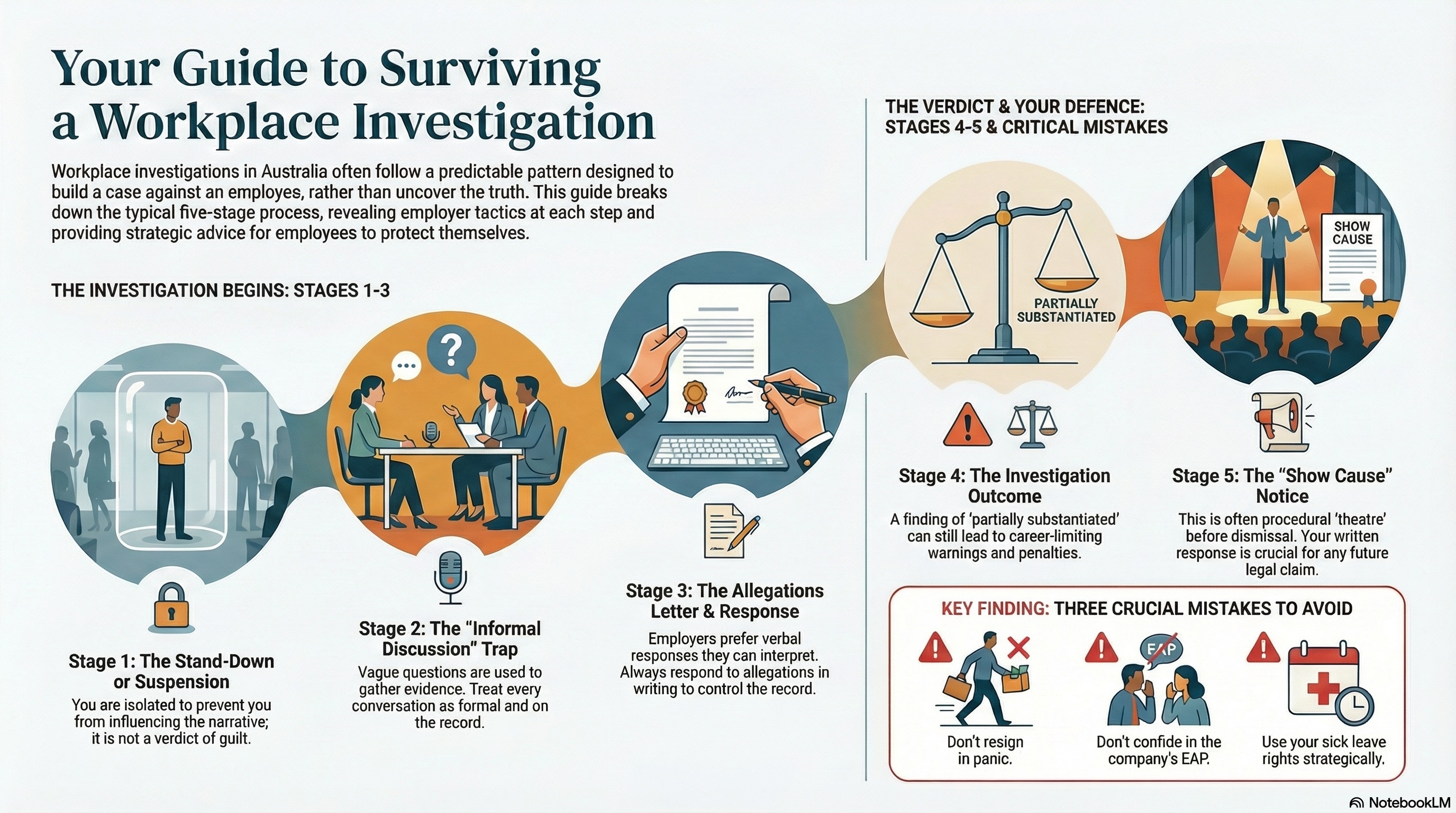
Read our comprehensive two-part guide on Workplace Investigations Australia:
https://awna.com.au/navigating-australia-workplace-investigation-part-1/
https://awna.com.au/navigating-australia-workplace-investigation-part-2/

































Sign in to leave a comment.