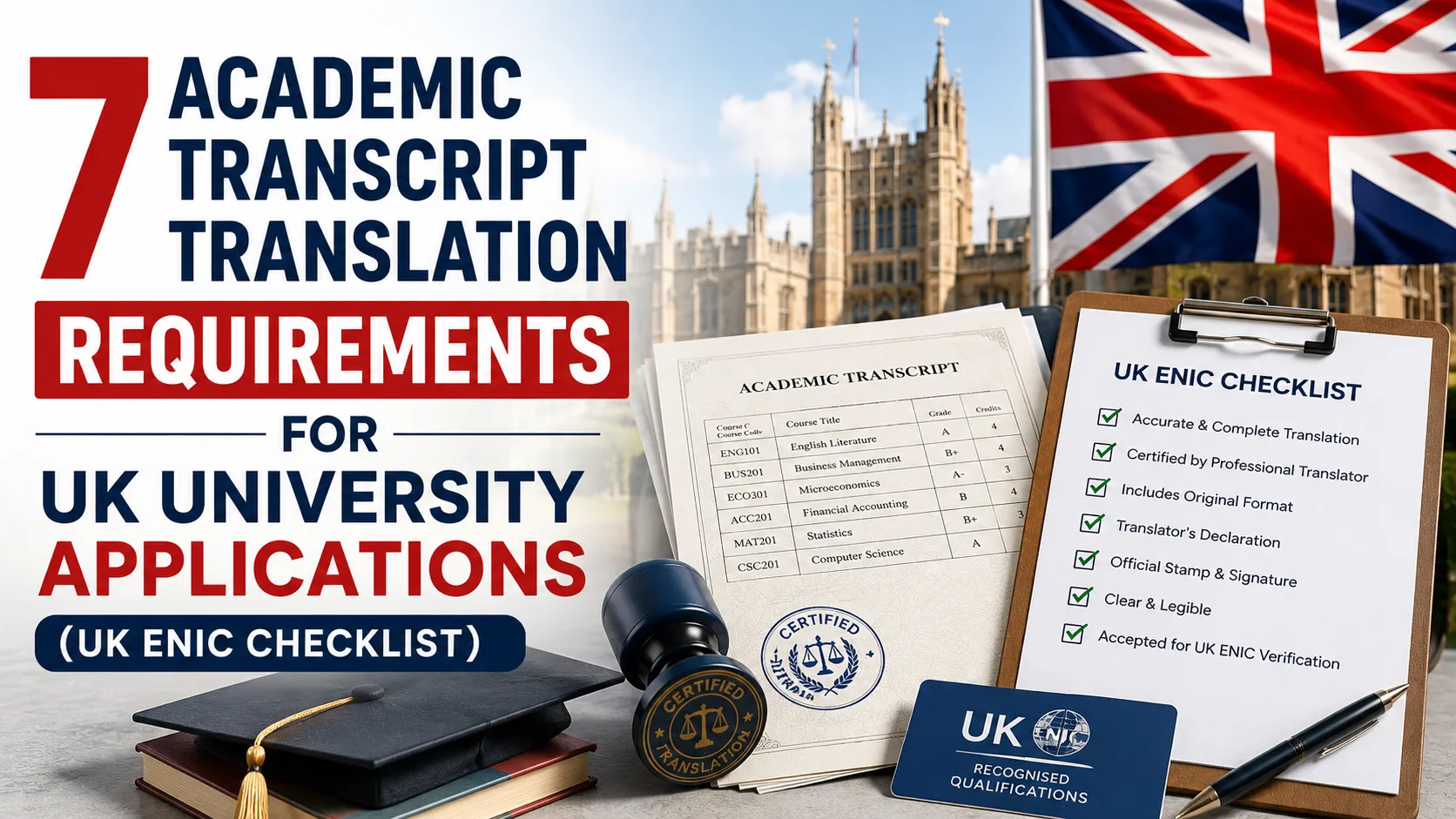

Applying to a UK university involves much more than meeting academic entry requirements. For international students, one of the most important supporting documents is the academic transcript. If that transcript is not in English, the quality of academic transcript translation can play a significant role in how smoothly your application progresses.
Many students spend months preparing personal statements, collecting references, and researching courses, only to encounter unexpected delays because their transcript translation fails to meet verification standards. In many cases, the issue is not academic performance but document compliance.
UK universities and UK ENIC use translated transcripts to understand qualifications earned overseas. To do this effectively, they need translations that are accurate, traceable, complete, and easy to verify.
This guide explains the seven key Academic Transcript Translation requirements commonly expected by UK universities and UK ENIC, helping you submit your academic documents with greater confidence and avoid avoidable delays.
Requirement #1: Use a Professional Certified Translation
For non-English academic documents, a professionally certified translation is generally expected. Universities and qualification assessment bodies need confidence that the translation can be independently verified. UK authorities often require an official assurance that the document has been translated accurately and includes details identifying the professional translator responsible for the work.
What to Look For
Choose a translator who:
- Has genuine, proven experience with academic documents.
- Provides fully compliant certified translations.
- Understands the nuances of university admissions requirements.
- Offers clear, professional certification procedures.
Many applicants prefer to work with translators associated with recognised professional bodies, such as the Institute of Translation & Interpreting (ITI) or the Chartered Institute of Linguists (CIOL). These credentials provide an immediate layer of institutional trust when your application hits the admissions desk.
Requirement #2: Include a Complete Certification Statement
A translation should clearly explain who prepared it and confirm that it accurately reflects the original document. Universities and credential evaluators routinely perform spot-checks and need a transparent verification trail.
A Certified Translation Should Normally Include:
- A formal statement of accuracy from the linguist.
- The translator's full name.
- A physical or verified digital signature.
- Clear contact information (including an operational telephone number and business email address).
- The exact calendar date of certification.
Why This Matters
If these certification details are missing or incomplete, admissions teams may halt the evaluation of your file and request additional documentation before continuing their assessment.
Requirement #3: Preserve the Original Transcript Format
Academic transcripts are structured records, and maintaining their visual layout helps reviewers compare the translation directly against the original document.
Transcripts frequently contain complex visual data, such as:
- Structured grade tables and semester breakdowns.
- Credit allocations and GPA calculations.
- Official university seals and institutional references.
- Registrar signatures and stamps.
Best Practice
The translation should preserve the table structure, course order, grade placement, and all official stamps or seals. Maintaining this structural consistency supports document authenticity and improves readability for the busy admissions officer reviewing your profile.
Requirement #4: Explain the Grading System Clearly
Admissions officers cannot properly assess your academic performance if they do not understand how grades are measured in your home country. Educational systems vary significantly between countries, meaning a mark that looks average on paper might actually represent a top-tier result.
Many applicants face unnecessary hurdles when numbers or classifications like a 7.5/10, an 80/100, or local terms for "Distinction" or "First Class" are submitted without context.
Information That May Need Clarification:
- The exact grading scale or rubric used by the institution.
- The minimum passing mark required.
- The credit structure and how it impacts course weightings.
- Classification terminology and scoring methodologies.
A clear, integrated explanation helps universities interpret your international qualifications with absolute accuracy.
Requirement #5: Translate Every Course, Module, and Academic Entry
Transcript translations must cover the entire document rather than selected sections. Admissions teams evaluate not only your final cumulative grades but also the specific subjects studied and the academic pathway followed throughout your studies.
Information Commonly Reviewed:
- Full course titles and individual module names.
- Exact credits earned per term.
- Final semester results.
- Academic classifications and any official registrar annotations.
Common Mistake
Some students request the translation of only summary sections or major modules to save time. This can create gaps that make a comprehensive academic evaluation difficult, often forcing universities to return the document for a full re-translation.
Requirement #6: Submit the Original Transcript and Translation Together
The original foreign-language document and its English translation should always be presented together so that reviewers can compare both versions simultaneously. This is a foundational step during qualification recognition and admissions assessment.
Recommended Submission Structure:
- The high-resolution copy of your original academic transcript.
- The certified English translation with all relevant stamps.
- Any supporting academic documents or diploma supplements requested by the faculty.
Document Organisation Tip
Clear document organisation helps admissions officers review information efficiently and reduces the likelihood of follow-up requests. Ensure your files are clearly named and bundled logically before uploading them to university application portals or the UK ENIC system.
Requirement #7: Allow Enough Time Before Application Deadlines
Transcript translation should be completed well before UCAS or individual university deadlines whenever possible. Leaving translation until the final stages of the application process can create unnecessary pressure during an already stressful period.
Typical Timeframes
| Service Type | Typical Turnaround |
| Standard Translation | 48–72 hours |
| Express Translation | Around 24 hours |
| Urgent Services | May be available depending on document complexity |
Planning ahead provides more time to review translations, double-check name spellings against your passport, and correct any administrative issues before formal submission.
UK ENIC Academic Transcript Translation Checklist
Before submitting your application, verify the following:
- Certified translation obtained from an independent professional.
- Full certification statement included on the document.
- Translator details, signature, and contact info are clearly present.
- Original table formatting and layout are carefully preserved.
- The institutional grading system is clearly explained.
- All courses, modules, and peripheral notes are fully translated.
- High-resolution original document is included alongside the translation.
- Names and dates match your passport and supporting records perfectly.
- Official seals, marginal stamps, and signatures are fully translated.
- Submission is prepared well before your university or UCAS deadlines.
Following this checklist systematically minimizes common, document-related delays.
Why Universities Pay Close Attention to Transcript Translations
Universities use transcripts to assess academic suitability, compare overseas qualifications with UK standards, and determine whether applicants meet specific entry requirements. A transcript is far more than a simple record of grades.
From our experience, admissions teams rely heavily on these translations because they need to evaluate:
- Overall academic achievement and intellectual consistency.
- The formal qualification level relative to the UK system.
- Direct subject knowledge and prerequisites for advanced modules.
- Educational progression and overall readiness for specific, competitive courses.
Accurate, edge-to-edge translation supports a fair, transparent, and efficient evaluation of your hard-earned academic credentials.
Frequently Asked Questions
Do UK universities require certified transcript translations?
Yes. For non-English academic documents, a professionally certified translation is commonly required to support the formal admissions review.
Does UK ENIC require translated academic documents?
Where your primary qualification documents are not in English, a certified translation is generally required before UK ENIC can conduct an assessment and issue a Statement of Comparability.
Can I translate my own academic transcript?
No. Even if you possess perfect English fluency, universities prefer independent certified translations because they provide greater accountability and objective verification.
Why must grading systems be explained?
Different countries use vastly different grading methods. Clear explanations help admissions teams evaluate your real academic performance accurately against UK benchmarks.
What should a certified transcript translation include?
A valid certified translation must feature a formal statement of accuracy, full translator details, a signature, direct contact information, and a complete translation of the original document.
Conclusion
A strong academic transcript can open the door to UK university study, but only if admissions teams and qualification assessors can review it confidently and accurately. For international students, this means ensuring that transcript translations are professionally prepared, properly certified, and fully aligned with the original document.
The seven requirements outlined above help create a translation that is clear, verifiable, and entirely suitable for academic assessment. By using an experienced academic translator, preserving formatting, explaining grading systems, and submitting complete documentation, students can significantly reduce the risk of delays during the admissions process.
If your transcript requires translation for a UK university or UK ENIC assessment, working with a specialist provider such as Notarised Translations can help ensure your academic documents meet recognised certification standards and are ready for submission from the outset, giving you greater confidence as you move towards your university goals.
Also Read: How to Get a Divorce Certificate Translation for a UK Spouse Visa: Step-by-Step Guide






























Sign in to leave a comment.