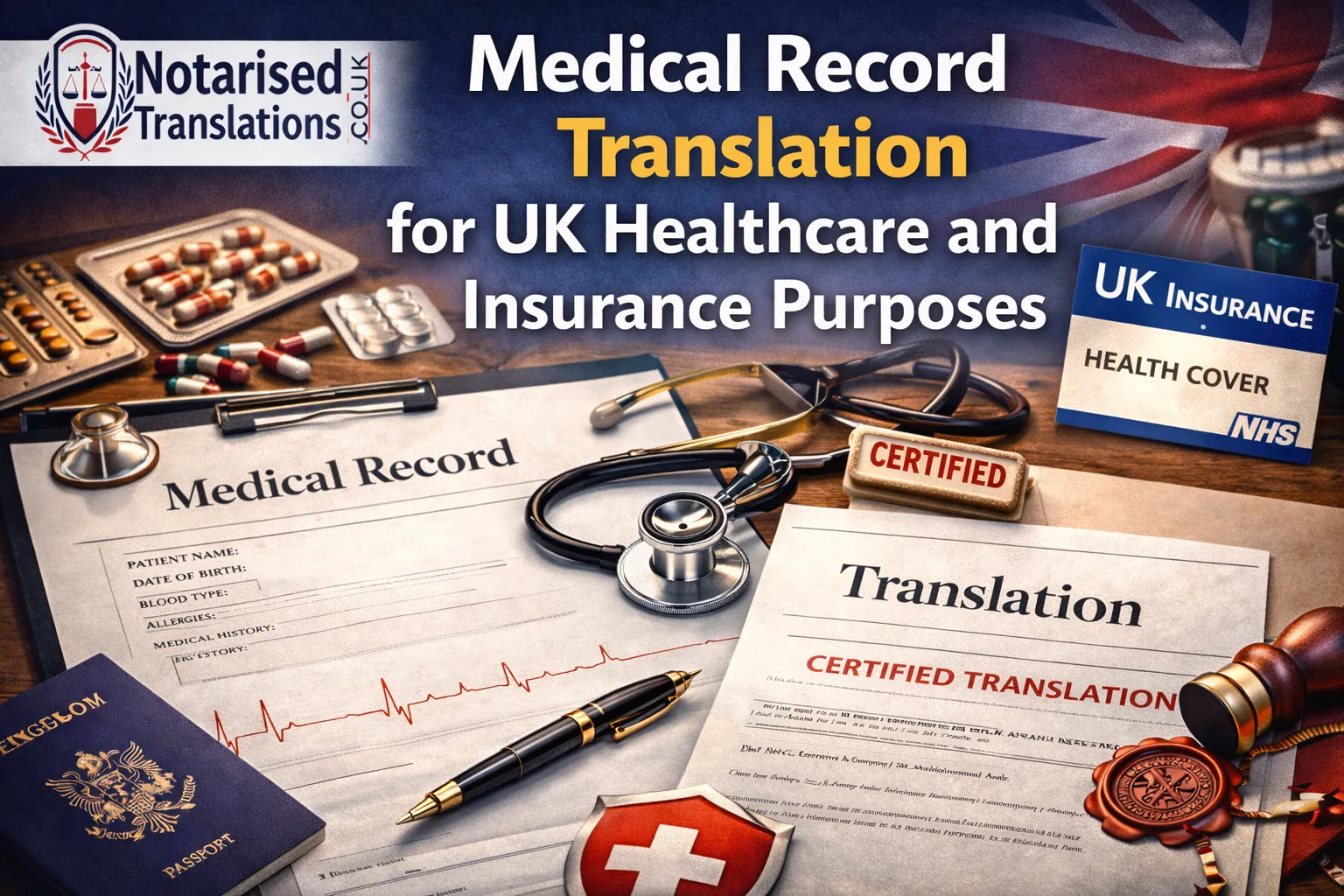

There's a particular kind of stress that comes with being unwell in a country where your medical history exists only in another language. Doctors are asking questions, forms need filling, and somewhere in your bag is a folder of documents that contain everything relevant — but none of it in English.
This isn't a rare situation. The UK has one of the most internationally diverse patient populations in the world, and NHS trusts deal with foreign-language medical records regularly. But "regularly" doesn't mean "automatically." The translation still needs to happen, it still needs to be accurate, and it still needs to meet the standards that healthcare and insurance providers actually require. If you're navigating this right now, medical document translation UK services exist precisely for this — and the quality of that translation can genuinely affect your care.
Why Medical Records Often Need Certified Translation in the UK
The most straightforward reason: a UK doctor cannot make informed decisions based on records they can't read. That sounds obvious. But the implications run deeper than just convenience.
Medication histories matter. Allergies matter. Surgical records matter. If a patient arrives in the UK with a chronic condition that's been managed for years in another country, and those management records are in Polish or Arabic or Mandarin, the treating physician is essentially starting from scratch — unless those records are translated. That's not good for the patient, and it creates unnecessary risk for the clinical team.
For insurance purposes, the stakes are financial as well as medical. UK health insurers and life insurers often require foreign medical records as part of underwriting — the process by which they assess risk and set premiums. If you've been treated for a condition abroad that would affect your insurability in the UK, the insurer needs to know about it, and they need to be able to read the documentation. An untranslated record doesn't count as disclosure. It counts as nothing.
GP registration is another trigger point. Many GP surgeries — particularly in areas with high international populations — will ask new patients to provide translated summaries of significant medical history if their records are in another language. Not every surgery requires this, but it's not uncommon, and it's a reasonable request.
Types of Medical Documents That Require Professional Translation
The range is wider than most people assume. Discharge summaries from hospital stays are the most common — these contain diagnoses, procedures performed, medications prescribed, and follow-up instructions. Blood test results and pathology reports. Radiology reports describing X-rays, MRI scans, or CT results. Surgical operation notes. Psychiatric assessment reports. Vaccination records. Prescription histories. Death certificates when required for insurance purposes.
Each of these document types has its own vocabulary, its own conventions, and its own potential for mistranslation. A radiology report describing a finding as "benign" in German uses a different word — "gutartig" — but the meaning needs to land exactly right in English. A psychiatric assessment translated loosely could change the clinical picture significantly.
This is why general translation — competent as it might be for other purposes — isn't appropriate for medical documents. The translator needs to be familiar with medical terminology in both languages, and ideally with the specific conventions of the medical system the document originated in. German medical documentation is formatted differently from UK medical documentation. So is French, Spanish, and Arabic. A translator who understands those differences produces a better, more usable result.
How Medical Translators Maintain Accuracy in Health Documentation
Professional medical translators don't just know two languages. They know medical language in two languages — which is a meaningfully different skill set. Many have backgrounds in healthcare, life sciences, or pharmacology, in addition to their translation training. Some hold dual qualifications.
When translating a medical document, a professional will flag terms that don't have a direct English equivalent and provide a brief explanatory note rather than forcing an inaccurate translation. They'll preserve the structure of the original document — because a GP or specialist reading the translation needs to be able to see at a glance where the diagnosis section ends and the treatment section begins.
They'll also note any stamps, signatures, or certifications on the original document, because these sometimes carry clinical or legal significance — a hospital's accreditation stamp, a specialist's registration number, a pharmacy's dispensing stamp.
For documents going to insurance providers, the apostille authentication services UK layer is occasionally required as well — particularly if the medical records originated in a country whose document standards UK insurers are less familiar with. Not always, but worth checking before you submit. An insurer who questions the provenance of a foreign medical record will use that uncertainty to delay or decline a claim.
Submitting Translated Medical Records to UK Healthcare Authorities
The process is more straightforward than most people expect, once you know what's needed.
For NHS registration or referral purposes, a certified translation — signed by a professional translator with a statement of accuracy — is generally sufficient. You don't typically need notarisation for routine NHS use. The translation should be clean, clearly formatted, and accompanied by a copy of the original document.
For insurance purposes, requirements vary by insurer. Some accept a certified translation. Others specifically request that the translator's credentials are stated on the translation itself — their qualifications, professional memberships, and contact details. A few insurers request notarised translations for high-value policies or complex claims. Read the insurer's documentation requirements carefully, and if they're not clear, ask in writing so you have a record of the answer.
Timing is worth thinking about too. If you're registering with a new GP or being referred to a specialist, having your medical records translated before your appointment — rather than turning up and explaining that the documents exist but aren't readable — makes the clinical encounter significantly more productive. Doctors are working under time pressure. A translated record they can actually use during the appointment is worth far more than an untranslated one that needs to be "looked at later."
One thing I'd add from experience with this process: if your medical records span multiple years and multiple document types, don't try to have everything translated at once unless it's all immediately relevant. Prioritise the documents that directly address the current clinical question or the specific insurance query. Translate the rest as needed. It keeps costs manageable and focuses the clinical conversation.
Medical translation isn't glamorous. Nobody talks about it until they need it. But when you need it, you really need it — and having it done properly is one of those things that quietly makes everything else possible.













Sign in to leave a comment.