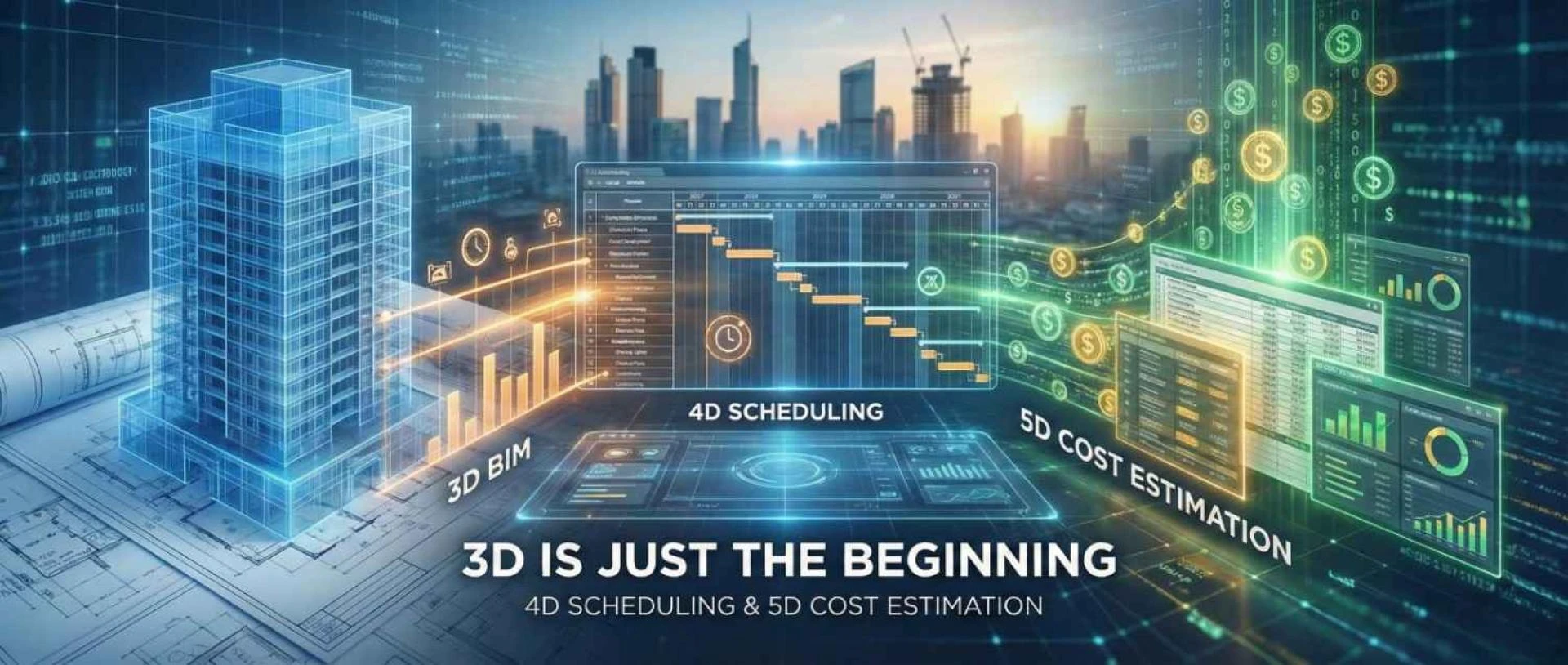

The "Pretty Picture" Trap
In the last decade, the AEC industry successfully normalized 3D BIM. We moved from flat 2D CAD to rich, three-dimensional models. But here lies the trap: many firms stop there. They treat BIM primarily as a visualization tool, a way to generate "pretty pictures" for client presentations and clash-free coordination.
3D is just the start. Most construction losses come from late materials or outdated budget spreadsheets, not from inaccurate visuals.
To realize digital ROI, we must use 4D (Time) and 5D (Cost). This article shows how these layers turn projects into predictable assets.
1. 4D BIM: Visualizing Time to Prevent Delays
If 3D is "what" we are building, 4D is "when" and "how." 4D BIM involves linking the project schedule created in scheduling tools such as Oracle Primavera P6 (P6) or Microsoft Project (MS Project) directly to the 3D model. This creates a visual simulation of the construction sequence.
In a traditional Gantt chart, a logic error like scheduling a crane in a space that hasn’t been excavated yet is just a line of text. It’s easily missed. In a 4D simulation, that error is visually obvious.
Key Applications of 4D Scheduling:
- Logistics & Phasing: Visualize site access, crane swings, and material laydown areas before the site is even fenced off.
- Safety Planning: Simulate high-risk activities to ensure crew safety, effectively "rehearsing" the build digitally.
- Progress Tracking: Compare "planned vs. actual" progress visually. If the steel erection is lagging, the 4D model highlights the deviation instantly.
The ROI: According to industry data, 4D-enabled projects report up to a 20-30% reduction in schedule delays by identifying sequencing conflicts during the pre-construction phase rather than on-site.
2. 5D BIM: Real-Time Cost Certainty
Manual QTO is fading. Old estimating means marking prints and retyping data—a slow, error-prone process.
5D BIM links costs to the model. When a designer widens a wall, costs update instantly as quantities change.
Why 5D Changes the Game:
- Automated Quantity Take-Offs (QTO): Estimators can spend less time counting doors and more time analyzing high-value cost drivers and market risks.
- Target Value Design: Architects see the cost impact of design changes in real time, preventing last-minute "Value Engineering" cuts.
- Cash Flow Forecasting: 4D and 5D together show when spending happens, making cash flow predictable.
The ROI: Research shows 5D BIM can cut estimating time by 50-80% and boost budget accuracy, eliminating quantity-related change orders.
3. The Synergy: How 4D and 5D Work Together
The real value is in combining 3D accuracy, 4D scheduling, and 5D costs for full project simulation.
Consider a complex hospital project. A 4D/5D workflow allows you to answer complex questions:
- "If we accelerate the steel fabrication by two weeks (4D), how does that impact our cash flow for next month (5D)?"
- "Does the cost of adding a second tower crane (5D) offset the savings from the reduced schedule duration (4D)?"
This capability transforms the contractor from a builder into a strategic partner, able to offer data-backed options rather than guesses.
Actionable Takeaways for AEC Professionals
To move your firm beyond 3D, consider these steps:
- Stop Manual Counting: If you still highlight for QTO, pilot automated take-offs on a small project with Revit or similar plugins.
- Visualize the Schedule: Don't just send a PDF Gantt chart to the owner. Use 4D simulation software (such as Navisworks or Synchro) to demonstrate the construction sequence. It builds massive trust.
- Standardize Your Data: 5D only works if your data is clean. Establish strict modelling standards so that a "Concrete Wall" in the model maps correctly to the "Concrete" line item in your budget.
- Partner for Scale: Implementing 4D/5D requires a flawless 3D foundation. If your internal team is at capacity, partner with expert BIM modelling services to ensure your models are data-rich and ready for advanced simulation.
The Future is Multidimensional
The construction industry is infamous for its low profit margins and high risk. 4D and 5D BIM are the best tools we have to mitigate that risk. They allow us to make mistakes in the digital world, where they are free to fix rather than in the physical world, where they cost millions.
3D gets you the project. 4D and 5D ensure you keep the profit.




























Sign in to leave a comment.