
The Silent Project Killer
In the high-stakes world of modern construction, projects rarely fail because the Architect couldn't design or the engineer couldn't calculate loads. They fail because the team couldn't communicate.
According to industry data, miscommunication and poor data management are responsible for over 50% of all rework on construction sites. In an era where profit margins are razor-thin and schedules are compressed, this is a statistic that no firm can afford to ignore. We often blame "unforeseen conditions" or "contractor error," but the root cause is frequently digital: a misalignment in the Building Information Modeling (BIM) strategy.
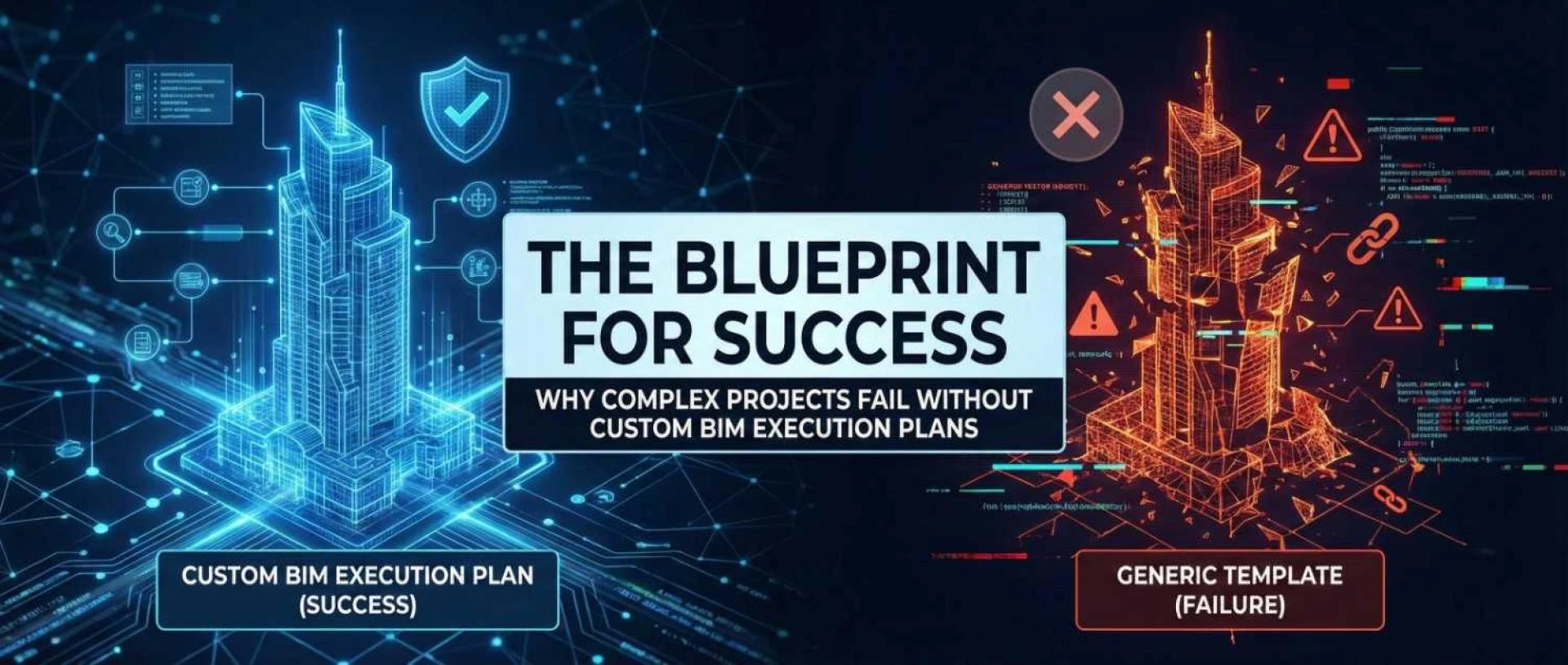
At the heart of this strategy lies the BIM Execution Plan (BEP). Often treated as a bureaucratic checkbox or a static PDF buried in a subfolder, the BEP is actually the "Project Constitution." It defines the laws, languages, and logistics of the digital build.
However, for complex projects, multi-tower mixed-use developments, healthcare facilities, or large-scale infrastructure, a generic, templated BEP is a recipe for disaster. This article explores why "copy-paste" planning leads to failure and why a Custom BIM Execution Plan is the only viable blueprint for success in 2026.
- The "Template Trap": Why Standardization Fails Complexity
The AEC industry loves standards, and for good reason. Standards like ISO 19650 provide a necessary framework for global consistency. However, there is a dangerous difference between a standard and a template.
Many firms, in a bid to save time during the frantic mobilization phase, copy a BEP from a previous project. They change the project name, update the address, and issue it to the team. This is the "Template Trap."
Why One Size Does Not Fit All
Imagine using the execution plan for a 5-story residential block to manage a 500-bed hospital.
The Residential Block requires basic clash detection (walls vs. pipes) and simple quantity take-offs.
The Hospital requires complex medical gas coordination, strict air pressure zoning, asset tagging for thousands of pieces of equipment, and integration with a specific Facility Management (FM) system.
If the BEP doesn't account for the Hospital's specific medical equipment requirements or the unique regulatory compliance needed for healthcare, the model will fail to deliver value. The structural engineer might model beams that clash with MRI zones because the "exclusion zones" weren't defined in the BEP. The MEP contractor might model generic pumps when the owner needs specific manufacturer data for their FM software.
A custom BEP acknowledges that every project has a unique "Digital DNA." It asks the hard questions upfront: What are the specific risks of THIS site? What are the specific deliverables for THIS client?
- The Anatomy of a Custom BEP: Defining the "Why" and "How."
A robust, custom BEP is not just a list of software versions. It is a strategic document that aligns the entire project team around common goals. It must rigorously define the following core pillars:
- BIM Goals and Uses
Before a single wall is modeled, the team must agree on why they are using BIM. A custom BEP explicitly lists the "BIM Uses":
Design Authoring: Creating the 3D geometry.
3D Coordination (Clash Detection): Identifying conflicts before construction.
4D Phasing: Simulating the construction schedule (critical for complex sites with limited access).
5D Cost Estimation: Extracting quantities for budget tracking.
6D Sustainability: Energy analysis and carbon tracking.
7D Facility Management: Asset data for operations.
If the BEP doesn't specify that "5D Cost Estimation" is a goal, the modelers won't structure their data to be readable by estimating software. The result? The estimator has to manually count items from 2D drawings, rendering the sophisticated 3D model useless for budgeting.
- The LOD Matrix (Level of Development)
This is the most critical section of a custom BEP. The Level of Development (LOD) defines exactly how reliable a model element is at a specific milestone.
- LOD 200 (Schematic): A generic light fixture. Good for spacing.
- LOD 400 (Fabrication): The specific light fixture with mounting details, electrical load data, and exact dimensions.
A custom BEP creates a matrix that assigns responsibility: "At the Design Development milestone, the Architect is responsible for the Light Fixture at LOD 300. At the Construction Doc milestone, the Electrical Contractor takes ownership and advances it to LOD 400." Without this custom matrix, you get "Scope Gaps" (no one models the hangers) or "Scope Overlaps" (both the Architect and the structural engineer model the floor slab, resulting in double-counting of concrete).
- The Technical Backbone: Coordinates, Software, and Interoperability
Complex projects often involve dozens of stakeholders: landscape architects, civil engineers, structural consultants, interior designers, and specialized MEP subcontractors. They utilize different software ecosystems (Revit, Civil 3D, Rhino, Tekla, Navisworks).
A Custom BEP acts as the "Rosetta Stone" that allows these systems to talk to each other.
Shared Coordinates and The "Origin Point"
Coordinate misalignment is one of the most expensive errors in BIM. If the Civil Engineer is working in State Plane coordinates (real-world location), and the Architect is working in "Project North" (0,0,0), the models won't line up. A custom BEP defines the Project Base Point and Survey Point explicitly. It dictates the exact procedure for acquiring coordinates so that when the mechanical subcontractor links the architectural model, the ductwork actually lands inside the building, not 500 feet away in the parking lot.
File Exchange Formats
Will the team share native Revit files (.rvt) or open-standard IFC files?
Native Sharing: High fidelity, but requires everyone to be on the same software version (e.g., Revit 2025).
IFC Sharing: Lower fidelity, but allows the steel fabricator using Tekla to collaborate with the Architect using ArchiCAD.
The BEP must mandate the software version. If the Architect upgrades to Revit 2026 mid-project while the structural engineer is stuck on 2024, collaboration breaks down immediately. A custom plan freezes the version for the project's duration.
- The Human Element: Communication & The Common Data Environment (CDE)
Technology is easy; people are hard. A custom BEP regulates the "social contract" of the project.
The Common Data Environment (CDE)
For complex projects, emailing Zip files is negligence. The BEP must define the CDE (e.g., BIM 360, ACC, Procore) and the strict folder structure compliant with ISO 19650. It answers:
How do we name our files? (e.g., PROJ-ARCH-L1-FLOORPLAN.rvt)
How do we handle revisions? (P01, P02 for WIP; C01 for Shared)
Who has permission to approve a model for construction?
Clash Detection Cycles
"We will run clash detection" is a vague promise. A custom BEP turns it into a rigorous process: "The BIM Coordinator will run a Federated Model clash test every Tuesday at 2:00 PM. A coordination meeting will be held every Thursday at 10:00 AM. The Mechanical Lead is responsible for resolving all 'High Priority' clashes with the Structural Steel by the following Monday."
This level of specificity transforms clash detection from a passive activity into an active management tool.
- Risk Mitigation & Legal Protection
We must view the BEP through a legal lens. In the event of litigation, say, a delay claim because the mechanical system didn't fit in the ceiling plenum, the lawyers will look at the BEP.
- Did the BEP specify that the ceiling void was a "High Priority" coordination zone?
- Did the BEP require the mechanical sub to model insulation thickness (LOD 350)?
If the answer is "yes," and the sub failed to do it, the liability is clear. If the BEP were a generic template that didn't mention insulation, the General Contractor might be liable for the delay.
A Custom BEP is your insurance policy. By clearly defining scope, reliability, and responsibility, it removes ambiguity. Ambiguity is where lawsuits are born.
Planning is Cheaper Than Fixing
The cost of developing a comprehensive, Custom BIM Execution Plan might take two weeks of a BIM Manager's time and several workshops with the team. The cost of not doing it could be months of delay, hundreds of thousands of dollars in rework, and a fractured relationship with the client.
In 2026, the complexity of our buildings demands an equal sophistication in our planning. We are no longer just stacking bricks; we are weaving complex digital tapestries of data, geometry, and time.
To succeed, you must stop treating the BEP as a template and start treating it as the blueprint for your project's digital survival.
For a deeper dive into the specific steps of drafting these documents and ensuring compliance across all stakeholders, read our detailed guide on Developing Custom BIM Execution Plans (BEPs) for Complex Projects.
Investing in a custom plan today ensures that the vision you design is exactly the reality you build.





























Sign in to leave a comment.