
The artificial intelligence landscape in 2026 has moved beyond simple experimentation. We are now in the era of Agentic AI—systems that can reason, plan, and autonomously execute complex workflows. At the heart of this revolution is deep learning, a specialized subset of machine learning inspired by the neural architecture of the human brain.
As industries from fintech to healthcare scramble to implement these advanced models, the professional demand for expertise has reached a fever pitch. However, many learners find that a Deep Learning Course is significantly more rigorous than standard software development training. To transition from a consumer of AI tools to a creator of neural architectures, you need a specific toolkit of mathematical, logical, and technical competencies.
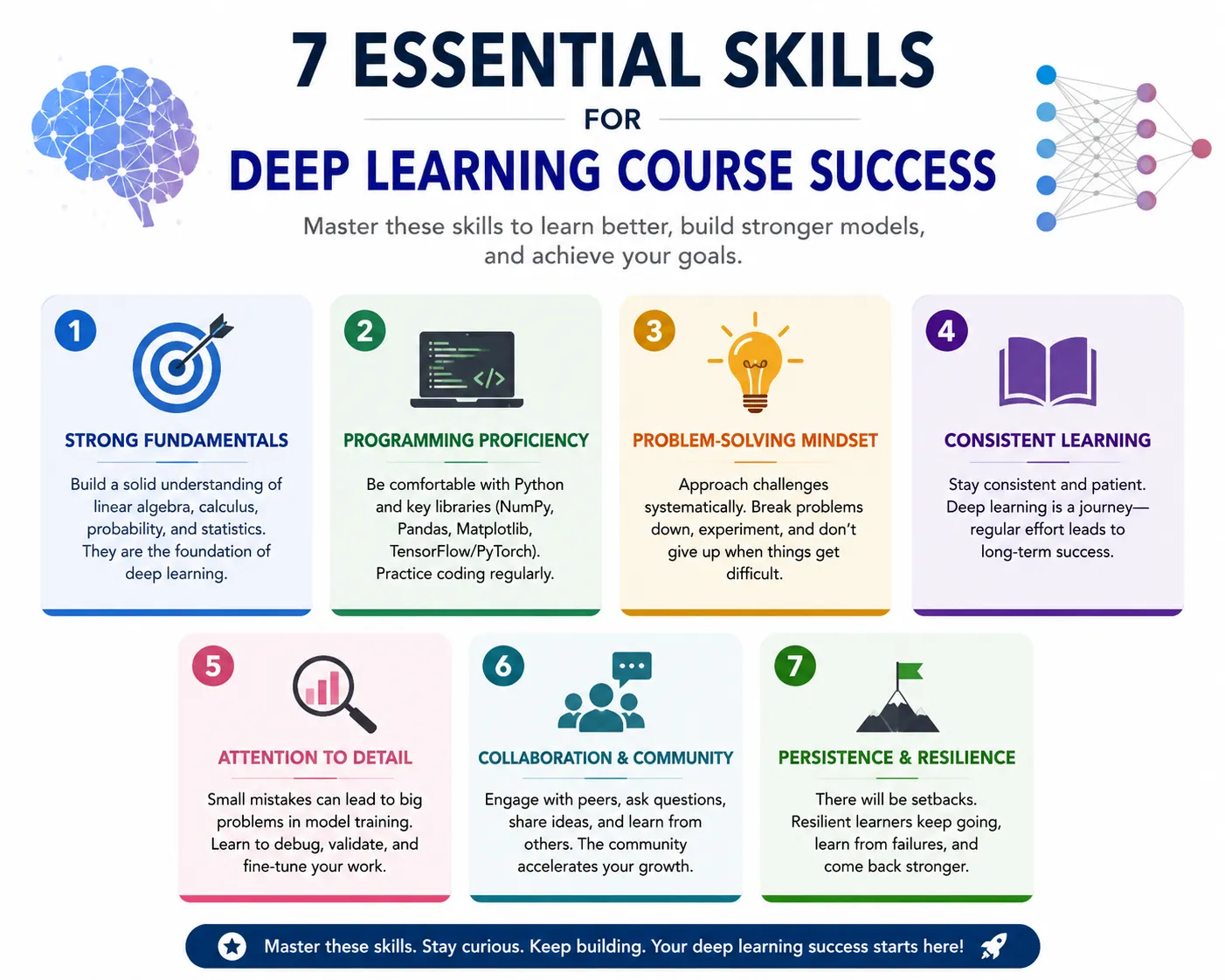
This guide outlines the seven essential skills required for Deep Learning Course success, providing a strategic roadmap for professionals looking to lead in the AI-driven economy.
1. Mathematical Intuition (Linear Algebra and Calculus)
Deep learning is essentially applied mathematics. While you do not need to be a theoretical mathematician, you must have a strong intuition for the "math under the hood."
Linear Algebra
Neural networks represent data as tensors—multidimensional arrays. You must be comfortable with matrix multiplication, transpositions, and vector spaces. When a model "learns," it is essentially performing massive linear transformations across these tensors.
Calculus and Optimization
The process by which a network improves is called Gradient Descent. This relies on the "Chain Rule" from calculus to calculate how a small change in a weight affects the final output error. Understanding derivatives allows you to diagnose why a model might not be converging or why it is experiencing "vanishing gradients."
2. Python Proficiency and Scientific Libraries
Python is the undisputed language of Artificial Intelligence. To succeed in a Deep Learning Course, your Python skills must move beyond basic syntax into the realm of high-performance data processing.
- NumPy: This is the foundational library for numerical computation. You must master array slicing, broadcasting, and vectorized operations to handle data efficiently.
- Pandas: Deep learning requires immense amounts of data. Proficiency in Pandas allows you to clean, filter, and transform raw datasets into formats suitable for neural networks.
- Object-Oriented Programming (OOP): Modern AI frameworks like PyTorch rely heavily on OOP. You need to understand classes and inheritance to build custom model architectures and data loaders.
3. Mastery of Neural Network Architectures
A common pitfall for beginners is treating deep learning as a "black box." Success requires a deep understanding of which architecture fits which problem. A comprehensive Deep Learning Course will require you to master:
- Convolutional Neural Networks (CNNs): The gold standard for computer vision. You must understand convolutional layers, pooling, and strides to build systems for image recognition or medical diagnostics.
- Recurrent Neural Networks (RNNs) and LSTMs: Essential for sequential data, such as time-series forecasting or speech processing.
- Transformers: By 2026, the Transformer architecture is the most critical topic. Understanding the "Attention" mechanism is what separates a basic coder from a Generative AI specialist.
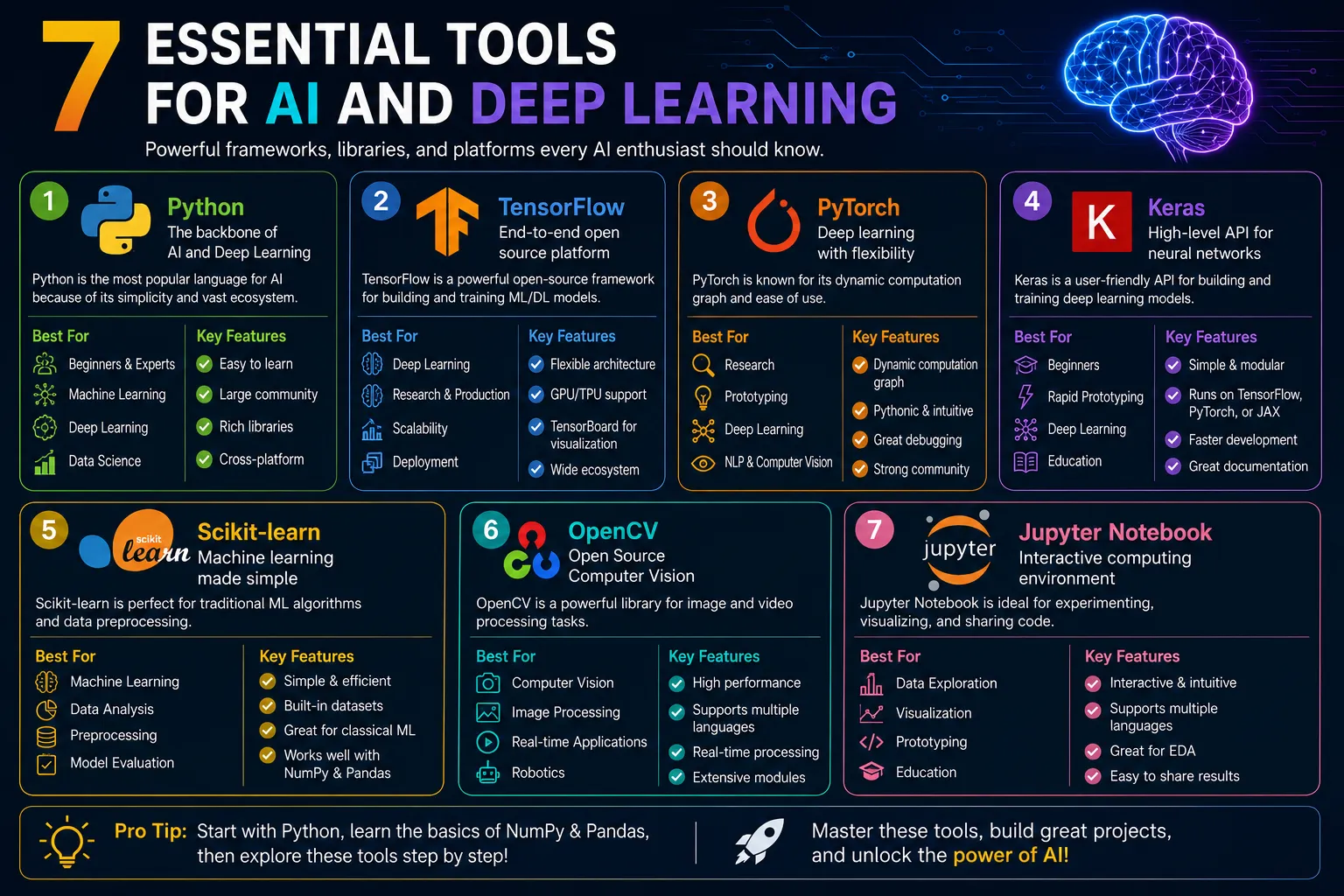
4. Framework Fluency: PyTorch vs. TensorFlow
While the mathematical principles remain the same, you must be proficient in at least one major deep learning framework to build production-ready models.
PyTorch
Currently the favorite in research and modern AI startups. Its dynamic computational graph makes it intuitive and easier to debug, which is a massive advantage during the learning phase.
TensorFlow and Keras
Widely used in large-scale enterprise production environments. It offers robust tools for mobile deployment (TF Lite) and high-performance serving.
To achieve Deep Learning Course success, choose one framework and go deep. Learn how to build custom layers, implement data augmentation, and use "Transfer Learning" to leverage pre-trained models like BERT or ResNet.
5. Data Strategy and Preprocessing
In the world of AI, the quality of your output is strictly limited by the quality of your input—a principle known as "Garbage In, Garbage Out." A successful practitioner spends more time on data than on model training.
- Data Augmentation: Learning how to artificially expand your dataset by rotating, flipping, or adding noise to your data.
- Normalization and Scaling: Understanding how to bring all input features to a similar scale so the neural network can learn efficiently without certain features dominating the gradients.
- Handling Imbalance: In real-world scenarios (like fraud detection or rare disease diagnosis), one class may be much rarer than another. You must know how to use oversampling or synthetic data generation (SMOTE) to ensure the model remains unbiased.
6. MLOps and Deployment Logic
In 2026, a model that only runs on your local computer is considered a prototype, not a solution. Professional success requires an understanding of MLOps (Machine Learning Operations).
Hiring managers are looking for professionals who can bridge the gap between a trained model and a live product. This involves:
- Containerization: Using Docker to package your model so it runs consistently across different cloud environments.
- Cloud Scaling: Utilizing platforms like AWS SageMaker or Google Vertex AI to train models on distributed GPU clusters.
- Model Monitoring: Learning how to detect "data drift"—when the real-world data starts to change, causing your model's accuracy to degrade over time.
7. Critical Thinking and Problem-Solving
Perhaps the most underrated skill for Deep Learning Course success is the "researcher's mindset." Deep learning is an experimental science. Models rarely work perfectly on the first try. You must be prepared to:
- Debug the Model: Is the loss not decreasing because the learning rate is too high? Or is it because the data is incorrectly labeled?
- Hyperparameter Tuning: Systematically testing different combinations of batch sizes, epochs, and dropout rates to find the optimal configuration.
- Bias Mitigation: Critically analyzing your model to ensure it doesn't perpetuate social biases present in the training data, a key requirement for ethical AI in 2026.
Conclusion: The Path to Mastery
Mastering these seven skills is a demanding but highly rewarding journey. As we navigate the complexities of the 2026 economy, the ability to build, manage, and scale neural networks has become one of the most valuable assets a professional can possess.
Success in a Deep Learning Course is not just about passing an exam; it is about developing a mindset that can solve the "unsolvable" problems of modern industry. By combining mathematical rigor with programming proficiency and a solid MLOps strategy, you position yourself as a primary architect of the AI-driven future.
The investment you make in these skills today will define your career trajectory for the next decade. Start with the foundations, build your portfolio, and embrace the iterative nature of the field. The era of deep learning is here—ensure you have the skills to lead it.


























Sign in to leave a comment.