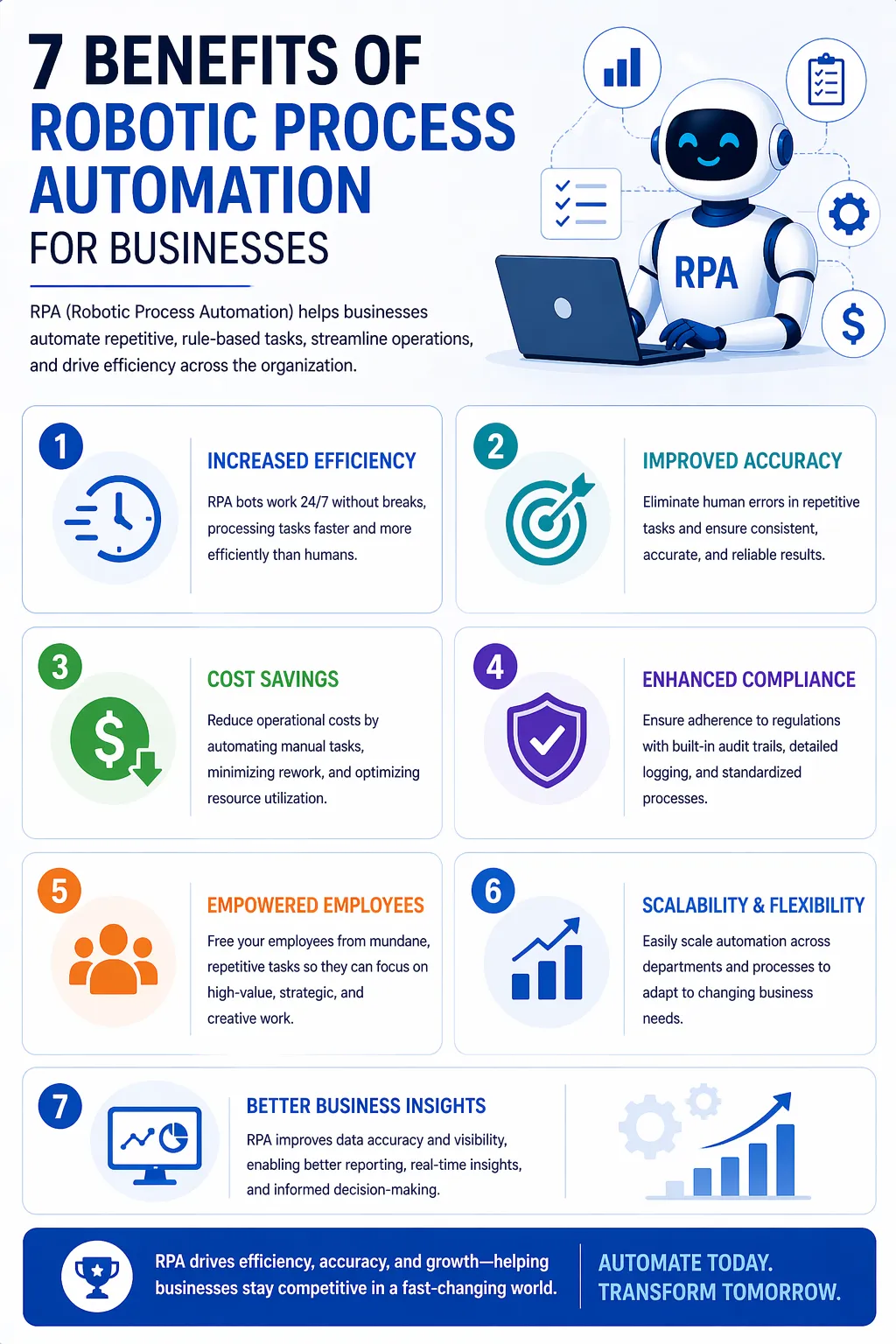

In the high-stakes environment of global commerce, efficiency is no longer a luxury—it is the baseline for survival. As organizations navigate the complexities of Digital Transformation, the role of Robotic Process Automation (RPA) has shifted from a back-office experiment to a front-line strategic driver. By deploying software "bots" to handle the repetitive, rule-based tasks that consume human bandwidth, companies are unlocking unprecedented levels of productivity.
Whether you are managing a large-scale Cloud migration or streamlining Cybersecurity compliance checks, RPA provides a scalable solution to the manual bottlenecks that slow down progress. Below, we explore the top seven benefits of implementing RPA software and how it is revolutionizing the modern workspace.
1. Drastic Increase in Operational Productivity
The most immediate benefit of RPA is the sheer volume of work a digital workforce can handle. Unlike human employees, RPA bots operate 24/7/365 without fatigue. They do not require breaks, sleep, or vacations.
In departments like Financial Services, where data entry and reconciliation are constant, a single bot can perform the work of three to five full-time employees. This 100% "uptime" ensures that processes like invoice processing or payroll are completed in a fraction of the time, allowing the organization to handle business surges without increasing headcount.
2. Elimination of Human Error and Enhanced Accuracy
Even the most diligent professional is prone to "copy-paste" errors or data entry slips, especially when performing monotonous tasks. In industries like Healthcare or banking, a single misplaced decimal point can lead to significant financial loss or regulatory non-compliance.
RPA software follows programmed rules with absolute precision. As long as the initial logic is correct, the bot will execute the task with 100% accuracy. This eliminates the need for "rework"—the costly process of finding and fixing mistakes—thereby streamlining the entire Supply Chain and improving data integrity across all platforms.
3. Significant Cost Savings and Rapid ROI
While the initial setup of an RPA framework requires investment, the Return on Investment (ROI) is often realized within the first year. By automating high-volume tasks, companies significantly reduce the "cost per transaction."
RPA is a non-invasive technology; it sits on top of your existing legacy systems. This means you do not have to spend millions on backend integrations or replace old software to see improvements. The cost of maintaining a bot is a small fraction of the salary and benefits associated with a human worker performing the same repetitive task.
4. Improved Employee Engagement and Morale
A common misconception is that "the robots are taking our jobs." In reality, RPA is a tool for human augmentation. By delegating the "robotic" parts of a job to a bot, employees are freed to focus on high-value, creative, and strategic work.
For example, in Human Resources, instead of a specialist manually entering data from a PDF into an ERP system, they can spend their time on talent development and employee wellness. This shift from mundane data processing to meaningful problem-solving leads to higher job satisfaction and lower turnover rates.
5. Enhanced Regulatory Compliance and Security
Maintaining a clean audit trail is one of the most taxing administrative burdens in modern business. RPA simplifies this by providing "perfect" documentation. Every click, data movement, and decision made by a bot is automatically logged and timestamped.
In the event of an audit, these logs provide a transparent, tamper-proof record of compliance. Furthermore, RPA enhances Cybersecurity by reducing the need for human access to sensitive data. Bots can be granted "least-privilege" access to move data between systems without a human ever seeing the credentials or the private information.
6. Scalability and Business Agility
Business needs are rarely static. A sudden spike in customer orders or a year-end accounting rush can overwhelm a manual workforce. Hiring and training temporary staff is slow, expensive, and often ineffective for short-term peaks.
RPA offers "elasticity." Organizations can deploy additional bots within minutes to handle a surge in volume and then "decommission" them when the demand subsides. This flexibility allows businesses to remain agile and responsive to market changes without the traditional friction of scaling a human workforce.
7. Seamless Integration Across Disparate Systems
One of the greatest challenges in IT Infrastructure is getting different software applications to talk to each other. RPA acts as the "universal glue." Because it interacts with the User Interface (UI), it can move data between a 30-year-old mainframe and a cutting-edge AI analytics tool without requiring complex custom coding or APIs.
This benefit allows organizations to modernize their workflows while continuing to extract value from their legacy investments. It accelerates the pace of Digital Transformation by ensuring that data flows freely across the entire enterprise architecture.
Conclusion: Reclaiming the Human Element
The top seven benefits of Robotic Process Automation all point toward a single goal: operational excellence. By eliminating errors, cutting costs, and providing 24/7 productivity, RPA provides the foundation for a more resilient business model.
The most profound benefit, however, is the reclamation of human time. When we automate the mundane, we allow our teams to innovate, empathize, and lead. In the age of Intelligent Automation, the most successful organizations will be those that use bots to handle the data, so their people can handle the vision.
Summary of RPA Benefits
| Benefit Category | Key Outcome |
|---|---|
| Productivity | 24/7 operation with no downtime. |
| Accuracy | 100% error-free execution of rule-based tasks. |
| Cost | Drastic reduction in operational expenses and labor costs. |
| Compliance | Automated, tamper-proof audit trails for every process. |
| Scalability | Instant ability to increase or decrease "digital" headcount. |
| Morale | Employees focus on strategic, high-value initiatives. |
| Integration | Connects legacy systems with modern cloud apps seamlessly. |



























Sign in to leave a comment.