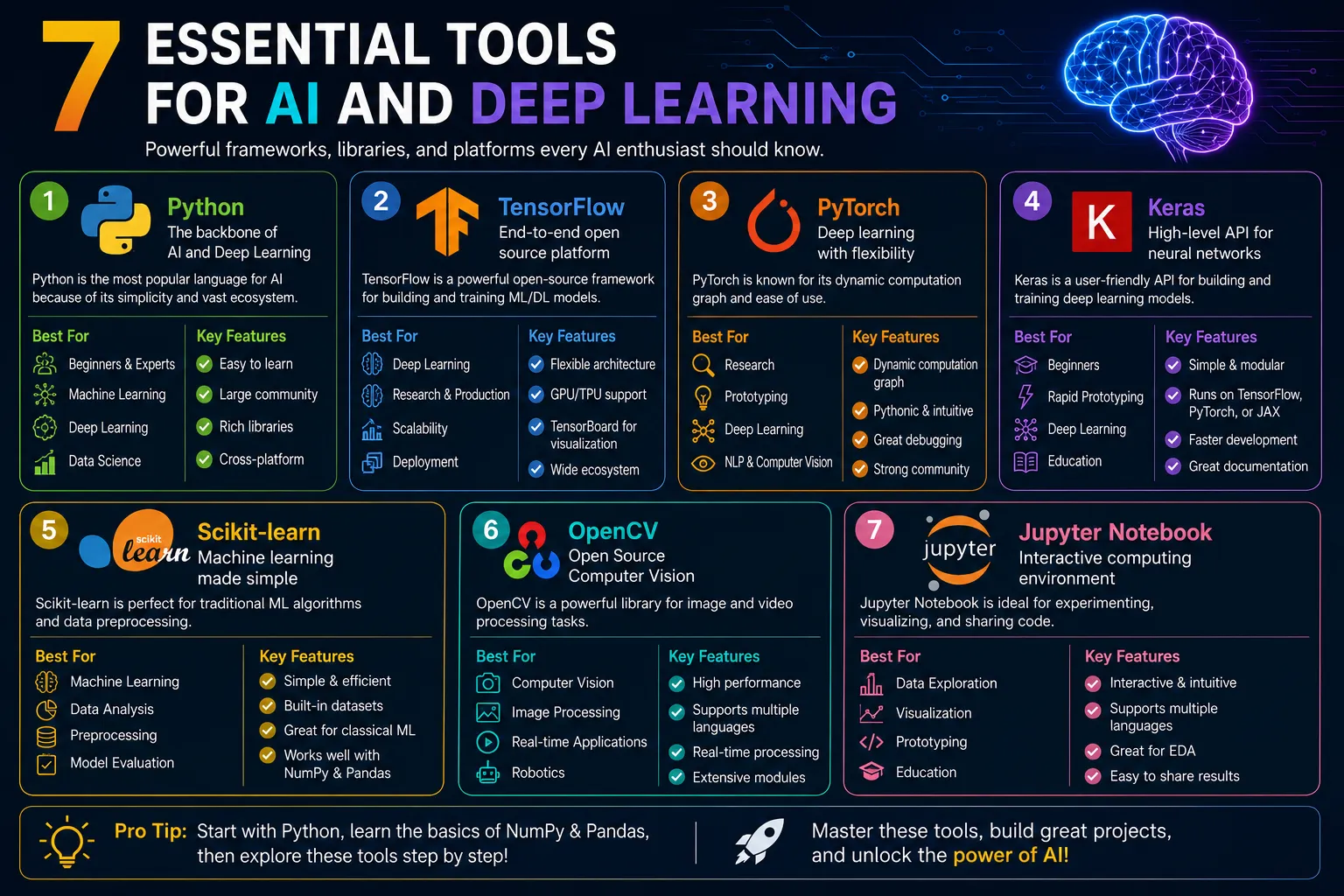

The rapid acceleration of Artificial Intelligence (AI) and deep learning in 2026 has transformed the professional landscape from one of speculative curiosity to one of critical implementation. For working professionals and decision-makers, the challenge is no longer just understanding what these technologies do, but mastering the 7 essential tools for AI and deep learning that enable scalable, production-ready solutions.
Whether you are a project manager overseeing a digital transformation or a developer building a complex neural network, the tools you select dictate the efficiency, accuracy, and security of your project. This guide outlines the industry-standard software and frameworks currently driving the 2026 tech stack, providing actionable insights for those pursuing high-level certifications and career advancement.
1. PyTorch: The Research-to-Production Powerhouse
Originally developed by Meta’s AI Research lab, PyTorch has firmly established itself as the premier framework for deep learning. Its primary appeal lies in its "Pythonic" nature and dynamic computational graph, which allows developers to modify the neural network’s behavior on the fly during training.
In professional environments, PyTorch is utilized for everything from natural language processing (NLP) to advanced computer vision. Its seamless integration with the Python ecosystem makes it an essential tool for rapid prototyping. For those aiming for advanced technical certifications, proficiency in PyTorch signals an ability to work with the latest cutting-edge AI architectures, including Large Language Models (LLMs) and Generative AI. Its flexibility allows for easier debugging compared to more rigid frameworks, which is vital when moving from a conceptual "proof of concept" to a deployed enterprise solution.
2. TensorFlow and Keras: Scalability for the Enterprise
While PyTorch dominates research and agility, TensorFlow, developed by Google, remains the backbone of large-scale enterprise AI. TensorFlow’s robust ecosystem is designed for deployment across diverse environments, including mobile devices (via TensorFlow Lite) and high-performance cloud clusters.
To simplify the development of these complex systems, professionals use Keras, the high-level API integrated into TensorFlow. Keras allows for the rapid construction of deep learning models with minimal code, making it a favorite for teams focused on speed-to-market. When discussing the 7 essential tools for AI and deep learning, TensorFlow stands out for its production-ready reliability and its suite of visualization tools, such as TensorBoard, which helps in monitoring model performance and debugging complex training loops through intuitive visual graphs.
3. Hugging Face: The Collaborative Engine of AI
In 2026, building an AI model from scratch is rarely the most efficient strategy. Hugging Face has become an indispensable platform for professionals to access pre-trained models. Think of it as a collaborative repository where the world's most advanced models—such as Llama 3, BERT, and various Diffusion models—are shared and fine-tuned.
For a business leader, Hugging Face provides the "building blocks" for AI integration. Instead of spending months and millions of dollars on training, teams can leverage Transfer Learning to take a model that already "understands" language or images and customize it for a specific industry task. This democratizes deep learning, allowing even mid-sized enterprises to deploy world-class AI solutions without needing a massive data center.
4. Google Vertex AI: Unified ML Infrastructure
The implementation of AI requires more than just a model; it requires a place to host, train, and monitor it. Google Vertex AI is a leading cloud-based platform that unifies the machine learning (ML) workflow. It provides a managed environment where data scientists can run experiments without worrying about the underlying hardware.
Vertex AI is particularly powerful due to its AutoML capabilities. For professionals who may not have a deep background in data science, AutoML can automatically select the best model architecture and tune hyperparameters, significantly lowering the barrier to entry. This makes it one of the most practical tools for project managers looking to integrate AI into existing workflows with high predictability and low overhead. It bridges the gap between raw data and actionable intelligence within a single, secure environment.
5. Weights & Biases (W&B): The Developer’s Laboratory
A critical part of the deep learning journey is experimentation. Often, a data scientist will run hundreds of versions of a model before finding the right configuration. Weights & Biases (W&B) is the premier tool for experiment tracking and model versioning.
W&B allows teams to:
- Visualize performance: See real-time loss and accuracy curves during the training phase.
- Collaborate: Share experimental results across a global team, acting as a collaborative hub for neural network performance.
- Auditability: In regulated sectors like finance and healthcare, having a detailed record of exactly how a model was trained is vital for compliance and maintaining E-E-A-T (Experience, Expertise, Authoritativeness, and Trustworthiness).
6. Apache Spark: Handling the Big Data Pipeline
Deep learning is notoriously "data-hungry." Before a model can learn, massive amounts of raw data must be cleaned, transformed, and organized. Apache Spark, particularly with its PySpark integration, is the industry standard for distributed data processing.
When handling petabytes of information—common in cybersecurity or global supply chain management—traditional tools fail. Spark allows you to process data across clusters of computers simultaneously. For any professional seeking a comprehensive understanding of the 7 essential tools for AI and deep learning, mastering Spark is essential for managing the "data pipeline" that feeds the AI engine. Without clean, structured data, even the most advanced neural network will fail to provide accurate results.
7. MLflow: Master of the Machine Learning Lifecycle
The final hurdle in AI is Model Drift—the phenomenon where an AI's accuracy degrades as real-world data changes over time. MLflow is an open-source platform designed to manage the entire machine learning lifecycle, from development to deployment and long-term maintenance.
MLflow helps professionals maintain "Model Governance." It ensures that every model deployed into production is documented, reproducible, and easily replaced if its performance drops. For decision-makers, MLflow provides the peace of mind that their AI investment is sustainable. It provides a standardized way to package models, ensuring they run consistently regardless of whether they are on a local server or in a multi-cloud environment.
Professional Standards: E-E-A-T and Tool Selection
When selecting from these 7 essential tools for AI and deep learning, it is vital to keep the principles of Experience, Expertise, Authoritativeness, and Trustworthiness (E-E-A-T) at the forefront. In 2026, the value of an AI project is not just in its complexity, but in its Explainability.
Using tools like MLflow and W&B ensures that your AI initiatives are transparent and auditable. For professionals in cybersecurity or finance, being able to explain why a model reached a specific conclusion is often a legal requirement. These tools provide the documentation necessary to satisfy regulatory bodies and build trust with end-users.
Conclusion: Future-Proofing with the Right Tech Stack
Mastering the 7 essential tools for AI and deep learning is a marathon, not a sprint. The synergy of these platforms forms the foundation of modern digital innovation. By mastering frameworks like PyTorch and TensorFlow, leveraging the collaborative power of Hugging Face, and managing the lifecycle with MLflow, you position yourself as a highly capable professional in a competitive market.
At iCertGlobal, we recognize that technical tools are most effective when paired with strategic oversight. Whether you are pursuing a certification in data science or looking to lead an AI-driven project, understanding these tools is your first step toward mastery. The intelligent systems of 2026 are built on these pillars; learning them today ensures you are ready for the challenges of tomorrow.
Key Takeaways for Success:
- Agility vs. Scale: Choose PyTorch for flexible research and TensorFlow for massive enterprise deployment.
- Don't Reinvent the Wheel: Use Hugging Face to leverage pre-trained models via transfer learning.
- Manage the Lifecycle: Use MLflow and Weights & Biases to track experiments and prevent model drift.
- Infrastructure Matters: Use Google Vertex AI to handle the heavy computational lifting in the cloud.
- Data is the Foundation: Use Apache Spark to ensure your data pipelines are robust and scalable.





















Sign in to leave a comment.