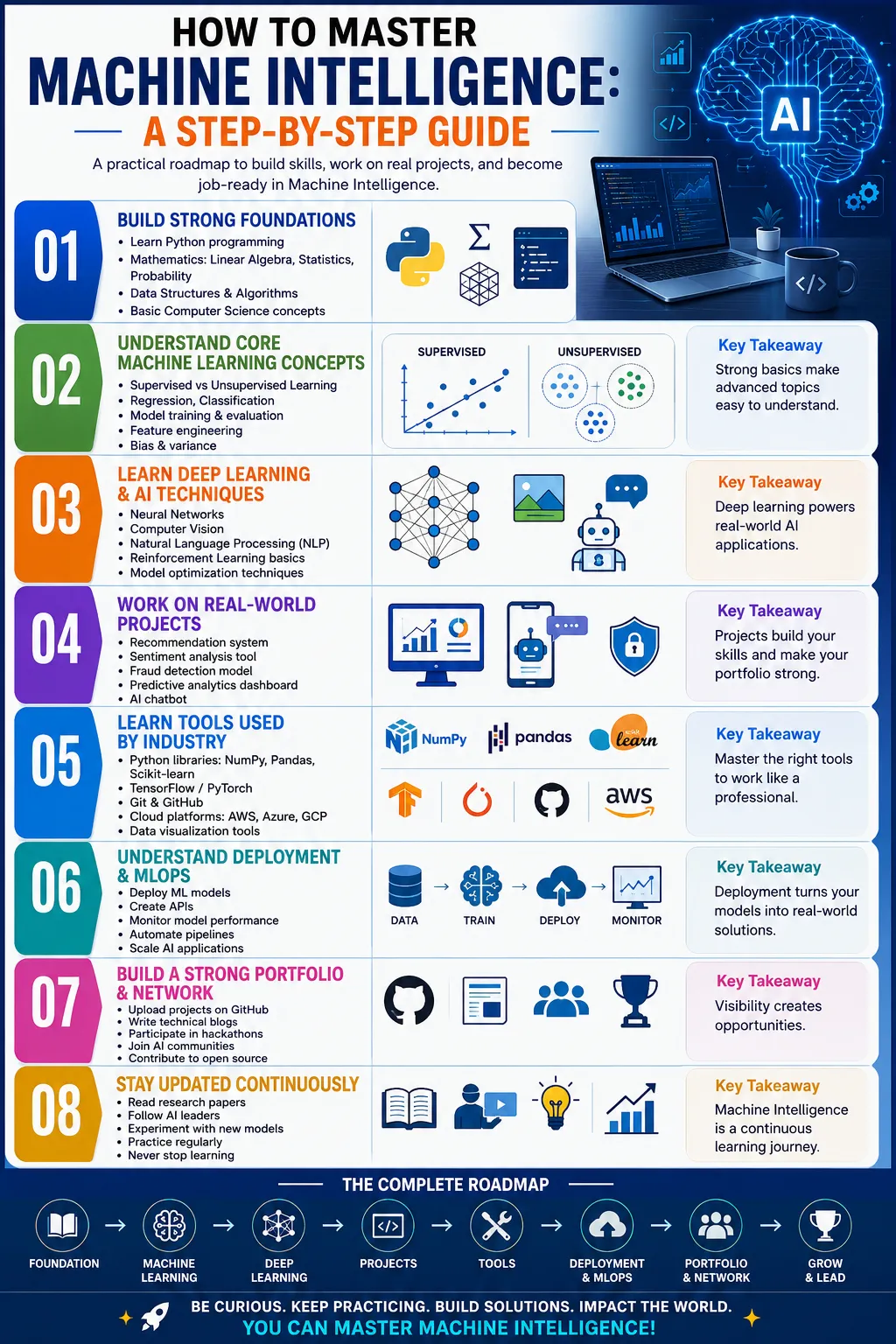

The year 2026 marks a definitive era where the integration of artificial intelligence is no longer a competitive advantage—it is a baseline requirement for professional survival. As global industries decentralize and automate, the demand for individuals who can architect, manage, and scale intelligent systems has reached an all-time high. However, for many working professionals, the path from "AI-aware" to "AI-master" feels obscured by dense jargon and complex mathematics.
Mastering machine intelligence requires more than just learning how to write a few lines of Python; it requires a structural understanding of how machines perceive, learn, and reason. This guide provides a strategic, step-by-Step roadmap to help you navigate this complex field, ensuring you gain the skills necessary to lead in an AI-driven economy.
Phase 1: Solidifying the Mathematical and Logical Core
Before you can build high-performing models, you must speak the language of the machine. Many practitioners make the mistake of jumping straight into coding libraries without understanding the underlying mechanics. To truly Master Machine Intelligence, you must start with the foundational pillars.
Linear Algebra and Calculus
Machine intelligence thrives on multi-dimensional data. You need to be comfortable with vectors, matrices, and tensors. Furthermore, understanding calculus—specifically derivatives—is essential for understanding how algorithms "optimize" themselves through a process called backpropagation.
Probability and Statistics
In 2026, AI is less about deterministic outcomes and more about probabilistic predictions. Mastering Bayesian inference, distributions, and hypothesis testing allows you to build models that can handle the uncertainty of real-world data, whether in financial forecasting or medical diagnostics.
Phase 2: Mastering the Programming Ecosystem
Python remains the undisputed champion of the machine intelligence world. However, mastery involves moving beyond basic syntax into the specialized libraries that drive modern innovation.
- Data Manipulation: Become an expert in Pandas and NumPy. In a professional environment, 80% of your time will be spent cleaning and structuring data.
- Visualization: Use tools like Matplotlib and Seaborn to translate complex data insights into visual narratives that stakeholders can understand.
- Machine Learning Frameworks: Start with Scikit-learn for classical algorithms (regression, decision trees) before graduating to deep learning powerhouses like PyTorch or TensorFlow.
Phase 3: Transitioning from Machine Learning to Machine Intelligence
Traditional machine learning is about identifying patterns. Machine intelligence, particularly in the current 2026 landscape, is about creating systems that can perform complex cognitive tasks. This phase of your journey focuses on the "Big Three" architectures.
1. Deep Learning and Neural Networks
This is where you learn to build architectures inspired by the human brain. You must master Convolutional Neural Networks (CNNs) for image processing and Recurrent Neural Networks (RNNs) for sequential data. Understanding these allows you to contribute to cutting-edge fields like autonomous vehicle technology and real-time biometric security.
2. Natural Language Processing (NLP) and Transformers
The rise of Large Language Models (LLMs) has changed the professional world. To Master Machine Intelligence, you must understand the "Attention Mechanism" and Transformer architectures. This skill is vital for professionals looking to build custom enterprise solutions, such as automated legal analysis tools or advanced sentiment analysis for global brands.
3. Reinforcement Learning (RL)
RL is the science of training an agent to take actions in an environment to maximize a reward. This is the cornerstone of advanced robotics and algorithmic trading. Learning RL positions you at the forefront of automation strategy.
Phase 4: Integrating MLOps and Cloud Scalability
A model that lives only on your local computer has zero business value. To be a master, you must understand how to deploy and maintain these systems at scale. This is where MLOps (Machine Learning Operations) comes into play.
- Cloud Infrastructure: Mastery requires proficiency in cloud platforms like AWS (Amazon Web Services), Microsoft Azure, or Google Cloud. You must learn how to leverage GPU-accelerated instances to train massive models.
- CI/CD for ML: Just as software requires continuous integration and deployment, machine intelligence models require continuous monitoring. You must learn to detect "model drift"—where the accuracy of your AI declines as the real-world data changes.
- Containerization: Familiarity with Docker and Kubernetes is essential for ensuring your AI applications are portable and scalable across different server environments.
Phase 5: Ethics, Governance, and Explainable AI (XAI)
In 2026, "Black Box" AI is no longer acceptable in regulated industries like healthcare or finance. To be a leader in this field, you must be able to explain why a machine made a certain decision.
- Explainable AI (XAI): Master techniques like SHAP (SHapley Additive exPlanations) to provide transparency to stakeholders. If an AI denies a loan or suggests a medical treatment, you must be able to justify that output logically and ethically.
- Bias Mitigation: Learn to identify and remove bias from your training datasets. Ethical AI is not just a moral obligation; it is a legal requirement under the evolving 2026 global regulatory frameworks.
- AI Governance: Understand the intersection of AI and privacy laws (such as GDPR and newer AI-specific acts). This knowledge allows you to act as a bridge between the engineering team and the legal department.
Phase 6: Practical Application through Domain Expertise
The final step to Master Machine Intelligence is to apply your knowledge to a specific industry. AI does not exist in a vacuum; it is a tool used to solve human problems.
Example: Project Management (PMP)
In project management, machine intelligence is used to predict resource slippage and budget overruns. A master in this field can integrate predictive analytics into a traditional PMP framework to increase project success rates significantly.
Example: Cybersecurity
Cybersecurity professionals use Graph Neural Networks (GNNs) to identify irregular patterns in network traffic, catching zero-day exploits before they can do damage. Combining AI mastery with cybersecurity expertise makes you one of the most valuable assets in the modern workforce.
The Path Forward: Continuous Learning
The field of machine intelligence moves faster than any other technology in history. Today’s state-of-the-art model is tomorrow’s legacy system. To maintain mastery, you must adopt a "Beta Mindset"—the idea that your education is never truly finished.
- Engage with Research: Regularly review papers on platforms like arXiv to stay ahead of architectural shifts.
- Participate in Competitions: Use platforms like Kaggle to test your skills against real-world datasets and global peers.
- Contribute to Open Source: Building and maintaining public libraries is the fastest way to gain deep, practical knowledge.
Conclusion: Becoming an Architect of the Future
Learning how to Master Machine Intelligence is a journey that begins with mathematics and ends with strategic leadership. By following this step-by-step guide—from the foundations of linear algebra to the complexities of MLOps and AI ethics—you are doing more than just learning a new skill. You are reconfiguring your professional identity for the most transformative decade in human history.
In 2026, the most successful individuals will be those who can harness the precision of machines to amplify human creativity and intuition. The tools are available, the roadmap is clear, and the demand is unprecedented. Now is the time to transition from a user of intelligence to a creator of it.
Key Takeaways for Success:
- Foundation First: Never skip the math; it is the reason why models work or fail.
- Code with Purpose: Focus on Python libraries that offer the highest utility for data cleaning and model deployment.
- Deployment is King: A model is only valuable if it is accessible and scalable in the cloud.
- Stay Ethical: Transparency and bias mitigation are the hallmarks of a true machine intelligence professional.
- Niche Down: Combine AI mastery with your existing industry expertise for maximum career impact.




















Sign in to leave a comment.