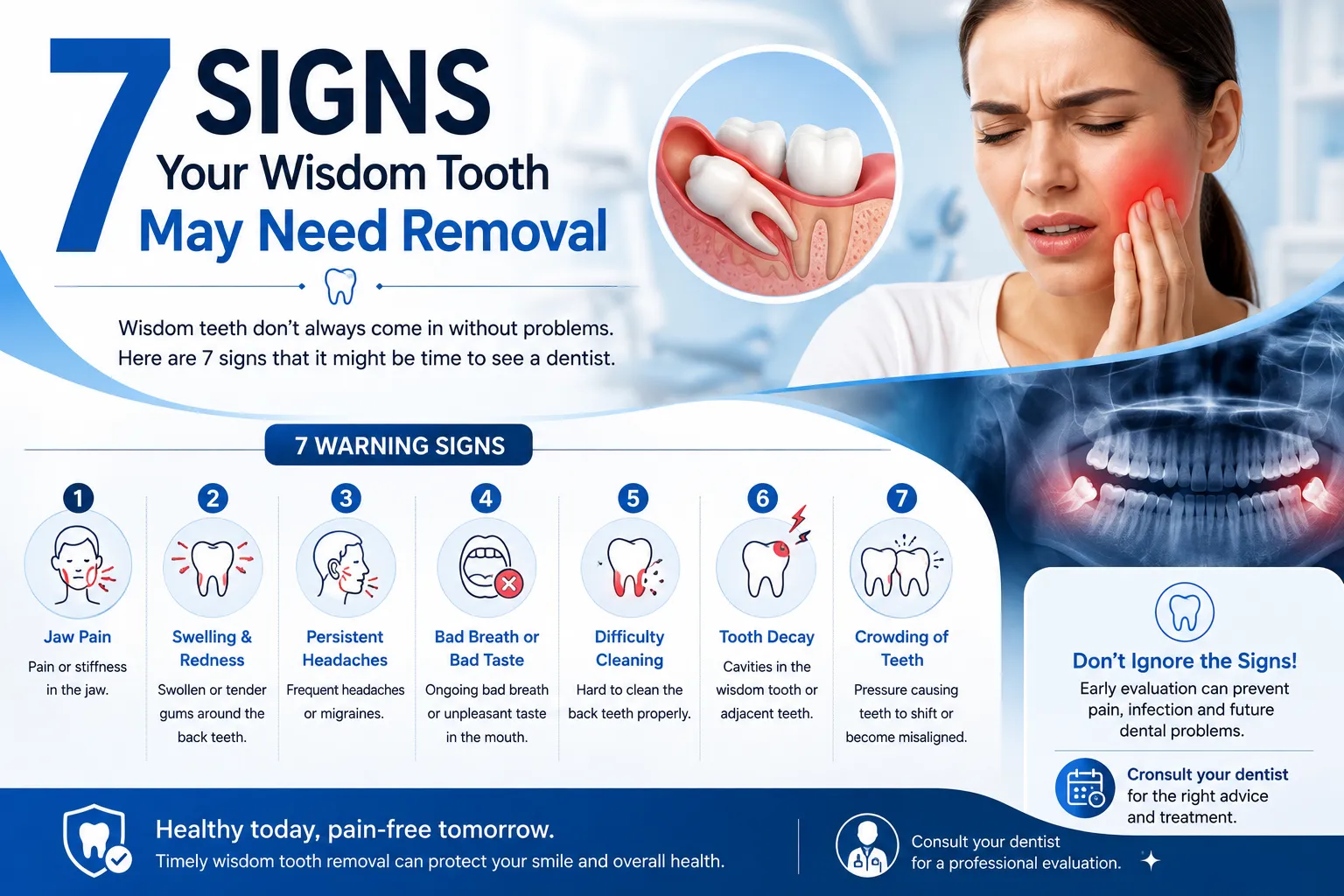

Wisdom teeth are the last set of teeth to develop at the back of the mouth. For some people, they grow normally without causing problems. For others, there may not be enough room for the tooth to erupt properly, leading to pain, swelling, infection, or pressure on nearby teeth.
If you are experiencing discomfort at the back of your mouth, you may wonder whether it is simply a temporary problem or a sign that your wisdom tooth needs attention. Here are 7 signs your wisdom tooth may need removal.
1. Persistent Wisdom Tooth Pain
Occasional discomfort can happen when a wisdom tooth is erupting. However, pain that continues or repeatedly comes back should not be ignored.
Persistent pain at the back of the mouth may indicate that the tooth is impacted, growing at an unusual angle, or causing pressure on surrounding tissues.
A dental examination can help determine the actual cause of the pain and whether wisdom tooth removal should be considered.
2. Swelling Around the Gums
Swelling around a partially erupted wisdom tooth is another common warning sign.
When part of the tooth remains covered by gum tissue, food particles and bacteria can become trapped around the area. This may contribute to inflammation and infection.
If you notice repeated swelling around the back of your gums, it is a good idea to have the area examined by a dentist.
3. Repeated Infection Around the Wisdom Tooth
A wisdom tooth that repeatedly becomes infected may require further evaluation.
Infection can cause symptoms such as gum swelling, tenderness, unpleasant taste, bad breath, or discomfort while chewing. If infections keep returning, your dentist may recommend removing the problematic tooth depending on its position and overall condition.
Ignoring repeated infections may allow the problem to become more uncomfortable and difficult to manage.
4. Difficulty Opening Your Mouth
If you experience difficulty opening your mouth fully, especially when it occurs along with pain or swelling near a wisdom tooth, it should not be overlooked.
Inflammation around an impacted or infected wisdom tooth can sometimes make normal jaw movement uncomfortable.
A dentist can examine the area and determine whether the wisdom tooth is contributing to the problem.
5. Your Wisdom Tooth Is Impacted
An impacted wisdom tooth does not have enough space to erupt normally. Instead, it may remain partially or completely underneath the gum or grow at an unusual angle.
Impacted wisdom teeth can put pressure on nearby structures and may increase the risk of pain, infection, or damage to neighbouring teeth.
Dental X-rays are often useful for understanding the position of a wisdom tooth and deciding what treatment may be appropriate.
6. Damage to the Nearby Tooth
A problematic wisdom tooth does not always affect only itself. If it grows too close to the neighbouring molar, it may create an area where food and bacteria become trapped or place pressure on the adjacent tooth.
Over time, this may contribute to dental problems affecting the nearby tooth.
For this reason, dentists may recommend evaluating wisdom teeth even when the symptoms seem relatively mild.
7. Your Dentist Recommends Removal After an Examination
Not every wisdom tooth needs to be removed.
Some wisdom teeth erupt properly, remain healthy, and can be cleaned effectively. However, when a tooth is causing recurring pain, infection, impaction, or damage to surrounding teeth, removal may be recommended.
Your dentist can evaluate the tooth clinically and, when necessary, use dental imaging to understand its position before discussing the available treatment options.
Why Early Wisdom Tooth Evaluation Matters
Waiting until wisdom tooth pain becomes severe is not always the best approach. A dental examination can help identify whether the tooth is erupting normally or creating a potential problem.
Early assessment is especially useful when symptoms such as recurring pain, swelling, infection, or difficulty opening the mouth are present.
The treatment decision should be based on the tooth's position, symptoms, surrounding structures, and overall oral health rather than pain alone.
What Happens During Wisdom Tooth Removal?
Wisdom tooth removal can range from a straightforward extraction to a more involved surgical procedure, depending on how the tooth has developed and whether it is impacted.
Before removal, the dentist examines the tooth and may recommend an X-ray to assess its position and relationship with nearby structures.
Modern dental techniques and appropriate anaesthesia can help make the procedure more comfortable. Your dentist will also provide aftercare instructions to support healing following the procedure.
Wisdom Tooth Removal in Ahmedabad
At Face Multispeciality Dental & Cosmetology Hospital, Dr. Stuti Bajaj provides teeth extraction and wisdom tooth removal services in Ahmedabad. The clinic's treatment information notes that wisdom tooth removal may be required when teeth are impacted, misaligned, lack sufficient space, cause pain or infection, or affect adjacent teeth.
If you are experiencing recurring wisdom tooth pain or swelling, a professional examination can help determine whether removal is appropriate for your situation.
Final Thoughts
Wisdom teeth do not always need to be removed, but certain symptoms should not be ignored. Persistent pain, swelling, repeated infection, difficulty opening the mouth, impaction, and damage to nearby teeth can all be reasons to seek a dental evaluation.
If you notice any of these 7 signs your wisdom tooth may need removal, consider scheduling a dental consultation rather than waiting for the symptoms to become severe.
For personalised evaluation and treatment, you can consult Dr. Stuti Bajaj at Face Multispeciality Dental & Cosmetology Hospital in Ahmedabad.

























Sign in to leave a comment.