

Stop Waiting, Start Winning: The Real Guide to SSC Exam Preparation Discipline
Every year, millions of aspirants aim for exams like SSC CGL, CHSL, and MTS. Most are smart and armed with endless PDFs and YouTube playlists, yet only a tiny fraction succeed. The difference is not just IQ — it is discipline. "Kal se pakka padhenge" is the most dangerous phrase in an SSC aspirant's vocabulary. Motivation is a spark that usually dies by Wednesday. To win, you need a system that works even when you do not feel like it. With SSC CGL Tier-1 2026 approaching, the only question is: Are you consistent enough to stay relevant?
Why Discipline Beats Motivation Every Single Time
Motivation is the ignition, but discipline is the fuel. A student studying six structured hours daily will always beat someone doing a distracted 12-hour marathon with a phone in hand.
Consistency compounds. Your speed and retention grow only if you show up every day without negotiating with yourself. The SSC exam does not reward "trying hard" — it rewards measurable effort. Two hours of deep Quantitative Aptitude practice is worth more than six hours of half-hearted reading.
Habits of Successful SSC Toppers
Toppers follow a pattern of extraordinary consistency. It is not exceptional talent — it is small daily habits repeated without excuses:
- They study the same subjects at the same time every day, training their brain to enter focus mode automatically
- They never skip a mock test — they treat a low score as a diagnostic tool, not a failure
- They maintain a dedicated Error Notebook and review it every Sunday without exception
- They sleep 7 to 8 hours without guilt — they know rest is part of preparation, not a break from it
- They limit their resources: one book per subject, one test series, no constant switching
- They ask teachers for help early instead of staying silently confused for weeks

The Real Problems Holding SSC Aspirants Back
Before fixing your routine, you must identify the discipline killers. If you are stuck after months of preparation, you likely have one of these habits:
- The Phone Trap: "Five minutes" of scrolling turns into two wasted hours
- Sleep Chaos: Sleeping at 1:00 AM and waking at 9:00 AM destroys your peak productive hours
- The Consistency Gap: Studying hard for three days and then disappearing for a week
- Mock Test Phobia: Avoiding tests because you never feel "ready enough"
- Resource Hoarding: Collecting new materials instead of revising what you already know
How to Build SSC Exam Preparation Discipline: Step-by-Step
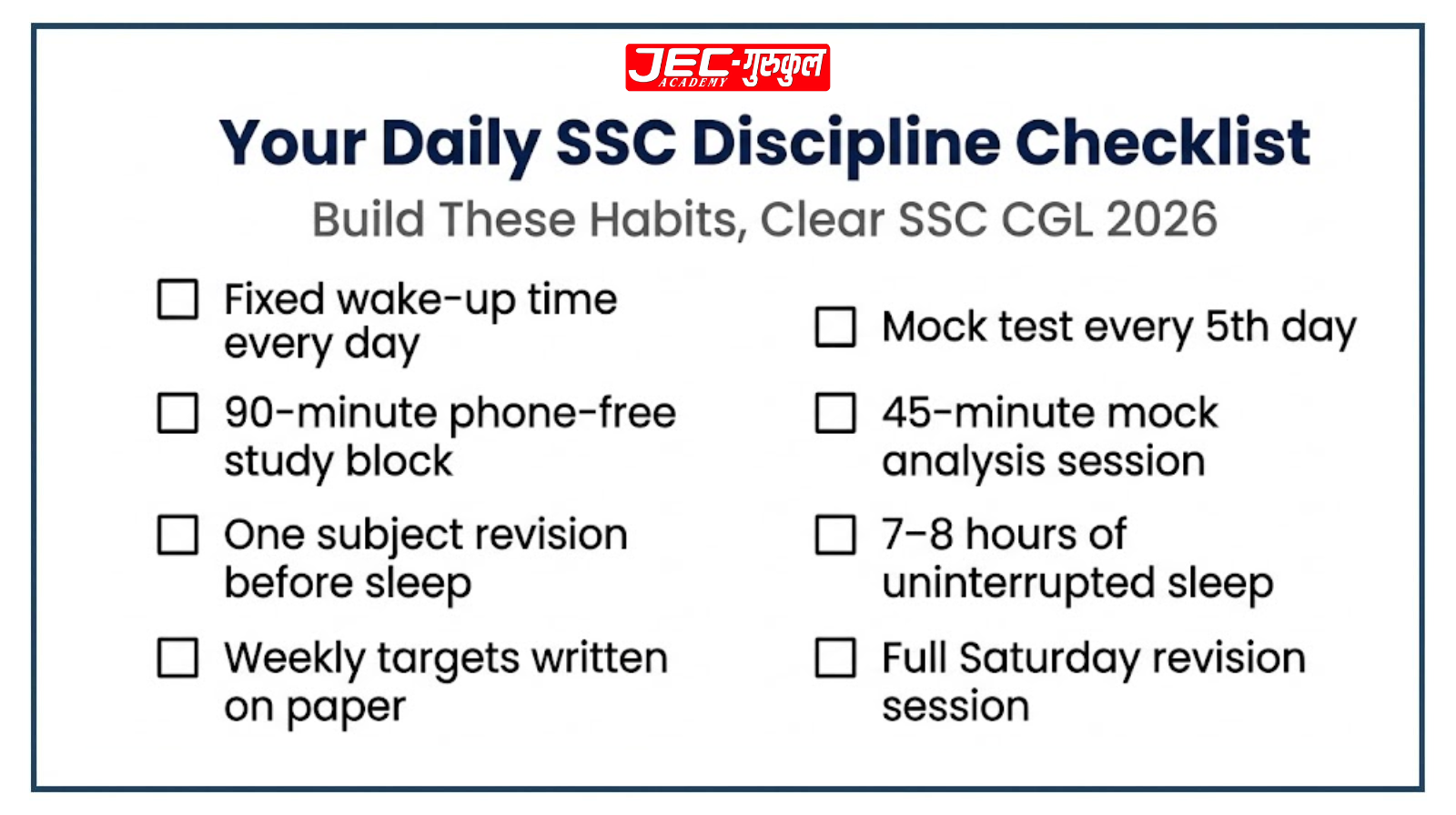
Fix Your Wake-Up Time First
Do not try to build a 10-subject schedule if your sleep is a mess. Establish one non-negotiable wake-up time — 5:30 AM or 6:00 AM. Do nothing else but maintain this for 14 straight days. Your wake-up time is the anchor your entire discipline hangs from.
Set Weekly Targets, Not Just Daily Goals
"Study Maths" is a wish, not a goal. Use this instead: "Complete 40 Ratio questions and revise Percentage formulas by Friday." Write five weekly goals on paper every Sunday night and physically check them off. This creates real accountability that no app can match.
Treat Mock Tests Like the Real Exam
Mocks are not for when you are "ready" — they are what make you ready. Take a full-length mock every 5th day. Put your phone in another room, set a timer, and sit in a chair exactly like exam day. Then spend at least 45 minutes analysing your mistakes. The analysis is where the actual learning happens.
Build One Phone-Free Study Block Daily
You need at least 90 minutes of deep work on your weakest subject every single day. No notifications, no music — just you and the paper. This one block will give you more output than five hours of distracted studying.
Make Revision Non-Negotiable
Every Saturday is for re-reading the week's notes. Review Maths formulas monthly and English grammar rules every two weeks. If you are not revising, you are not preparing — you are just browsing.
Sample Daily Timetable for SSC Aspirants
| Time | Activity |
| 5:30 AM | Wake up and 10-minute walk |
| 6:00 – 8:00 AM | Quantitative Aptitude — Phone-free block |
| 8:30 – 10:30 AM | English Language and Comprehension |
| 10:30 – 11:30 AM | Current Affairs and Static GK |
| 11:30 AM – 1:30 PM | Reasoning Ability |
| 2:30 – 4:30 PM | Weak Subject Practice or Previous Year Papers |
| 5:00 – 7:00 PM | Mock Test every 5th day or Deep Practice |
| 7:00 – 8:30 PM | Mock Analysis and General Awareness |
| 9:30 – 10:00 PM | Light Revision of the day's notes |
| 10:30 PM | Lights out — 7 to 8 hours sleep |
How to Recover When Your Discipline Breaks Down
Every aspirant goes through a phase where the routine collapses — illness, a family event, or simply a week where nothing clicked. This is normal. What separates toppers from those who quit is what they do the morning after.
Do not try to study 14 hours to compensate. That leads to more burnout within 48 hours. Instead, restart with one simple subject to regain momentum, reschedule your most important weekly targets, and build back up gradually. The goal is to restart the engine — not erase lost time in one frantic session.
For structured guidance, expert faculty, and a disciplined study environment, explore the best ssc coaching in jaipur at JEC Academy.
Discipline Is the Real Exam
SSC CGL 2026 will not ask how motivated you were in January. It will only reward how consistently you practiced when others gave up. Stop waiting for the perfect day and start with one habit today — kal se nahi, aaj se.
If you protect your study hours and take your mocks seriously for the next 90 days, the SSC exam preparation discipline will turn cracking this exam from a dream into a reality.


























Sign in to leave a comment.