
How to Crack SSC CGL 2026: Step-by-Step Preparation Strategy for Freshers and Repeaters
The window of opportunity is open. SSC CGL 2026 Tier-1 is anticipated to take place between June and July 2026. This gives you about 3-4 months for Tier-1 and 6-7 months for Tier-2. That is enough time to get it right, but only if you stop preparing randomly and start following a concrete plan. Whether you are taking the SSC CGL for the first time or are a repeater determined to rectify last year's mistakes, this guide provides an objective, real-world roadmap designed around how toppers actually prepare.
SSC CGL 2026 Exam Pattern at a Glance
Before formulating your strategy, you must understand the exact details of what you are preparing for. Know the numbers, not just the titles.
Tier-1 (Expected: June-July 2026)
- 100 questions, 200 marks, 60 minutes total (+2 marks for each correct answer).
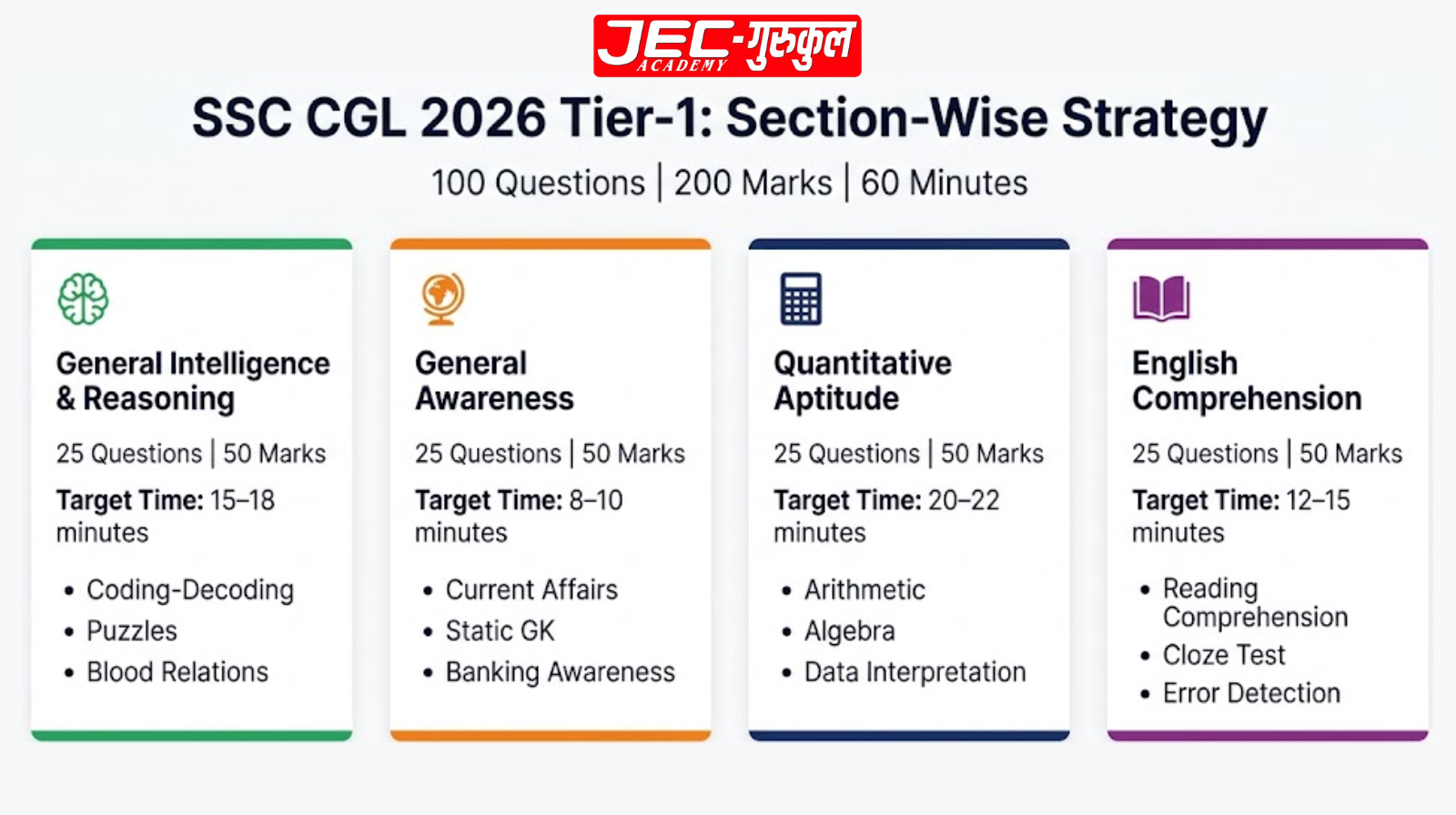
- Four segments: General Intelligence and Reasoning, General Awareness, Quantitative Aptitude, and English Comprehension—25 questions per section.
- Negative marking of 0.50 for each incorrect answer.
Tier-2 (Expected: September-October 2026)
- Paper 1 (Compulsory for all posts): Mathematical Abilities + General Intelligence and Reasoning + English Language + General Awareness + Computer Knowledge. Total 390 marks (excluding qualifying computer/typing tests). Time: 2 hours and 15 minutes.
- Paper 2 (JSO posts only): Statistics—100 questions, 200 marks, 2 hours.
- Paper 3 (AAO posts only): General Studies (Finance and Economics)—100 questions, 200 marks, 2 hours.
- Negative marking: 1 mark for each incorrect answer in Paper 1, and 0.50 marks in Papers 2 and 3.
The fundamental difference between the two tiers defines your strategy. Tier-1 is a speed-based exam (allowing around 36 seconds per question), while Tier-2 is a depth-based exam where conceptual clarity and accuracy determine your final score. Your preparation method for each must be completely different.
Tier-1 Preparation Strategy: Speed, Accuracy, and Section Priority
With 60 minutes to complete 100 questions, the goal is not to tackle all of them. The objective is to correctly answer 85-90 questions with high precision. Here is how to break it down section by section:
- General Awareness: This is the most time-efficient section. An experienced aspirant can complete it in 8-10 minutes. Concentrate on the last six months of current affairs and static GK covering polity, history, geography, and science fundamentals. Spend 30 minutes each day on a GK capsule. There are no shortcuts or substitutes here.
- Reasoning: This section builds your momentum. Topics like series, analogy, classification, coding-decoding, blood relations, and puzzles form the core. They are highly logical and can be mastered through practice. Aim for 100% accuracy. These questions require diligence, not just intelligence.
- English Comprehension: This is where consistency pays off. Prioritize reading comprehension, error spotting, fill-in-the-blanks, and vocabulary. Students who study English daily for three months consistently score between 22 and 24 out of 25.
- Quantitative Aptitude: This is the longest and most demanding section. Do not attempt to master every single topic. Focus heavily on ratio and proportion, percentages, simple and compound interest, profit and loss, time and work, geometry, and trigonometry. These core subjects cover 70-75% of the syllabus every single year.
Subject-Wise Important Topics for Tier-1
| Subject | High-Priority Topics | Target Score |
| Quantitative Aptitude | Ratio, Percentage, Geometry, Trigonometry, SI/CI, Profit & Loss | 16-18 out of 25 |
| General Awareness | Current Affairs, Polity, History, Geography, Science | 20-22 out of 25 |
| English Comprehension | RC, Error Spotting, Vocabulary, Fill in the Blanks | 21-23 out of 25 |
| Reasoning | Series, Coding-Decoding, Blood Relations, Analogy, Puzzles | 23-25 out of 25 |
Export to Sheets
Tier-2 Preparation Strategy: Depth Over Speed
Many aspirants make a fatal error: they wait for their Tier-1 results before starting their Tier-2 preparation. By then, they are left with only four weeks to cover four to five months' worth of syllabus. Begin your Tier-2 preparation alongside Tier-1 from month 3 onwards.
- For Paper 1 (Compulsory): The negative marking increases to 1 full mark for each incorrect answer. Attempt only the questions you are absolutely confident in. In Math, prioritize data interpretation, algebra, and mensuration. For English, concentrate deeply on grammar, para jumbles, and sentence improvement.
- For JSO Posts: Start with Statistics—Mean, Median, Mode, Index Numbers, Regression, and Time Series—no later than month 4. Leaving this for the final month is a guaranteed way to underperform.
- For AAO Posts: Finance and economics require structured note-taking. Study NCERT Economics (Classes 11-12) and develop a solid foundation in accounting before moving to advanced topics.
Sample 4-Week Study Schedule
| Week | Morning Block (2 hrs) | Afternoon Block (2 hrs) | Evening Block (2 hrs) |
| Week 1 | Quantitative Aptitude — fundamentals & formulas | Reasoning — topic-wise practice sets | GK capsule + English vocabulary building |
| Week 2 | Quant — advanced topics with timed practice | English — comprehension & grammar sets | Reasoning — full topic revision & speed drills |
| Week 3 | Full-length mock test (Sunday) | Error log review & weak topic revision | GK — current affairs + static revision |
| Week 4 | Subject-wise mini tests on all 4 sections | Error log review — second round | Current Affairs consolidation + strategy adjustment |
Export to Sheets
Preparation Mistakes That Cost Aspirants the Selection
Data consistently shows that the majority of candidates fail the SSC CGL not due to a lack of competence, but due to a lack of strategic awareness.
- Avoiding Mock Tests: If you are not taking a full-length mock test every week starting from month 2, you are just reading, not preparing. Mock tests expose your true speed and accuracy gaps.
- Skipping the Error Log: Every incorrect answer in a mock test must be recorded. Note the question, the subject, and the exact reason for the error. Without an error log, you will repeat the same mistakes for months.
- Uneven Subject Focus: Many aspirants spend 80% of their time on Quant and completely ignore GK. They fail by 3-4 marks, while toppers consistently secure 20-22 marks in GK.
- Inconsistent Daily Routines: Studying for 10 hours one day and only two hours the next destroys retention and speed. A consistent 6 hours of daily focus beats irregular marathon sessions every time.
- Starting Tier-2 Too Late: Tier-2 is vastly more extensive than Tier-1. Waiting for Tier-1 results to begin studying is the primary reason repeaters remain repeaters.
Topper Habits That Separate Selections from Near-Misses
Candidates who clear the SSC CGL share a set of non-negotiable daily habits. They aren't doing anything extraordinary; they are just remarkably consistent.
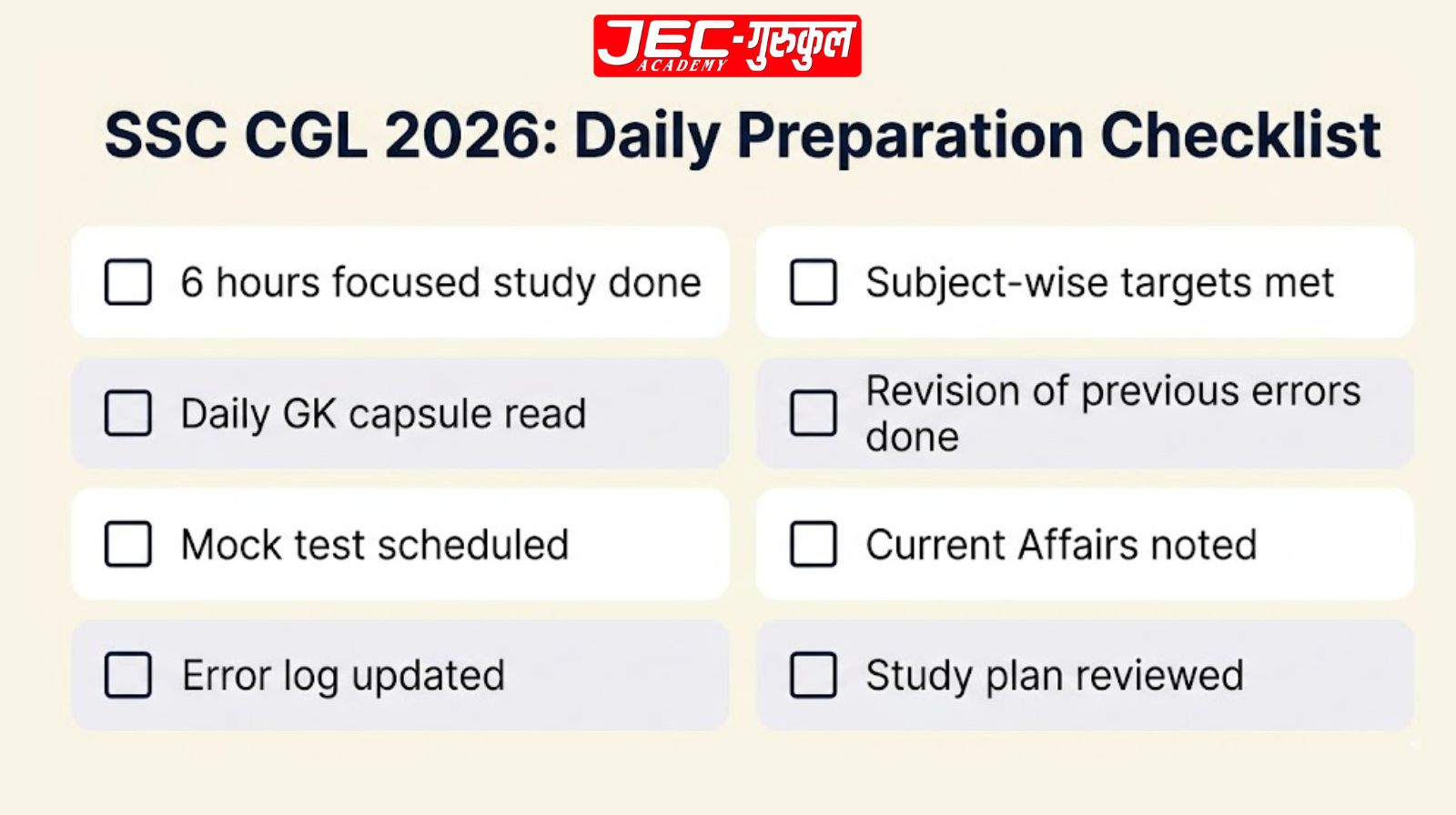
- Six hours of focused study daily: Distraction-free blocks of 60 minutes, with brief breaks in between.
- One full-length mock test weekly: Followed by a rigorous two-hour review the next day.
- A daily-updated Error Log: A simple physical notebook or Google Sheet works perfectly.
- Highly specific daily goals: Not just "I will study Quant today," but rather, "I will solve 30 percentage problems while maintaining 85% accuracy."
- 30 minutes of GK reading every morning before touching any other subject.
To get a proven, tested roadmap, explore the comprehensive SSC CGL 2026 preparation methodology developed by JEC Academy.
Your SSC CGL 2026 Selection Starts Today
The candidates who crack SSC CGL in 2026 are not inherently smarter than you. They are simply more focused, more consistent, and more transparent with themselves about their weaknesses. You have the exam structure, the section-wise plan, the weekly schedule, and the habits of toppers. The only thing left to do is to start—and start today, not when the official notification drops.
SSC CGL 2026 is more than just a test. For thousands of candidates across India, it is an opportunity to secure a career, a livelihood, and a family's dream. Treat it with the seriousness it deserves, adhere to a proven approach, and make this year your year of selection.





























Sign in to leave a comment.