
Acne is one of the most common skin concerns, but the marks left behind after a breakout can sometimes be confusing.
Many people use the terms “acne marks” and “acne scars” interchangeably, but they are not the same thing. Understanding the difference is important because they may require different approaches to improve their appearance.
At Dr. Aggarwal’s Clinic, Jodhpur, skin concerns are evaluated individually so that treatment can be planned according to the type and severity of the concern.
What Are Acne Marks?
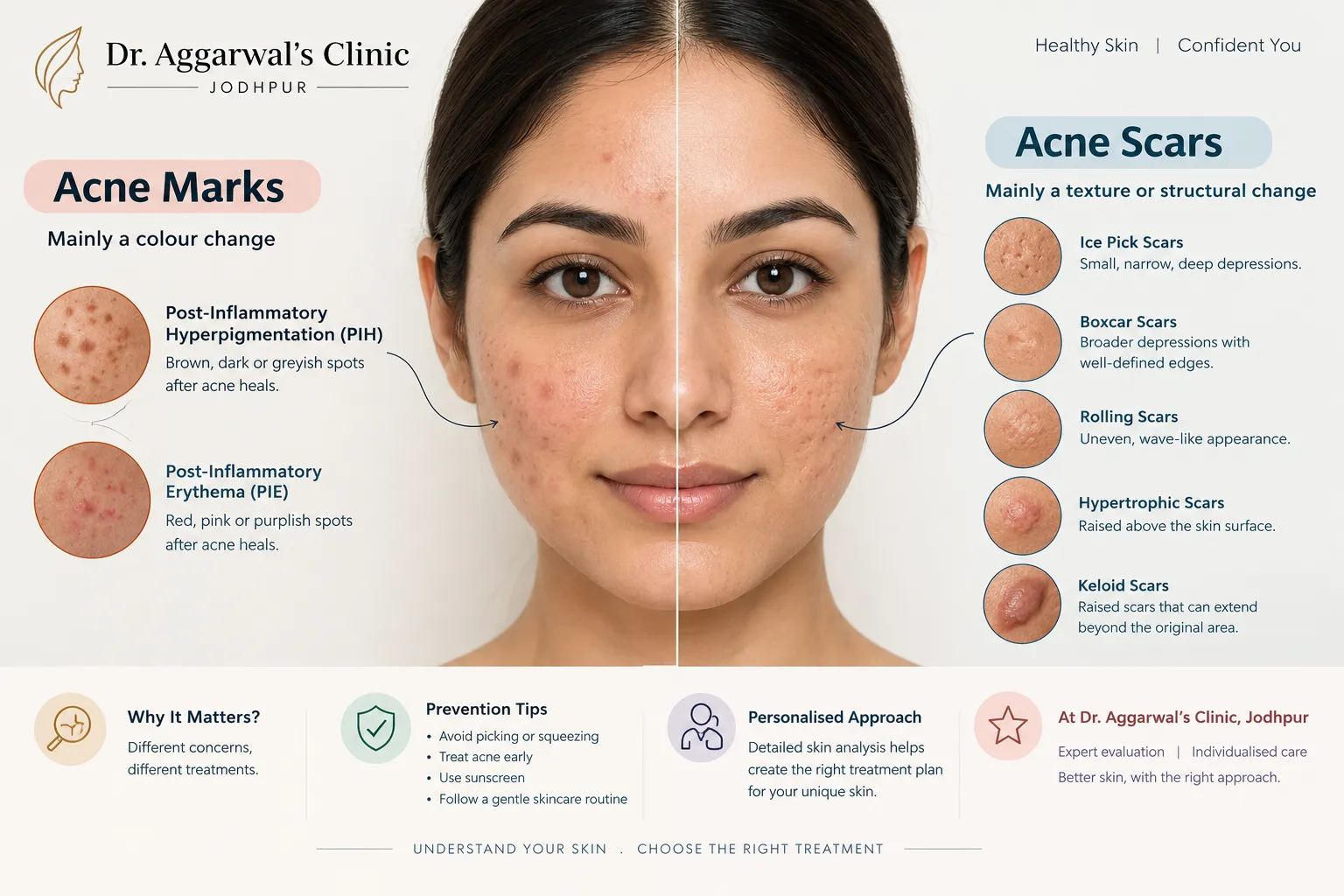
Acne marks are usually areas of discoloration left behind after an acne lesion heals.
They occur when inflammation from acne affects the skin’s pigmentation. Unlike true acne scars, acne marks generally do not involve a permanent change in the texture or structure of the skin.
Common types include:
1. Post-Inflammatory Hyperpigmentation (PIH)
These are brown, dark or greyish spots that may appear after acne heals.
PIH is more commonly noticeable in medium to deeper skin tones and can become more prominent with sun exposure.
2. Post-Inflammatory Erythema (PIE)
These appear as red, pink or purplish spots after acne has healed.
They are related to changes in the small blood vessels and inflammation in the skin.
What Are Acne Scars?
Acne scars are different because they involve a change in the skin's texture or underlying structure following acne inflammation.
They can develop when deeper inflammation damages collagen and other supporting structures of the skin.
Acne scars are commonly classified into different types.
1. Ice Pick Scars
These are small, narrow and deep depressions that extend into the skin.
2. Boxcar Scars
These are broader depressions with well-defined edges. They can be shallow or deeper.
3. Rolling Scars
Rolling scars create an uneven, wave-like appearance on the skin because of changes in the tissue underneath.
4. Hypertrophic Acne Scars
Unlike depressed scars, hypertrophic scars are raised above the skin surface due to excess collagen formation.
5. Keloid Acne Scars
Keloids are raised scars that can extend beyond the original area of injury or acne inflammation.
Because different scar types affect the skin differently, their treatment approach may also vary.
Acne Marks vs. Acne Scars: Key Difference
The easiest way to understand the difference is:
Acne Marks = Mainly a colour change
Acne Scars = Mainly a texture or structural change
For example, if you have a flat brown or red spot left after a pimple, it may be an acne mark.
If the skin has a visible depression, indentation or raised area, it may be an acne scar.
However, not every spot or uneven area can be accurately classified just by looking at it yourself. A professional skin assessment can help determine what type of concern is present.
Why Does the Difference Matter?
Because the treatment approach may be different.
For pigmentation or acne marks, treatment may focus on factors such as:
- Controlling active acne
- Managing pigmentation
- Supporting skin renewal
- Sun protection
- Improving overall skin health
For acne scars, treatment may focus more on skin texture and collagen remodelling.
Depending on the individual case, a dermatologist or qualified aesthetic professional may consider options such as:
- Microneedling-based treatments
- Fractional treatments
- Radiofrequency-based procedures
- Chemical peels
- Laser-based procedures
- Subcision for selected depressed scars
- Combination treatment approaches
The appropriate treatment depends on the scar type, depth, skin characteristics and presence of active acne.
Can Acne Marks and Scars Be Prevented?
Preventing acne itself and treating it early can reduce the risk of long-term marks and scars.
Some important steps include:
- Avoiding frequent picking or squeezing of pimples
- Treating active acne appropriately
- Using sunscreen regularly
- Following a suitable skincare routine
- Avoiding harsh or irritating products
- Seeking professional advice when acne is persistent or severe
Picking or squeezing inflammatory acne can increase tissue damage and may increase the likelihood of persistent marks or scarring.
Why Skin Analysis Matters
One of the most important steps before choosing a treatment is identifying what you are actually treating.
Two people may both say they have “acne marks,” but one may have pigmentation while another may have depressed acne scars.
Similarly, a person may have a combination of:
- Active acne
- Pigmentation
- Red post-acne marks
- Multiple types of acne scars
- Uneven skin texture
That is why a detailed skin assessment can help create a more personalised treatment plan.
Acne Scars and Marks May Need Different Approaches
There is no single treatment that works for every type of acne-related skin concern.
The right approach depends on factors such as:
- Type of acne concern
- Depth and severity
- Skin type
- Skin tone
- Active acne
- Previous treatments
- Individual expectations
In some cases, a combination approach may be considered rather than relying on one procedure alone.
Acne Scars vs. Acne Marks: Quick Comparison
| Feature | Acne Marks | Acne Scars |
|---|---|---|
| Main concern | Change in skin colour | Change in skin texture/structure |
| Common appearance | Red, pink, brown or dark spots | Depressed or raised areas |
| Skin texture | Usually flat | Usually uneven |
| Examples | PIH, PIE | Ice Pick, Boxcar, Rolling, Hypertrophic, Keloid |
| Treatment approach | Often focused on pigmentation/inflammation | Often focused on texture and collagen remodelling |
| Assessment | Skin assessment is helpful | Scar-type assessment is important |
Acne Scars Treatment at Dr. Aggarwal’s Clinic, Jodhpur
At Dr. Aggarwal’s Clinic, Jodhpur, acne-related concerns are approached with an emphasis on detailed skin analysis and personalised treatment planning.
The first step is to understand whether you are dealing with pigmentation, post-acne redness, textural changes, active acne, acne scars, or a combination of concerns.
Based on the assessment, an appropriate treatment plan can be discussed according to your skin characteristics, scar type, concerns and expectations.
The goal is not simply to treat what is visible on the surface, but to understand the underlying skin concern and choose an appropriate approach.
Final Takeaway
Acne marks and acne scars are not the same.
Marks are generally related to changes in skin colour, while scars involve changes in skin texture or structure.
If you are unsure whether you have acne marks, acne scars, or both, a professional skin assessment can help identify the concern and guide the next steps.
Understand your skin before choosing your treatment.
At Dr. Aggarwal’s Clinic, Jodhpur, personalised skin assessment is an important part of developing an appropriate acne and acne-scar treatment plan.


















Sign in to leave a comment.