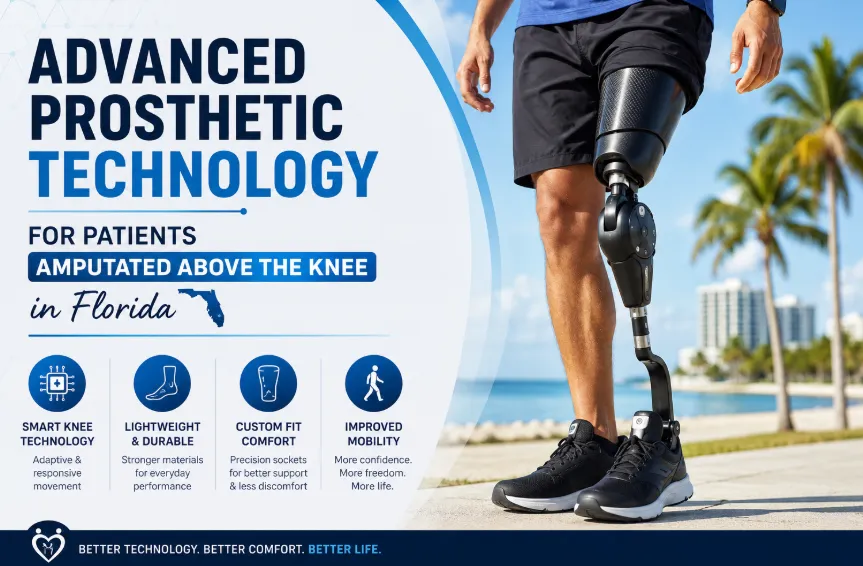

I still remember sitting in a quiet clinical consultation room in Tampa years ago, listening to a patient talk about missing the simple feeling of walking along the Gulf shore. He had been amputated above the knee following a sudden motorcycle crash on Interstate 4, and his life had completely flipped upside down. He told me that losing his knee felt like losing his compass because every curb, every stair, and every patch of grass suddenly felt like a massive hazard. The raw vulnerability in his eyes stayed with me for a long time, and honestly, it is the exact reason I care so deeply about this field.
When you are amputated above the knee, you lose the natural hinge that gives your leg its rhythm, balance, and trust. It is not just about replacing missing bone and muscle, because you are trying to recreate a complex biomechanical miracle that most people take for granted every single second. Sitting in a physical therapy clinic watching someone take their very first hesitant steps on a new leg brings a wave of mixed emotions. There is grief for what was lost, absolute fear of falling, and a tiny flicker of hope that life might start looking normal again.
Here in Florida, that journey comes with its own very distinct set of challenges and triumphs. Between the scorching humidity, relentless sand, uneven coastal terrain, and complex healthcare systems, getting fitted for a leg is a real journey. Technology has moved forward by leaps and bounds over the past few years, but technology alone does not solve every problem. You need the right setup, the right fit, and an advocate who understands what happens when human skin meets high-tech hardware under a blazing Florida sun.
The Brutal Reality of Losing a Joint: Why Above-the-Knee is Different
If you or someone you love was recently amputated above the knee, you have probably already noticed that lower-limb prosthetics are talked about in two very different categories. Below-the-knee amputations retain the natural knee joint, which means the body still knows where the leg is in space and can control the lower leg naturally. But when you are amputated above the knee, you lose that built-in brake, that biological shock absorber, and the natural feedback loop that keeps you upright.
In my experience, the sheer amount of energy it takes to walk with an above-knee leg is what catches people off guard the most. Your hip muscles have to work double time to swing the artificial limb forward, stabilize your pelvis, and keep you from pitching sideways. Early on, new amputees get exhausted just walking across a living room. That is completely normal, though nobody really warns you about how draining those first six months are going to be.
That’s usually where problems start, right at the intersection of exhaustion and frustration. People expect to put on a leg and walk out the door like nothing happened. But without a functioning biological knee, your brain has to learn how to trust a mechanical or computerized device to catch you every time your foot strikes the ground. If that trust is not there, you start walking with a limp, throwing your hip out, or staring down at the floor in constant fear of tripping.
Breaking Down the Tech: What Actually Works Today
The world of prosthetics moves fast, and marketing materials love to make every new device sound like sci-fi magic. But let's look at what is actually happening in clinics across Florida today and what components make a real difference in daily life.
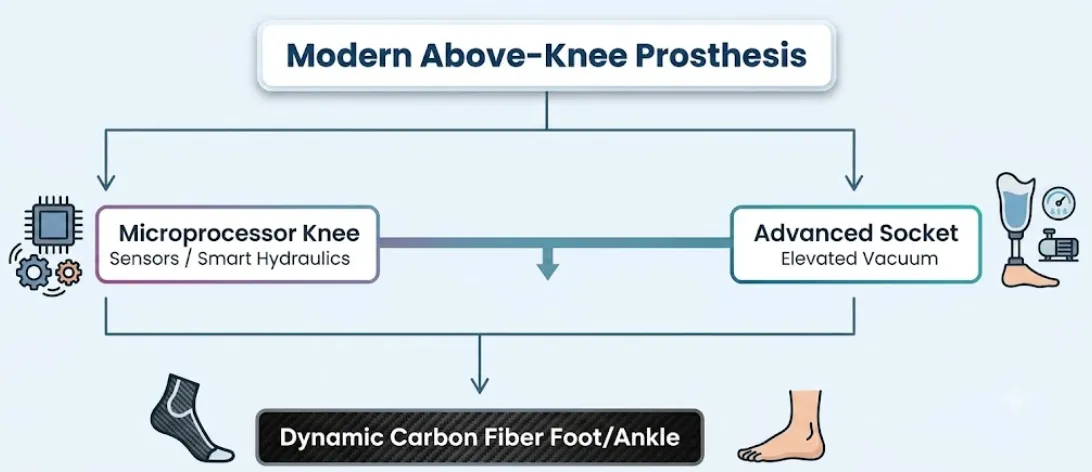
Microprocessor Knees (MPKs): The Computer in Your Leg
For decades, mechanical knees relied on basic friction, weight-activated locks, or simple hydraulic fluid loops. They worked, but they were rigid. If you stepped on a small pebble or hit a sudden dip in the pavement, the knee would buckle, and down you went.
Today, microprocessor-controlled knees have completely transformed safety for patients amputated above the knee. These devices feature embedded microchips, gyroscopes, and accelerometers that sample movement data hundreds of times every second.
- Stumble Recovery: If your toe catches the edge of a sidewalk crack, the knee senses the sudden acceleration and instantly stiffens its hydraulic resistance so you can catch yourself on your other leg. Honestly, stumble recovery alone has saved more emergency room visits than almost any other advancement in orthotic history.
- Variable Gait Speed: Older knees forced you to walk at one fixed pace. Modern MPKs automatically adjust fluid resistance as you speed up or slow down, giving you a smooth, natural stride whether you are rushing through an airport or strolling through a park.
- Intuitive Stance: Modern computerized knees recognize when you are standing still, locking stability into place so you do not have to constantly exert effort to keep your leg straight while waiting in line at the grocery store.
I've seen this happen a lot: patients who were terrified to walk without a walker suddenly regain the confidence to hold their spouse's hand while walking around Orlando theme parks, all because the microprocessor knee gave them back their sense of stability.
Modern Sockets and Vacuum Systems: Ending the "Sweat Slide"
You can buy the most expensive, ultra-high-tech computer knee on the market, but if your socket fits poorly, that high-tech limb will end up sitting in your closet gathering dust. The socket is the custom-molded shell that fits directly over your residual limb. It is the bridge between your skeleton and the prosthesis artificial limb.
In the old days, hard plastic sockets sat over heavy wool socks. Today, we use lightweight carbon fiber, flexible inner liners made of medical-grade silicone or mineral-oil gel, and active vacuum suspension systems.
Elevated vacuum systems actively draw air out of the socket using a tiny mechanical or electric pump as you walk. This creates a secure pull that holds the prosthesis firmly against your skin. It eliminates pistoning, which is that vertical slipping movement that causes painful skin friction, blisters, and deep tissue sores.
The Florida Factor: Heat, Saltwater, Humidity, and Sand
Living in Florida with an above-knee leg presents unique conditions that textbooks printed in northern states almost never discuss. If you live in Jacksonville, Miami, Pensacola, or anywhere in between, weather plays a massive role in your day-to-day comfort.
The Sweat Problem and Limb Volume Changes
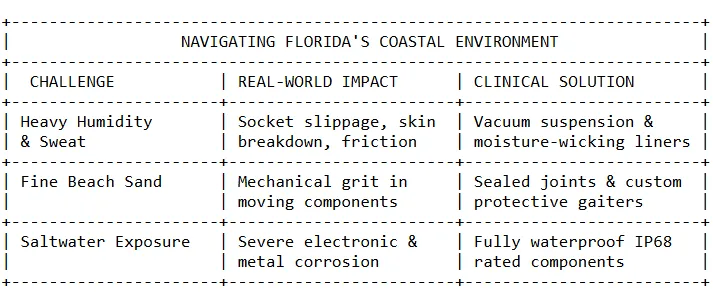
Florida heat means sweat, and sweat inside a prosthetic socket is an absolute nightmare. When moisture builds up between your skin and your silicone liner, suspension breaks down. The liner starts sliding off, friction goes through the roof, and your skin breaks down fast.
Most amputees don't realize this initially, but your residual limb changes size constantly throughout the day. In high temperatures, your body tries to cool itself down by expanding blood vessels, causing your limb to swell. Then, after an hour of walking and sweating, fluid leaves the limb, causing it to shrink dramatically.
Pro Tip from Experience: Always carry an emergency kit in your car or bag. Keep extra prosthetic socks of varying ply, a travel towel, skin sealant wipes, and a small hand pump if your suspension uses one. Being stuck at a Jacksonville outdoor market with a spinning socket because of sweat build-up is a situation you only want to experience once.
Saltwater, Sand, and High-Tech Electronics
Florida means beaches, boats, and humidity. But electronics, saltwater, and fine quartz sand are natural enemies.
Standard microprocessor knees contain delicate sensors, circuit boards, and battery terminals. If sand gets inside the hydraulic chamber or saltwater corrodes the charging port, you are looking at thousands of dollars in repairs. And trust me, that gets expensive fast.
Fortunately, modern engineering has stepped up. Fully waterproof microprocessor knees, like the Ottobock Genium X4 or specialized IP68-rated waterproof systems, allow users to submerge their leg entirely in fresh, salt, or chlorinated pool water. If you live near the coast or love fishing, insist on discussing water resistance ratings with your prosthetist right from the start.
The Invisible Struggle: Phantom Pain and Socket Adjustments
We cannot talk about above-knee amputation without addressing what happens when the limb is taken off at night. Phantom limb pain is intensely real, deeply uncomfortable, and often misunderstood by well-meaning family members.
Your brain spent decades sending signals down nerves to your lower leg and ankle. When those nerves are severed during surgery, the cut nerve endings inside your residual limb can form sensitive bundles called neuromas. Your brain sends a signal down, gets no response, and interprets that silence as intense burning, cramping, or electric shocks in a foot that is no longer physically there.
Modern Solutions That Help
- Targeted Muscle Reinnervation (TMR): Surgeons reroute severed nerves into surrounding healthy thigh muscle during or after amputation. This gives the nerves somewhere useful to go and dramatic reductions in phantom pain have been documented.
- Osseointegration: For patients who simply cannot tolerate a traditional socket due to short residual limbs, severe scarring, or constant skin breakdown, osseointegration offers a remarkable alternative. A titanium implant is anchored directly into the thigh bone (femur). The prosthesis artificial limb snaps directly onto an attachment post protruding through the skin, eliminating socket rub completely.
- Mirror Therapy & Virtual Reality: Training your visual cortex to see a functional leg helps calm the hyperactive pain signals firing inside the brain.
In my experience, dealing with phantom pain requires patience and a multi-pronged approach. Never suffer in silence thinking it is all in your head, because it is a direct anatomical response that can be managed with the right medical team.
Navigating Insurance and Healthcare Coverage in Florida
Now let's talk about the administrative battle, because getting approval for modern prosthetics can feel like a full-time job. Whether you have commercial insurance, Medicare, or coverage through the VA, insurance companies do not like paying for top-tier microprocessor knees or custom carbon vacuum sockets without a fight.
Insurance adjusters classify lower-limb amputees using functional mobility levels called K-Levels (K0 through K4):
- K0: Patient does not have the ability or potential to ambulate or transfer safely.
- K1: Limited household ambulator (can transfer and walk on flat surfaces at a fixed speed).
- K2: Limited community ambulator (can handle low environmental barriers like curbs or single steps).
- K3: Community ambulator who can navigate most environmental barriers and variable walking speeds.
- K4: High-impact athlete, active child, or adult with strenuous demands.
Here is the kicker: Most insurance plans will only cover a microprocessor-controlled knee if you are documented as a K3 ambulator or higher.
If your medical records make you look like a K2 walker who stays in the house, the insurance system will automatically deny coverage for advanced knees and stick you with a basic mechanical knee.
That is why documentation is everything. You need your prosthetist, physical therapist, and physician working in unison. Your medical charts must show that you have the motivation, cardiovascular health, and life goals to walk outdoors, cross busy Florida streets, navigate ramps, and stay active.
Real Advice for the First Year After Amputation
If you are currently sitting in a rehab facility or recovering at home after an above-knee amputation, here is the unfiltered advice I give to my own family members:
- Do Not Rush the Final Leg: Your limb is going to shrink and change shape drastically over the first 6 to 12 months as swelling resolves and muscle tissue reconfigures. You will start with a temporary (prep) prosthesis. Embrace it. Use that period to build hip strength, master balance, and let your limb mature.
- Focus Heavily on Hip Flexor Stretching: When you sit in a wheelchair or bed all day, your hip flexors shorten up tight. If your hip flexors freeze up, standing straight on a prosthetic leg becomes physically impossible. Lie flat on your stomach for 20 to 30 minutes every day to stretch out the front of your hip.
- Find a Clinic with an On-Site Lab: Having a prosthetist who fabricates, modifies, and aligns sockets in their own local Florida facility makes a massive difference. If every adjustment requires shipping your socket to an out-of-state factory, you will spend weeks stuck in bed waiting for minor fixes.
- Connect with Other Amputees: No doctor or therapist, no matter how skilled, truly understands what it feels like to lose a leg. Join a local peer support group through the Amputee Coalition or regional Florida medical networks. Talking with someone who has been walking on an artificial leg for five years will teach you practical tricks no manual ever covers.
Frequently Asked Questions
How long does a prosthesis artificial limb typically last?
A custom prosthetic socket usually lasts 2 to 4 years depending on limb volume changes, while the structural components like microprocessor knees and carbon feet typically last around 3 to 5 years before requiring refurbishing or replacement.
Is an above-knee prosthesis comfortable to wear all day?
When properly fitted with modern flexible liners and vacuum suspension, it should be comfortable enough for full-day wear. If you experience sharp pain, skin rubbing, or severe bruising, your socket needs adjustment right away.
Can I drive a car if I am amputated above the knee?
Yes, many amputees drive safely. If your right leg was amputated, you will need a licensed installer to add a left-foot accelerator pedal to your vehicle, or install hand controls.
How do I stop my leg from sliding off when I sweat in Florida?
Using high-performance moisture-wicking liners, antiperspirants specifically formulated for prosthetic use, and active suction or vacuum suspension systems prevents movement caused by sweat.
What is the weight difference between a real leg and a prosthesis artificial limb?
An artificial leg actually weighs significantly less than a biological leg. However, because it attaches externally to the outside of your thigh rather than through native bone and muscle, it can initially feel heavier.
How long does it take to learn to walk after an above-knee amputation?
Most individuals spend 3 to 6 months in structured physical therapy learning balance, weight transfer, and gait mechanics, with full confidence taking about a year.
Can I swim with an above-knee prosthetic leg?
Only if your components are specifically rated IP68 waterproof. Standard prosthetic limbs contain steel hardware and microchips that rust or short circuit in water.
Does Medicare cover advanced microprocessor knees in Florida?
Medicare covers microprocessor knees for patients who meet K3 functional mobility criteria and have documented physical stability and cardiovascular capability.
What should I do if my residual limb shrinks and the socket feels loose?
Add prosthetic socks over your silicone liner to fill the extra space. If you are wearing more than 6 to 8 ply of socks, contact your prosthetist to cast you for a smaller socket.
What is osseointegration and is it available in Florida?
Osseointegration is a surgical procedure where a titanium rod is implanted directly into your femur bone, bypassing the need for a traditional socket. It is performed by specialized orthopedic surgical teams across select Florida medical centers.
Recommended Resources and Support Networks
- Amputee Coalition: The leading national non-profit offering peer support network matching, educational limb loss resources, and advocacy for amputees.
- Florida Division of Vocational Rehabilitation (VR): A state agency that helps individuals with physical disabilities get adaptive equipment, training, and prosthetics required to re-enter or remain in the workforce.
- VA Sunshine Healthcare Network (VISN 8): Excellent specialized prosthetic care, rehab services, and gait training programs for Florida veterans suffering from limb loss.
- Local Clinical Gait Centers: Seek out specialized prosthetic clinics throughout Tampa, Orlando, Fort Myers, and Miami that offer on-site fabrication labs and dedicated physical therapy facilities.
Taking the Next Step Toward Independence
Losing a leg above the knee is one of the toughest challenges a person can face. There are days when the physical strain, the slow progress in therapy, and the paperwork battles feel overwhelming. It is okay to feel angry or exhausted by it all.
But please remember that your life is not defined by what was taken away. With modern microprocessor technology, advanced socket designs, and a dedicated clinical team advocating for you, walking again with comfort, stability, and genuine confidence is entirely achievable.
Take it one day at a time, celebrate the small victories like standing up smoothly or taking ten clean steps without holding a bar, and never settle for a leg that causes you pain. Reach out to a qualified prosthetist in your area today, set up a comprehensive evaluation, and start building the path toward reclaiming your movement and your life.
























Sign in to leave a comment.