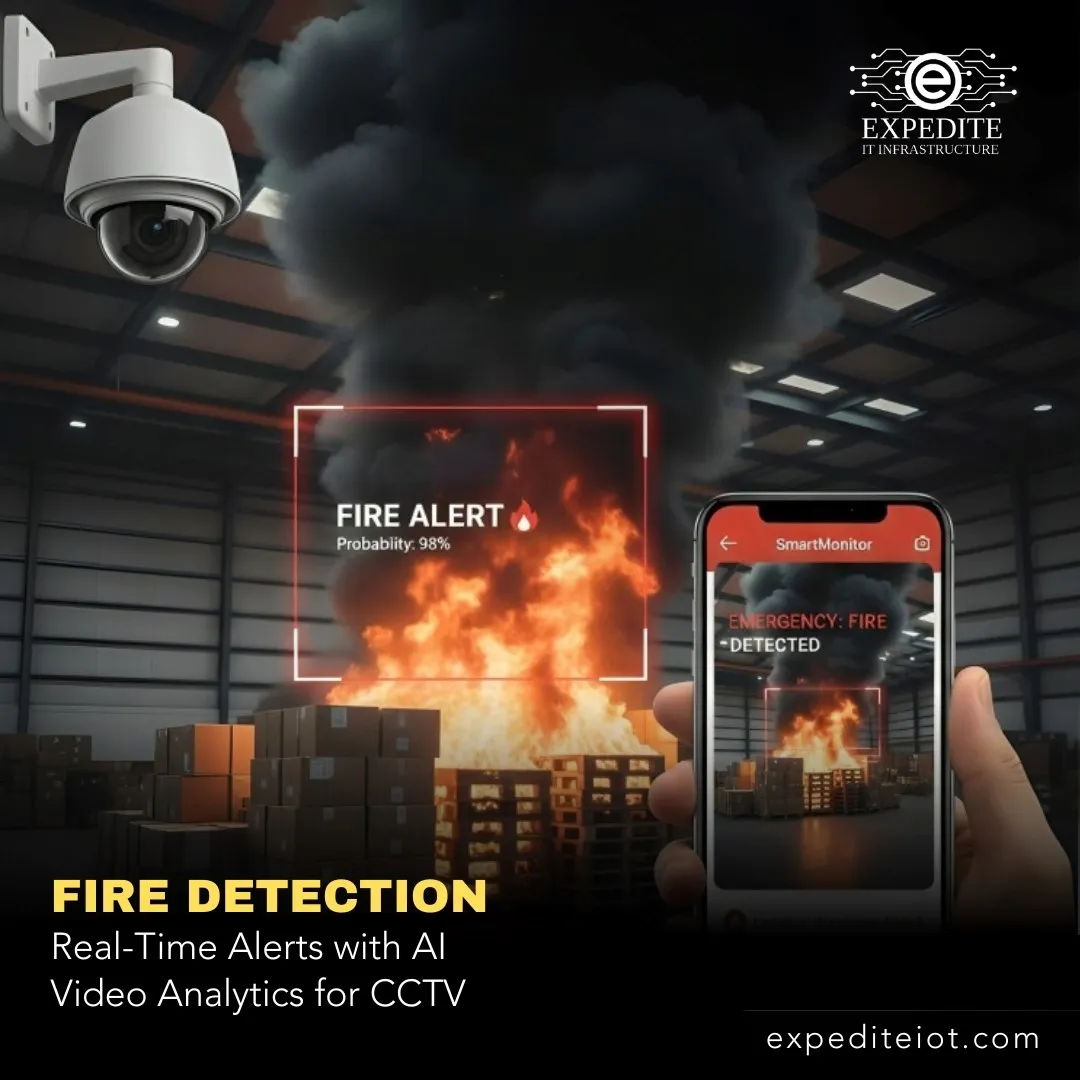

Kuwait's industrial sector — the oil refineries of Mina Al-Ahmadi and Mina Abdullah, the petrochemical facilities of Shuaiba Industrial Area, the LNG terminals of Kuwait Oil Company, and the rapidly expanding manufacturing zones of Sabhan and Rai — handles flammable hydrocarbons, pressurised gases, and chemical inventories at a scale where a single undetected fire ignition can escalate from a small flame to a catastrophic facility-threatening event in minutes. Conventional smoke detectors and heat sensors respond only after combustion products have accumulated — minutes too late for the early intervention that prevents escalation.
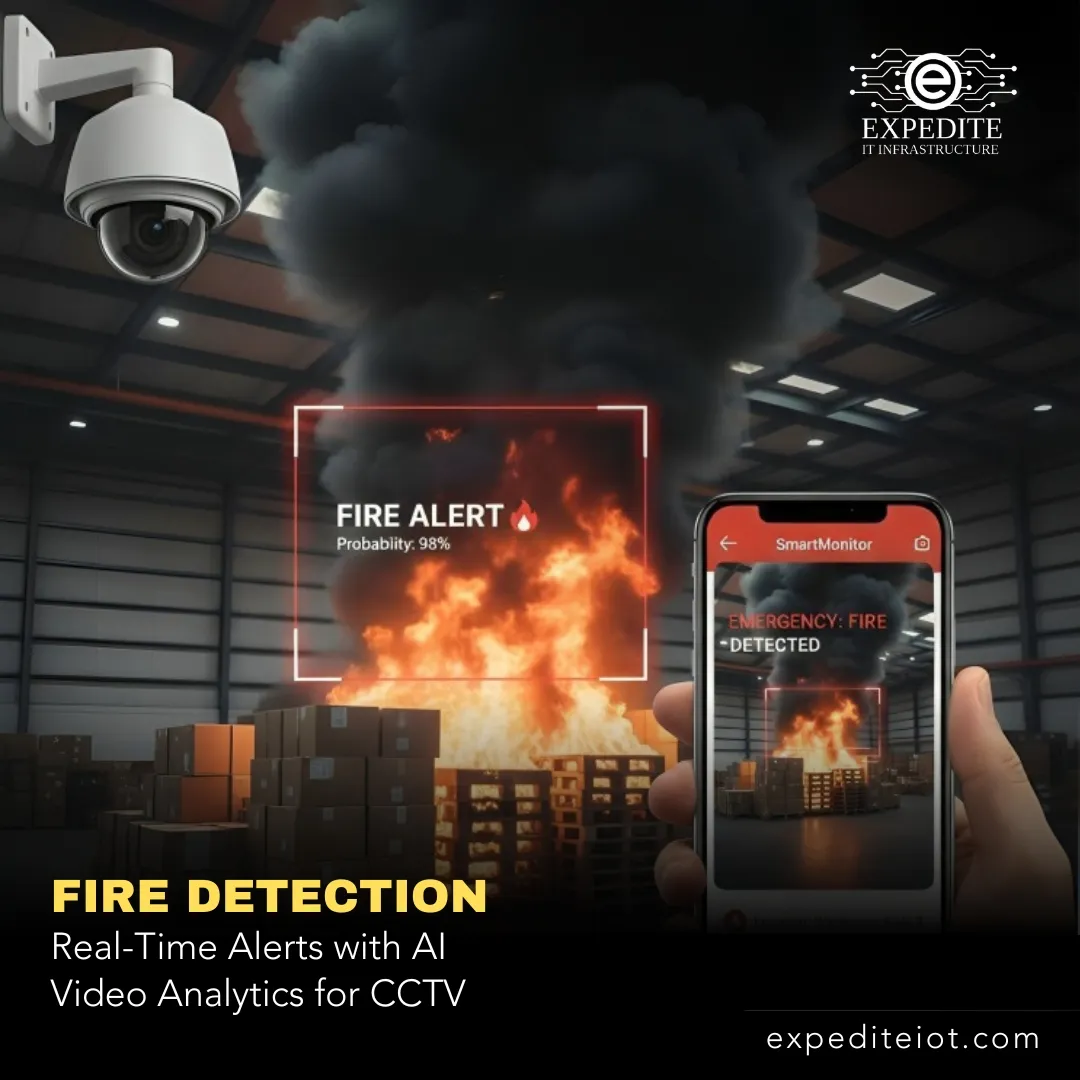
Video Analytics powered by deep-learning AI changes this equation fundamentally, detecting the first visible traces of flame and smoke through existing camera infrastructure at the speed of light — giving Kuwait's industrial safety teams the early warning that saves lives, assets, and operational continuity. Expedite IoT deploys this transformative technology across Kuwait's most demanding industrial environments, delivering fire safety performance that legacy detector systems cannot match.
Kuwait's Industrial Fire Risk: Why Standard Detection Is Not Enough
Kuwait's economy remains deeply anchored in the hydrocarbon sector. Kuwait Petroleum Corporation (KPC) and its subsidiaries — Kuwait National Petroleum Company (KNPC), Kuwait Oil Company (KOC), and Petrochemical Industries Company (PIC) — collectively manage one of the highest concentrations of flammable hydrocarbon inventory per square kilometre of any industrial estate in the world. The Mina Al-Ahmadi refinery, the largest refinery in the GCC, processes over 466,000 barrels per day within a complex of interconnected processing units, storage tanks, and pipeline infrastructure where a fire event in one zone can rapidly spread to adjacent assets.
The specific fire risk factors in Kuwait's industrial environment that make conventional detection inadequate:
- High-bay process areas, tank farms, and open-air loading jetties where ceiling-height point detectors cannot accumulate sufficient combustion particles to trigger within the first 4–12 minutes of a fire event — the critical early-intervention window
- Ambient summer temperatures above 50 °C accelerating hydrocarbon vapour evaporation rates and reducing the ignition energy threshold of flammable atmospheres — making the margin between a hot surface and an ignition event dangerously narrow
- Shamal wind events dispersing smoke horizontally across wide open-air areas before it can reach ceiling-mounted detectors — rendering conventional volumetric detectors ineffective across Kuwait's coastal industrial sites
- KNPC HSE Management System and Kuwait Fire Service Directorate (KFSD) requirements for demonstrable fire detection response time improvements at Tier 1 process hazard facilities
- Continuously unmanned process areas where rotating shift schedules leave equipment zones without direct human observation for extended periods — making automated visual detection the only reliable early-warning mechanism
AI-Powered Video Analytics: How Deep Learning Detects Fire in Seconds
AI-Powered Video Analytics applies convolutional neural networks (CNNs) and temporal pattern recognition algorithms trained on millions of real fire and smoke incident video frames to identify the characteristic pixel-level signatures of combustion — colour gradients in the 520–620 nm visible spectrum associated with open flame, the luminosity flicker profile of burning hydrocarbon vapours, the expanding spatial footprint and rising trajectory of smoke plumes, and the motion vector patterns that distinguish real combustion from steam, dust, or camera lens contamination.
The AI engine processes standard IP camera streams at 15–30 frames per second, analysing each frame in under 200 milliseconds for combustion signatures. When consistent fire or smoke indicators are confirmed across multiple consecutive frames — eliminating single-frame false triggers — an alert is generated within 2–5 seconds of initial flame or smoke appearance. This response time is 3–8 minutes faster than conventional point detectors in high-bay industrial environments, a lead time that transforms the severity outcome of the event.
Multi-Class Combustion Recognition for Industrial Environments
Kuwait's petrochemical and refining environments produce combustion events with distinct visual signatures — open hydrocarbon flame (characteristically orange-yellow with high luminosity), dense black smoke from heavy oil or polymer combustion, light grey smoke from electrical equipment fires, and the nearly invisible blue flame characteristic of liquefied petroleum gas (LPG) burns. Expedite IoT's AI models are trained on industry-specific datasets capturing all of these combustion types, ensuring reliable detection across the full range of fire scenarios present in Kuwait's industrial estate.
Camera-Agnostic Deployment on Existing CCTV Infrastructure
The analytics engine is compatible with ONVIF-compliant IP cameras from all major manufacturers — Hikvision, Dahua, Axis, Bosch, Hanwha, and Sony — integrating with existing video management systems (VMS) including Milestone XProtect, Genetec Security Center, and Avigilon Control Center. Kuwait industrial sites with existing CCTV infrastructure can deploy AI fire detection as a software intelligence layer without replacing cameras — transforming sunk capital assets into active fire safety sensors.
Real-Time Object Detection: Tracking Threats as They Develop
Real-Time Object Detection capability in Expedite IoT's platform goes beyond simply identifying that smoke or flame is present — it tracks the spatial evolution of the detected threat across consecutive frames, quantifying the rate of flame spread, the direction and velocity of smoke plume propagation, and the proximity of the developing fire to adjacent high-hazard assets such as pressurised storage vessels, electrical switchgear, and pipeline manifolds.
This spatial threat tracking intelligence — delivered in real time to the Kuwait industrial site's safety operations centre (SOC) — enables incident commanders to make informed decisions about evacuation zone scope, suppression resource deployment, and adjacent hazard isolation before firefighting teams arrive on scene. At Shuaiba Industrial Area, where process units handling different hazardous materials are in close proximity, knowing the direction and speed of fire spread provides the 90-second intervention window that prevents a single-unit fire from becoming a multi-asset catastrophe.
Real-time detection capabilities include:
- Flame location pinpointing — identifying the spatial origin of the flame source within the camera's field of view, mapped to plant area grid coordinates for first-responder navigation
- Smoke plume trajectory tracking — monitoring smoke spread direction and rate across wide-area process zones, identifying downstream areas at risk of smoke exposure before visibility is compromised
- Multi-camera incident fusion — correlating simultaneous detections from adjacent cameras to construct a comprehensive incident footprint across a facility zone, rather than treating each camera detection as an independent event
- Asset proximity alerting — automatically cross-referencing the detected fire location against a pre-loaded plant asset registry and flagging when the fire perimeter approaches within a configurable distance of designated high-hazard equipment
Advanced AI Recognition: Discrimination Between Real Threats and Environmental Conditions
Advanced AI Recognition is the capability that separates professional-grade industrial fire detection analytics from commodity video analysis tools — the ability to reliably distinguish real combustion events from the numerous visual phenomena in Kuwait's industrial environments that superficially resemble fire or smoke but are not: steam from heat exchangers and cooling towers, process gas flare stacks producing legitimate controlled flames, dust clouds generated by material handling operations, shamal-driven sand in suspension creating reduced visibility, sun glare and lens flare in Kuwait's high-intensity solar conditions, and vehicle exhaust plumes in busy logistics areas.
Expedite IoT's advanced recognition engine addresses each of these challenges through:
- Flare stack exclusion zones: Configurable geographic exclusion polygons drawn around Kuwait Oil Company and KNPC flare stacks within the camera field of view — excluding the controlled flame signature from fire detection processing while maintaining full detection sensitivity in adjacent areas
- Steam and vapour discrimination: Spectral and motion analysis distinguishing the thermal-updraft trajectory and colour temperature of steam (cold-start, rising vertically, white-grey) from the luminosity and flicker characteristics of real combustion
- Temporal consistency filtering: Requiring sustained combustion indicators across a minimum of 5–10 consecutive frames before generating an alert — filtering out single-frame triggers from sun reflections, lightning flashes, or camera noise artifacts
- Multi-sensor fusion: Integrating AI visual detection with conventional point detector, heat detector, and gas detection system signals — requiring corroborating confirmation from a secondary sensor type before escalating to the highest-priority alert tier for maximum confidence in high-risk industrial zones
Prolonged Detection: Monitoring That Never Blinks Across Kuwait's Industrial Estate
Prolonged Detection is the operational characteristic that defines AI video fire detection's decisive advantage over human patrol-based monitoring across Kuwait's vast industrial sites. A security patrol officer covering a large process area can physically observe any specific zone for a fraction of each patrol cycle — perhaps 30 seconds in every 20-minute circuit. The AI video analytics system observes every camera's field of view simultaneously, at 15–30 frames per second, 24 hours a day, 365 days a year, without attention lapses, fatigue, distraction, or the reduced situational awareness that characterises human observers working the 3–5 a.m. shift during Kuwait's demanding summer season.
The operational value of continuous, uninterrupted monitoring is highest precisely during the periods when human observation is most impaired:
- Public holiday and National Day shutdown periods when Kuwait industrial sites operate with skeleton maintenance crews and reduced safety team coverage
- Night-time shift operations when reduced lighting and human fatigue combine to dramatically reduce the probability that a patrol observer will detect early-stage fire indicators
- Extreme weather periods — Kuwait's summer sandstorm events reduce outdoor patrol frequency and restrict security team movement while simultaneously increasing fire risk from suspended conductive dust
- Large-scale planned maintenance shutdowns (turnarounds) when hundreds of contractors work simultaneously across multiple process units, creating elevated fire ignition risk from hot work operations that must be monitored continuously from a single command position
False Alarm Reduction: Protecting Kuwait Industrial Operations from Unnecessary Disruption
False Alarm Reduction is among the most commercially significant benefits of AI video fire detection for Kuwait industrial operators — and one of the most consistently cited pain points among safety managers operating conventional detector arrays across the Kingdom's process industry sites. Industry data from GCC petrochemical operators indicates that between 70% and 93% of all fire alarm activations are false alarms, caused by steam, dust, process exhaust, and environmental factors triggering particle-based detectors that cannot discriminate between combustion products and other airborne material.
The operational cost of a false alarm in Kuwait's industrial environment is substantial:
- Kuwait Fire Service Directorate (KFSD) emergency response mobilisation — a full fire tender response to a false alarm at Mina Al-Ahmadi or Shuaiba costs the operator a KFSD penalty assessment and consumes emergency response resources needed for genuine incidents
- Process interruption — evacuating a process unit on a false alarm triggers emergency shutdown procedure that may require 2–8 hours to safely restart, with associated production loss and equipment wear costs
- Operational desensitisation — the 'cry-wolf' effect documented in occupational safety research, where workers and operators who experience repeated false alarms respond more slowly and with less urgency to genuine emergency activations — directly increasing injury and fatality risk in real events
Expedite IoT's AI analytics platform achieves false alarm reduction rates above 90% compared to conventional point detectors in Kuwait industrial deployments — through multi-frame temporal consistency filtering, context-aware exclusion zone management, and multi-sensor corroboration requirements before alert escalation.
Instant Alerts and Notifications: Getting the Right Information to the Right Person in Seconds
Instant Alerts and Notifications from Expedite IoT's platform are not generic alarms — they are structured, information-rich incident messages that give Kuwait industrial safety teams the situational intelligence they need to initiate the correct response protocol within the first 30 seconds of a detected event, without waiting for a patrol officer to physically reach the scene or a supervisor to interpret an undifferentiated alarm tone.
The alert package transmitted on fire or smoke detection:
- Detection details: Detection type (flame, dense smoke, light smoke), confidence score, first detection timestamp, camera identifier, and plant area grid reference — providing immediate situational context to the SOC operator
- Visual evidence: A video clip of the detection event and a snapshot image with the detected flame or smoke region highlighted — enabling the SOC operator to visually confirm the threat before activating the full emergency response protocol
- Multi-channel delivery: Simultaneous SMS, push notification, email, and integration with the facility's DCS (Distributed Control System) and safety instrumented system (SIS) — ensuring the alert reaches every relevant responder regardless of their current location or communication device
- Escalation protocol: If the primary SOC contact does not acknowledge within a configurable window (typically 3–5 minutes for industrial fire events), automatic escalation to the shift supervisor, HSE manager, and Kuwait Fire Service Directorate emergency dispatch — ensuring no fire event goes without a coordinated response regardless of primary contact availability
- Automated suppression trigger: For zones equipped with gaseous suppression systems (FM-200, CO₂, NOVEC 1230) or deluge sprinkler arrays, the platform can trigger zone-specific suppression activation via dry-contact relay output within seconds of confirmed detection — initiating protection before human response arrives on scene
Video Analytics Kuwait: Sector Applications Across the Country's Industrial Estate
Video Analytics Kuwait deployments by Expedite IoT address the full breadth of the country's industrial fire detection requirements:
- Oil refining and petroleum processing: KNPC's Mina Al-Ahmadi, Mina Abdullah, and Shuaiba refineries — monitoring process units, tank farms, loading jetties, and flare systems with ATEX-rated camera hardware in Zone 1 and Zone 2 classified areas
- Upstream oil and gas: Kuwait Oil Company (KOC) gathering centres, booster stations, and well-pad facilities across the Burgan, Raudhatain, and Sabriyah oil fields — remote site monitoring via 4G/LTE cellular-connected camera networks where fixed network infrastructure is absent
- Petrochemical manufacturing: Petrochemical Industries Company (PIC) facilities in Shuaiba Industrial Area — monitoring polymer production areas, solvent storage zones, and chemical loading bays with multi-class combustion detection covering both hydrocarbon and chemical fire signatures
- Power generation: Ministry of Electricity, Water and Renewable Energy (MEWRE) power stations at Sabiya, Az-Zour, and Shuaiba — monitoring turbine halls, transformer yards, and fuel oil storage areas with round-the-clock unmanned surveillance supplementing conventional detector networks
- Logistics and industrial zones: Sabhan Industrial Area, Rai Industrial Zone, and Kuwait Free Trade Zone (KFTZ) warehousing and light manufacturing facilities — AI fire detection protecting mixed-occupancy industrial real estate serving Kuwait's growing non-oil private sector
- Kuwait International Airport: DGCA aviation fuel storage, aircraft maintenance hangars, and cargo terminal buildings — high-bay fire detection where ceiling-mounted point detectors are ineffective and AI video analytics provides the rapid visual detection that aviation safety standards require
Why Expedite IoT Is Kuwait's Trusted AI Fire Safety Technology Partner
- Experience: Over a decade of AI-powered video analytics and fire safety technology deployments across Kuwait, Saudi Arabia, Qatar, Oman, and the wider GCC — with active industrial installations at oil and gas facilities, petrochemical plants, power generation assets, and critical infrastructure sites
- Expertise: Certified fire protection engineers (CFPS), CCTV design specialists (CSPM), AI systems integration architects, and process safety professionals with HAZOP and LOPA methodology training — delivering the multi-disciplinary expertise that industrial fire detection demands
- Authoritativeness: Solutions compliant with Kuwait Fire Service Directorate (KFSD) technical requirements, KNPC HSE Management System standards, NFPA 72 (fire alarm and signalling systems), EN 54-10 (flame detectors), EN 54-12 (line-type smoke detectors), IEC 61508 (functional safety of electrical/electronic systems), and API RP 505 (fire protection for petroleum facilities); integration partner for Milestone, Genetec, and Avigilon VMS platforms
- Trustworthiness: ISO 9001:2015-certified project delivery; 24/7/365 NOC monitoring with Arabic and English SOC analyst coverage; 4-hour emergency on-site response SLA across Kuwait; annual AI model performance recertification reports; and NIST FRVT-equivalent video analytics accuracy benchmarking delivered to clients annually
Conclusion
Deploying deep-learning Video Analytics from Expedite IoT across major installations like the Mina Al-Ahmadi refinery complex allows operators to detect open hydrocarbon flame, dense smoke, or near-invisible LPG combustion in seconds through existing camera networks, ensuring crucial early-intervention lead times. This highly accurate AI-Powered Video Analytics system provides Real-Time Object Detection and advanced False Alarm Reduction to maintain uninterrupted operations at critical sites, delivering instant alerts and compliance with stringent KFSD, NFPA, and API safety standards throughout Kuwait's industrial sectors.
FAQs
FAQ 1: How does AI-Powered Video Analytics detect fire faster than Kuwait's existing conventional detectors?
Conventional point smoke detectors require combustion particles to physically travel through the air and enter the detector's sensing chamber — a process that in Kuwait's high-bay process areas, open-air tank farms, and large industrial buildings can take 4 to 12 minutes, depending on air currents, ceiling height, and the rate of fuel combustion. During that interval, a fire that could have been suppressed with a portable extinguisher may have grown to require a full fire tender response. AI video analytics detects fire and smoke visually — analysing the pixel-level signatures of flame luminosity, smoke colour gradients, and combustion motion vectors in the camera's field of view within 200 milliseconds of each frame capture. When consistent combustion indicators are confirmed across 5–10 consecutive frames, an alert is generated within 2–5 seconds of the first visible appearance of flame or smoke. In Kuwait's typical industrial high-bay environment, this represents a 3 to 8-minute early warning advantage over conventional detectors — the difference between a first-response outcome and a major incident outcome in a hydrocarbon processing environment.
FAQ 2: How does Advanced AI Recognition handle Kuwait's flare stack emissions and steam venting without generating false alarms?
Flare stack operation and steam venting are among the most challenging false alarm sources in Kuwait's refinery and petrochemical environment — both produce visible flames and vapour plumes within camera fields of view that superficially resemble uncontrolled fire events. Expedite IoT addresses flare stack false alarms through configurable geographic exclusion zones — polygonal areas drawn on the camera image around the known position of each flare stack — within which flame detection processing is disabled while full detection sensitivity is maintained in all surrounding areas. Steam and vapour venting is discriminated from real smoke through spectral analysis (steam presents as white-grey with cold-start characteristics and vertical thermal-updraft trajectory, contrasting with the darker colour temperature and horizontal or turbulent spread of real combustion smoke) and temporal behaviour analysis (steam venting from known process equipment locations follows predictable operational patterns that the AI system learns during its calibration period and filters accordingly). For additional confidence in critical refinery zones, multi-sensor corroboration is configured — requiring simultaneous confirmation from a gas detection system or conventional heat detector before generating a maximum-priority alert.
FAQ 3: Can the Real-Time Object Detection system integrate with Kuwait industrial sites' DCS and safety instrumented systems?
Yes — integration with distributed control systems (DCS), safety instrumented systems (SIS), and fire and gas (F&G) detection systems is a standard component of Expedite IoT's industrial video analytics deployment for Kuwait oil, gas, and petrochemical facilities. The video analytics platform communicates with industrial control systems through Modbus TCP/IP, OPC-UA, and dry-contact relay output — enabling fire detection alerts to trigger automated safety actions directly within the plant's existing safety logic: activating zone isolation valves, initiating emergency depressurisation sequences, triggering deluge suppression systems, and sending HART-compatible process alarm signals to the DCS operator console. For Kuwait facilities operating KNPC-standardised Honeywell Experion or ABB System 800xA DCS platforms, Expedite IoT provides pre-qualified integration configurations that have been tested and documented for compatibility with the plant's safety instrumented function (SIF) alarm management architecture, enabling straightforward engineering change control approval for the integration.
FAQ 4: What camera hardware is required for Video Analytics Kuwait deployments in ATEX-classified petrochemical zones?
Kuwait's petrochemical process areas, tank farms, and marine loading jetties are classified under IEC 60079-10 as Zone 1 or Zone 2 hazardous areas where flammable vapour-air mixtures may be present — requiring all electrical equipment, including IP camera hardware, to be certified as ATEX (Atmospheres Explosible) compliant under ATEX Directive 2014/34/EU or equivalent IECEx certification. Expedite IoT specifies and supplies ATEX-certified IP camera units rated for Zone 1 (Group IIA/IIB for refinery hydrocarbon vapours) or Zone 2 deployment as required by the specific area classification of each camera position, in enclosures rated IP66 or higher for Kuwait's dust and humidity conditions. These cameras provide full 1080p or higher resolution image quality suitable for AI analytics processing while maintaining the explosion protection certification required for safe operation in hazardous atmospheres. For areas where ATEX camera installation is impractical, Expedite IoT configures purged and pressurised camera enclosures (Type X or Type Z purging per IEC 60079-13) enabling standard industrial IP cameras to operate safely within a continuously purged housing mounted in the hazardous area.
FAQ 5: How does Expedite IoT support Instant Alerts and Notifications integration with Kuwait Fire Service Directorate emergency response systems?
Expedite IoT's Kuwait industrial video analytics platform supports direct integration with Kuwait Fire Service Directorate (KFSD) emergency notification frameworks through a combination of structured API data transmission and automated voice/SMS notification to KFSD-registered emergency contact numbers. When the AI platform confirms a fire event above the configured confidence threshold, the alert package transmitted to KFSD dispatch includes: the facility name, address, and GPS coordinates; the specific plant zone and camera reference identifying the fire location within the site; the detection timestamp and event classification (flame type, smoke density); the current wind direction and speed from the site's weather monitoring integration (supporting KFSD incident commander decisions on approach route and evacuation downwind zone); and a direct link to the live camera stream and recorded detection video clip. This structured pre-dispatch information — provided before KFSD units even leave the station — enables incident commanders to pre-assign the correct appliance type, foam tender, and hazmat support based on accurate pre-arrival intelligence rather than defaulting to maximum resource mobilisation for every alarm. For Kuwait's major industrial operators under KNPC and KOC emergency response frameworks, Expedite IoT provides an API integration specification for connection to the operator's existing emergency management software (EMS) platform, ensuring the video analytics alert flows seamlessly into the site's established emergency command and control procedures.
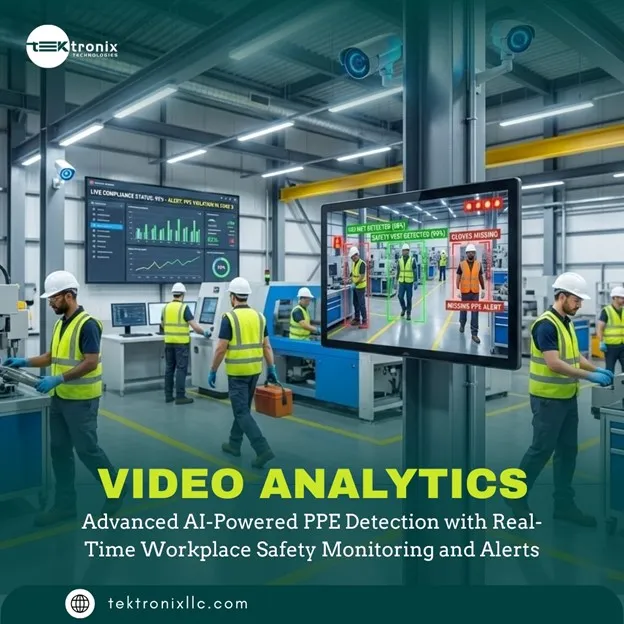
Real-Time PPE Compliance Monitoring





























Sign in to leave a comment.