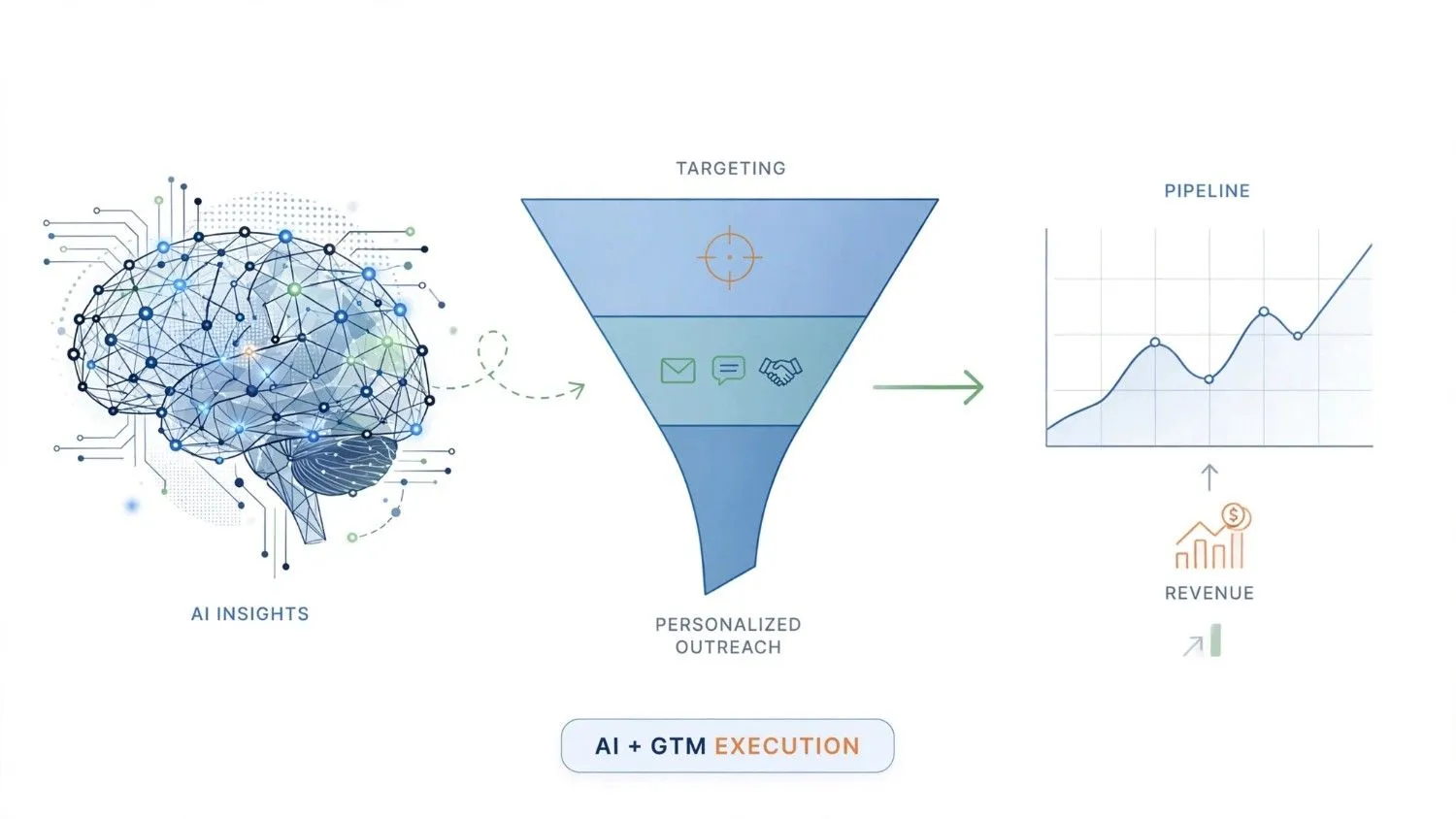

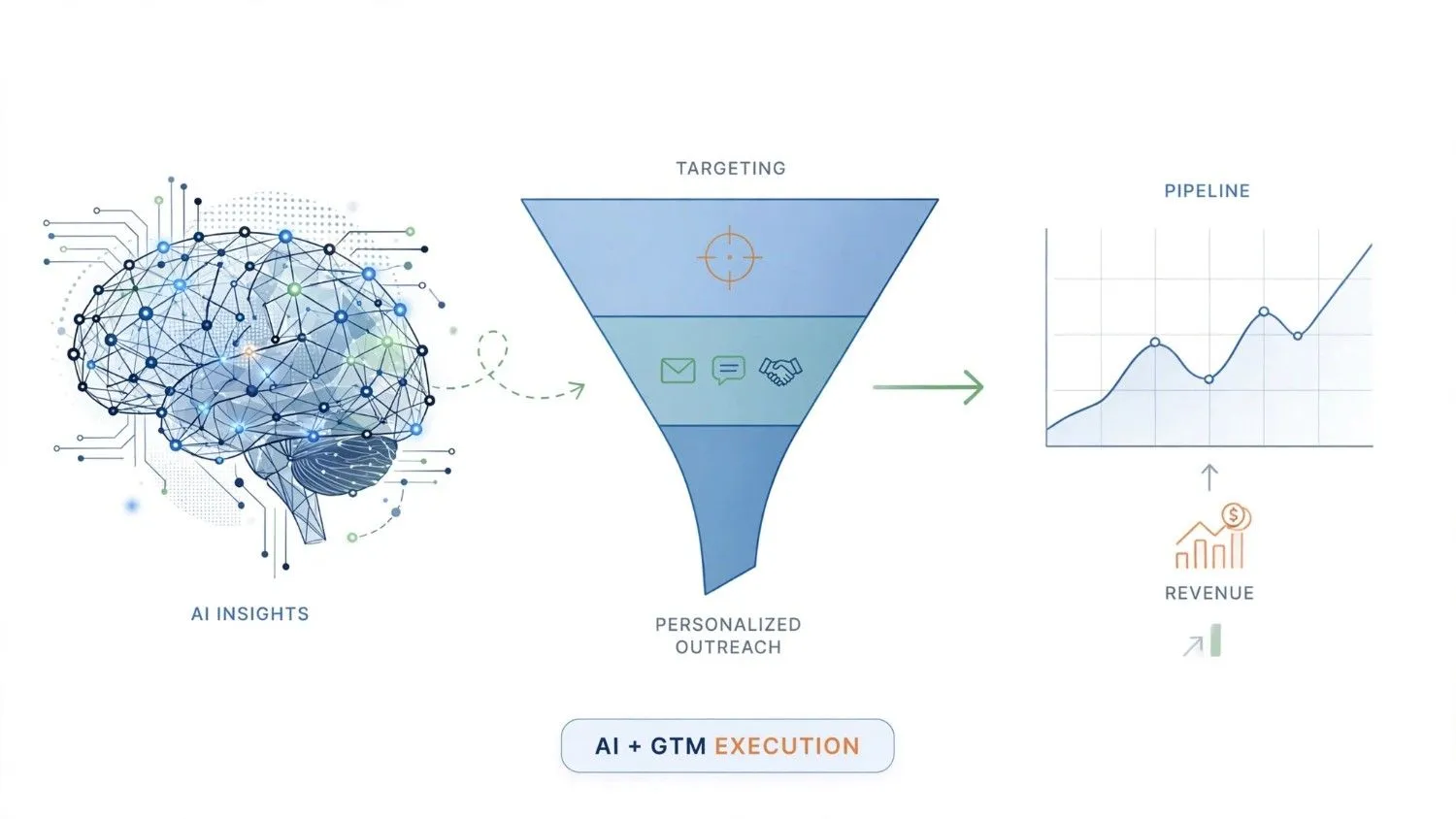
AI improves go-to-market (GTM) execution by sharpening ideal customer profile (ICP) targeting, personalizing outbound outreach at scale, accelerating lead qualification and routing, and improving pipeline forecast accuracy through pattern analysis of historical deal data. The overall effect is that GTM teams spend less time on manual research and administrative work, and more time on the conversations most likely to convert.
What Does "Go-to-Market Execution" Actually Mean?
Go-to-market execution refers to the operational work of turning a GTM strategy — target market, positioning, pricing, channel mix — into repeatable revenue results. This includes identifying which accounts to pursue, how to reach them, what message resonates, how leads move through the pipeline, and how forecasts are built from that pipeline data. Strategy sets the direction; execution is the day-to-day discipline of targeting the right accounts, engaging them effectively, and converting engagement into closed revenue. Weak execution can undermine even a well-designed GTM strategy, which is why execution quality is measured separately from strategic planning in most revenue operations (RevOps) frameworks.
Why AI Is Reshaping GTM Execution in 2026
GTM execution has always relied on data — firmographic fit, intent signals, engagement history — to prioritize where sales and marketing effort should go. AI has become central to this work for a specific reason: the volume of available signal (intent data, product usage, firmographic databases, engagement history) now exceeds what teams can process manually with the same speed competitors are moving at. Three shifts explain why this is accelerating now:
- Buyer research has moved earlier and become less visible. Buyers increasingly self-educate before ever engaging a vendor, which means traditional top-of-funnel engagement metrics capture less of the actual buying journey than they used to.
- Intent data has become more abundant but harder to interpret manually. Multiple data sources (website visits, content downloads, technographic signals, hiring patterns) now feed GTM systems, and AI models are better suited than manual review to combining these into a single prioritized signal.
- GTM teams are under pressure to do more with smaller headcounts, which increases reliance on automation for research, list-building, and routine outreach personalization that previously required manual SDR effort.
For RevOps and sales leadership, this means AI is shifting from a reporting layer to an execution layer — directly influencing which accounts get contacted, in what order, and with what message.
How AI Improves Each Stage of GTM Execution
1. Sharper ICP Identification and Account Targeting
AI models can analyze historical closed-won data to identify firmographic and behavioral patterns that predict fit — company size, industry, technology stack, hiring signals, and funding stage — often surfacing combinations that are not obvious from a manually defined ICP. This produces a more precise targeting list than static firmographic filters alone, which tends to reduce wasted outbound effort on accounts unlikely to convert.
2. Intent Signal Aggregation
Rather than manually monitoring multiple intent data sources, AI systems can continuously combine signals — website engagement, content consumption, job-change activity, competitor research behavior — into a single account-level intent score. This allows GTM teams to prioritize outreach toward accounts showing active buying signals, rather than working through account lists in a fixed, signal-blind order.
3. Personalized Outbound at Scale
AI-assisted outreach tools can tailor messaging based on an account's industry, role, or recent activity without requiring a human to manually draft every variation. This does not replace the strategic judgment behind what message to send — it reduces the manual labor of producing role- and industry-specific variants across a large account list, which allows SDR teams to maintain relevance at a volume that manual personalization cannot match.
4. Faster, More Consistent Lead Qualification
AI-based qualification models can evaluate incoming leads against historical conversion patterns in real time, flagging which leads most closely resemble past closed-won deals. This reduces the lag between lead capture and qualified follow-up, which matters because response speed is one of the more consistent predictors of conversion in B2B outbound and inbound motions alike.
5. Pipeline Forecasting and Deal-Risk Detection
AI models trained on historical deal data can identify patterns associated with deals that stall or slip — for example, extended gaps between stakeholder engagement, unusually long time-in-stage, or missing champion activity — often before these risks are visible to a sales manager reviewing the pipeline manually. This allows forecasting to move from a largely rep-reported exercise toward one grounded in observed deal behavior, which tends to improve forecast accuracy over time.
6. Sales Enablement and Content Recommendation
AI systems can recommend the most relevant case study, one-pager, or talking point for a given deal stage or buyer persona, based on what has historically influenced similar deals. This reduces the time reps spend searching for the right collateral and increases the likelihood that prospects receive content actually relevant to their stage in the buying process.
Where AI Genuinely Improves GTM Execution — and Where It Doesn't
AI's impact is strongest in tasks involving pattern recognition across large, structured data sets: ICP scoring, intent aggregation, and pipeline-risk detection are all areas where AI models can process signal volume a human team cannot match manually. These are the areas where GTM teams tend to see measurable improvement in targeting precision and forecast accuracy.
AI's impact is weaker in areas that depend on relationship context, negotiation, and nuanced judgment — understanding an economic buyer's internal politics, reading hesitation in a live conversation, or adapting a pitch mid-meeting based on unspoken cues. Teams that treat AI as a replacement for human-led relationship-building at the negotiation and closing stages, rather than as a tool for surfacing and prioritizing the right opportunities earlier, tend to see execution quality plateau rather than improve. AI performs best in GTM execution as a targeting and prioritization layer that informs human decision-making, not as a substitute for the judgment required to close complex B2B deals.
Common Mistakes When Applying AI to GTM Execution
- Automating outreach volume without improving targeting first. Sending more AI-personalized messages to a poorly defined target list increases activity without improving results; targeting precision should come before scaling message volume.
- Treating AI-generated intent scores as final rather than directional. Intent scores work best as a prioritization input reviewed alongside account context, not as an autonomous trigger for outreach without human review, particularly for higher-value accounts.
- Under-investing in data quality. AI models trained on incomplete or inconsistent CRM data will produce unreliable targeting and forecasting outputs regardless of how sophisticated the model is; clean data infrastructure has to come first.
- Removing human judgment from qualification too early. AI can accelerate the qualification process, but fully automating qualification decisions without human review tends to misroute complex or ambiguous accounts that don't cleanly match historical patterns.
Building an AI-Assisted GTM Motion: A Practical Framework
Teams introducing AI into GTM execution generally see better results by sequencing adoption rather than automating every function simultaneously:
- Clean and consolidate GTM data first. AI targeting and scoring models are only as reliable as the underlying CRM and intent data; fragmented or inconsistent data undermines every downstream AI application.
- Start with ICP scoring and intent aggregation. These are the highest-leverage, lowest-risk applications, since they inform prioritization without removing human judgment from outreach or negotiation.
- Layer in AI-assisted personalization once targeting is validated. Personalized outreach is most effective when aimed at a well-defined, high-intent account list, not applied broadly before targeting has been refined.
- Introduce forecasting and deal-risk models last. These require the most historical deal data to be reliable, so they typically deliver the most value once earlier stages are already generating clean, structured data.
For B2B and SaaS companies running outbound-driven GTM motions, AI-assisted targeting and intent scoring are most valuable when they feed directly into a responsive outbound execution process — a well-prioritized account list loses much of its value if follow-up is slow, generic, or poorly sequenced. The Global Associates works with B2B and SaaS teams to connect AI-informed targeting and intent signals with structured outbound execution, so improved prioritization translates into pipeline rather than a longer list that never gets worked effectively.
Conclusion
AI improves go-to-market execution most reliably in the areas where pattern recognition across large data sets outperforms manual analysis: ICP targeting, intent signal aggregation, lead qualification, and pipeline forecasting. These applications free GTM teams from time-intensive manual research and let outreach and follow-up happen faster and with more relevant context. Where AI adds less value — and can actively hurt execution quality if over-relied upon — is in the relationship-driven stages of the buying process, where negotiation, trust-building, and reading unspoken buyer signals still require human judgment. The GTM teams seeing the strongest results in 2026 are not the ones automating every function, but the ones using AI to sharpen where and how their people spend time, while keeping human judgment in the loop at the stages where it still matters most.




























Sign in to leave a comment.