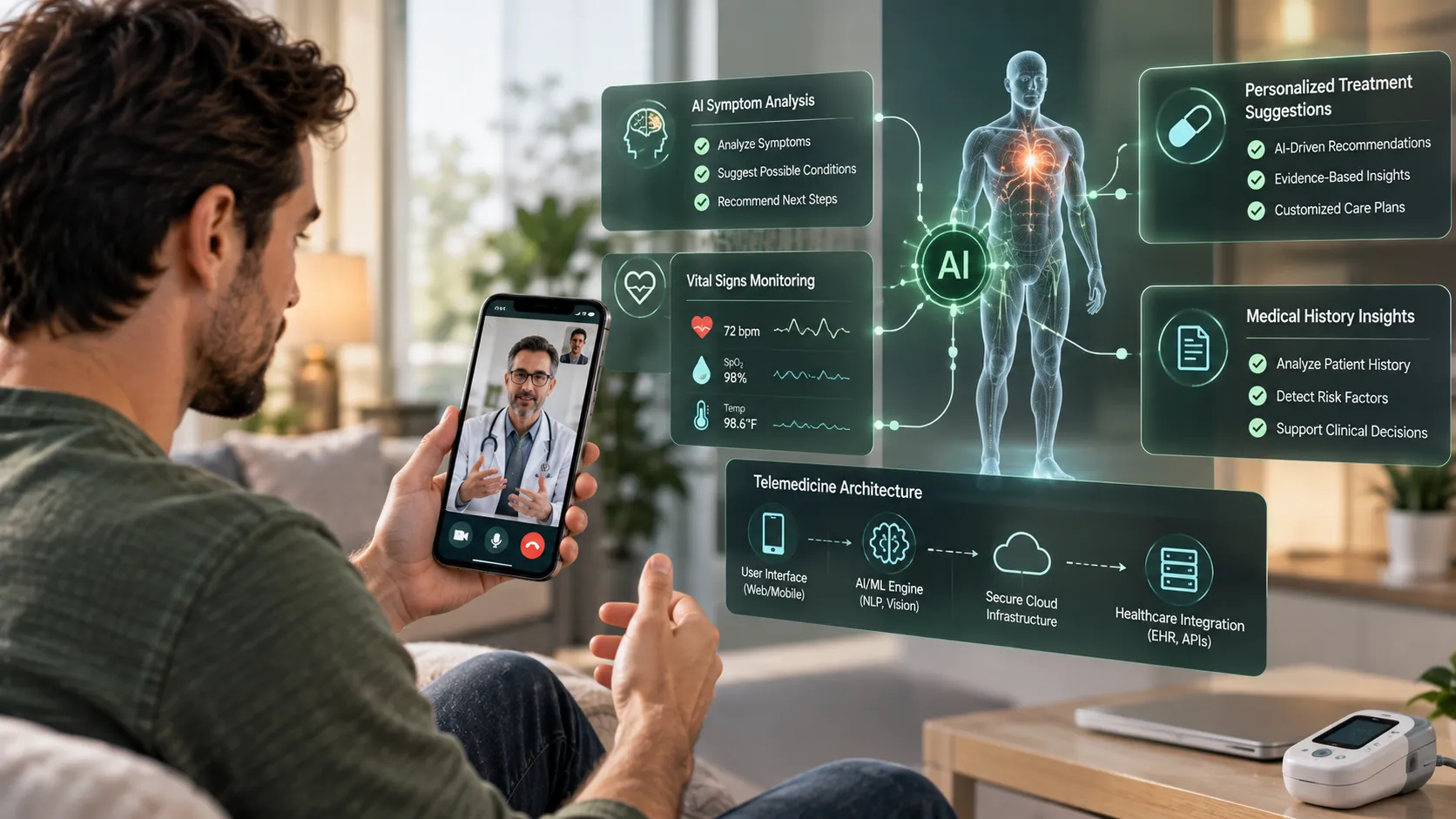

Telemedicine is evolving from a virtual consultation channel into a connected digital-care environment where artificial intelligence can support clinical, administrative, and patient-facing workflows. Instead of limiting virtual care to video appointments, healthcare organizations can use AI to structure patient information, automate documentation, identify relevant patterns, personalize communication, and improve operational coordination across the care journey.
The market opportunity reflects this transition. According to Grand View Research, the global telemedicine market is estimated at $157.9 billion in 2026 and is projected to reach $514.2 billion by 2033, representing a CAGR of 18.4% between 2026 and 2033. This growth is creating demand for platforms that can support more intelligent and scalable models of remote care.
For organizations planning telemedicine software development, AI should therefore be considered an architectural capability rather than an isolated chatbot or add-on. Its implementation needs to connect intelligence services with healthcare workflows, patient data, provider applications, interoperability layers, security controls, and appropriate human oversight.
What Role Does AI Play in Modern Telemedicine?
AI becomes valuable in telemedicine when it solves specific clinical or operational problems instead of simply increasing the number of technology features. Its strongest applications generally involve processing large amounts of information, recognizing patterns, reducing repetitive work, and presenting relevant information to patients or healthcare professionals at the right point in a workflow.
Intelligent Patient Intake
AI-powered intake can collect symptoms, medical history, medications, and other relevant information through conversational interfaces before a consultation begins. The system can organize unstructured responses into a structured summary, helping clinicians enter appointments with a clearer understanding of the patient's reported concerns and reducing repetitive questioning.
Automated Clinical Documentation
Speech recognition and generative AI can transform consultation conversations into structured documentation, summaries, follow-up instructions, or draft notes. Rather than replacing clinicians, the technology can reduce documentation workload while allowing providers to review, correct, and approve information before it becomes part of the patient's formal medical record.
Clinical Decision Support
AI can analyze available patient information and surface relevant patterns, risk indicators, previous records, or supporting information for clinician consideration. The important distinction is that decision support should assist professional judgment rather than automatically convert an algorithmic output into a diagnosis, prescription, or treatment decision.
Personalized Patient Engagement
AI can tailor reminders, educational content, follow-up communication, and care-plan interactions according to patient context. For example, a chronic-care platform could adapt follow-up messages according to a patient's documented care plan, recent interactions, or monitoring trends instead of sending identical messages to every user.
Which AI Use Cases Create the Most Practical Value?
The most useful applications extend beyond the consultation itself. AI can connect activities occurring before, during, and after a virtual appointment, allowing healthcare organizations to reduce fragmented workflows while giving clinicians better access to relevant information.
- Remote patient monitoring: AI can analyze incoming readings from connected devices and identify unusual patterns that may require human review. For example, a chronic-care platform could prioritize meaningful changes in blood pressure, glucose, oxygen saturation, or heart-rate trends instead of requiring clinicians to manually inspect every reading.
- Predictive risk identification: Machine-learning models can examine longitudinal information to identify patterns associated with deterioration, missed follow-ups, or escalating care requirements. These outputs should function as risk signals that initiate appropriate review rather than being presented as definitive clinical conclusions.
- Appointment optimization: AI can analyze scheduling patterns, predict demand, recommend suitable appointment slots, and automate routine reminders. This can help providers manage capacity more effectively while reducing administrative interactions that do not require clinical expertise.
- Post-consultation automation: AI can assist with follow-up summaries, referral drafts, patient instructions, and reminders using clinician-approved information. This creates value after the consultation while reducing repetitive administrative work that can otherwise consume significant provider and staff time.
What Should an AI Telemedicine Architecture Look Like?
An AI-enabled platform requires more than connecting an application to an AI model. A scalable architecture should separate patient experiences, business workflows, healthcare data, intelligence services, integrations, and security so that individual components can evolve without destabilizing the wider platform.
Experience Layer
The experience layer includes patient applications, provider portals, administrative dashboards, consultation interfaces, conversational experiences, and appointment journeys. AI should appear naturally within these workflows rather than forcing patients or clinicians to move into disconnected interfaces whenever they need an intelligent capability.
Application and Workflow Layer
This layer manages appointments, consultations, prescriptions, referrals, notifications, billing, care plans, and provider workflows. AI services should interact with these functions through controlled APIs, permissions, and defined business rules instead of receiving unrestricted access to sensitive clinical operations.
Healthcare Data Layer
Patient records, consultation information, medical documents, device readings, diagnostic information, and patient-generated data may need to be processed by different services. A structured data strategy helps maintain consistency, provenance, access control, interoperability, and appropriate retention across these sources.
AI Intelligence Layer
This layer can contain natural language processing, speech recognition, generative AI, predictive models, recommendation engines, retrieval systems, and model-orchestration components. Each capability should have a clearly defined purpose, input boundary, output format, validation process, and monitoring mechanism.
Integration and Security Layer
APIs and healthcare interoperability standards connect the platform with EHRs, laboratories, pharmacies, medical devices, payment systems, and other healthcare applications. Identity management, encryption, consent management, audit logging, and access controls should operate across these integrations rather than being treated as separate post-development additions.
How Do You Implement AI in a Telemedicine Platform?
Successful implementation starts with the healthcare problem rather than the AI technology. WHO's telemedicine implementation guidance emphasizes planning, implementation, maintenance, governance, infrastructure, and sustainability as interconnected considerations for telemedicine programs.
- Define the problem: Identify a measurable clinical or operational bottleneck where intelligent automation or information processing could create meaningful value. Avoid introducing AI into workflows where it does not solve a clearly defined problem.
- Assess the data: Determine what patient, clinical, operational, device, or communication data the capability requires. Evaluate quality, availability, consent, ownership, interoperability, retention, and security before deciding how the model should be trained or integrated.
- Select the AI approach: Choose between machine learning, NLP, speech processing, generative AI, predictive analytics, retrieval-augmented generation, or a combination according to the use case. The technology should follow the requirement rather than the other way around.
- Design human oversight: Establish where clinicians or authorized staff review, modify, approve, or reject AI outputs. For higher-impact healthcare workflows, human oversight should be deliberately embedded into the process rather than treated as an optional safeguard.
- Validate before scaling: Test accuracy, reliability, usability, latency, security, bias, failure scenarios, and output quality using realistic workflows. After deployment, continuously monitor performance because model behavior can change as patient populations, workflows, and underlying data evolve.
What Security and Governance Controls Does AI Telemedicine Need?
AI adds another layer of governance to telemedicine because systems may process, transform, retrieve, summarize, or infer information from highly sensitive healthcare data. Security architecture therefore needs to address conventional healthcare protection requirements alongside AI-specific risks such as inappropriate outputs, insufficient traceability, and model drift.
Patient Data Protection
Encryption, strong authentication, role-based access, secure APIs, data minimization, and controlled retention policies should protect sensitive information throughout its lifecycle. Access should be limited according to legitimate workflow requirements, with activity captured through appropriate audit mechanisms.
AI Output Governance
Generated summaries, recommendations, classifications, and responses should have defined review requirements. Organizations should be able to identify where an AI-generated output entered a workflow, whether a professional reviewed it, and whether subsequent modifications were made.
Model Monitoring
Production monitoring should evaluate accuracy, unexpected outputs, hallucination rates, latency, model drift, and system failures according to the use case. Defined escalation procedures are important when AI produces information that requires additional verification or human intervention.
Accessibility and Trust
Telemedicine services need to remain usable across different devices, connectivity conditions, abilities, languages, and levels of digital literacy. WHO's implementation guidance also emphasizes accessibility, equity, governance, and appropriate legal and policy frameworks as important considerations for sustainable telemedicine.
How Should Businesses Build an AI Roadmap for Telemedicine?
A healthcare organization does not need to introduce every AI capability simultaneously. A phased strategy can establish data, integration, governance, and workflow foundations before expanding into more sophisticated intelligence.
Phase 1: Workflow Intelligence
Start with comparatively controllable applications such as documentation assistance, patient intake, appointment support, summarization, and routine communication. These use cases can establish organizational familiarity with AI while generating measurable workflow data.
Phase 2: Connected Intelligence
Connect AI capabilities with healthcare records, remote monitoring, care plans, and operational systems. This allows the platform to move from isolated AI features toward context-aware workflows that can use information from multiple authorized sources.
Phase 3: Advanced Decision Support
After validation and governance processes mature, organizations can consider predictive risk signals, personalized care pathways, advanced analytics, and more sophisticated clinical decision-support capabilities appropriate to their specific healthcare environment.
Phase 4: Continuous Optimization
Post-launch improvement should use clinician feedback, patient behavior, workflow performance, model monitoring, and operational metrics. The objective is not to maximize the number of AI features, but to continuously improve measurable outcomes while maintaining safety, reliability, and user trust.
What Metrics Should Measure AI Telemedicine Success?
AI implementation should be evaluated through outcomes rather than the number of intelligent features launched. The appropriate metrics will differ by use case, but organizations can establish a balanced framework covering clinical workflows, patient experiences, technology performance, operations, and governance.
- Clinical workflow: Measure documentation time, review effort, follow-up completion, and workflow turnaround to determine whether AI is reducing administrative friction.
- Patient experience: Track appointment completion, response times, engagement, satisfaction, and accessibility to understand whether intelligent workflows improve the patient journey.
- AI performance: Monitor accuracy, false-positive rates, hallucination frequency, response latency, and human override rates according to each individual use case.
- Operational performance: Evaluate automation rates, appointment utilization, support workload, processing costs, and platform availability to connect AI adoption with business performance.
- Governance: Monitor audit completeness, access incidents, AI-related exceptions, model changes, and review compliance to ensure that the platform remains accountable as it scales.
Conclusion
AI is changing the role of telemedicine from a simple virtual consultation channel into a more connected digital-care environment. Its potential extends across patient intake, documentation, monitoring, personalization, operational automation, and decision support, but meaningful results depend on how these capabilities are integrated into real healthcare workflows.
The strongest approach to AI in telemedicine software development is therefore problem-first and architecture-led. Healthcare organizations should define measurable use cases, establish reliable data foundations, integrate AI through controlled services, maintain human oversight, and continuously monitor performance. This creates a platform that can evolve with clinical requirements without treating AI as a standalone feature.
FAQs
What is AI in telemedicine software development?
AI in telemedicine involves integrating technologies such as machine learning, natural language processing, speech recognition, generative AI, and predictive analytics into remote-care workflows. These capabilities can support patient intake, documentation, monitoring, communication, information retrieval, and clinical decision-support processes.
What are the main AI use cases in telemedicine?
Common applications include intelligent patient intake, consultation transcription, clinical documentation, remote patient monitoring, personalized patient engagement, appointment optimization, risk identification, and post-consultation workflow automation. The appropriate use case depends on the healthcare organization's workflow, data availability, and governance requirements.
Can AI diagnose patients through telemedicine software?
AI can support clinicians by organizing information, recognizing patterns, and presenting relevant signals, but its role should be determined according to the intended clinical use case, validation requirements, applicable regulations, and appropriate professional oversight. AI outputs should not automatically be treated as definitive clinical conclusions.
What architecture is required for an AI-enabled telemedicine platform?
A scalable platform generally requires patient and provider interfaces, application workflows, healthcare data services, AI capabilities, APIs, interoperability components, identity management, security controls, monitoring, and audit mechanisms. Separating these layers helps organizations introduce new intelligence capabilities without rebuilding the complete platform.
How should a healthcare business start implementing AI?
Begin with a clearly defined clinical or operational problem, identify the required data, select an appropriate AI approach, establish human oversight, validate the system against realistic workflows, and monitor production performance. Once the foundation is reliable, additional AI capabilities can be introduced in controlled phases.


























Sign in to leave a comment.