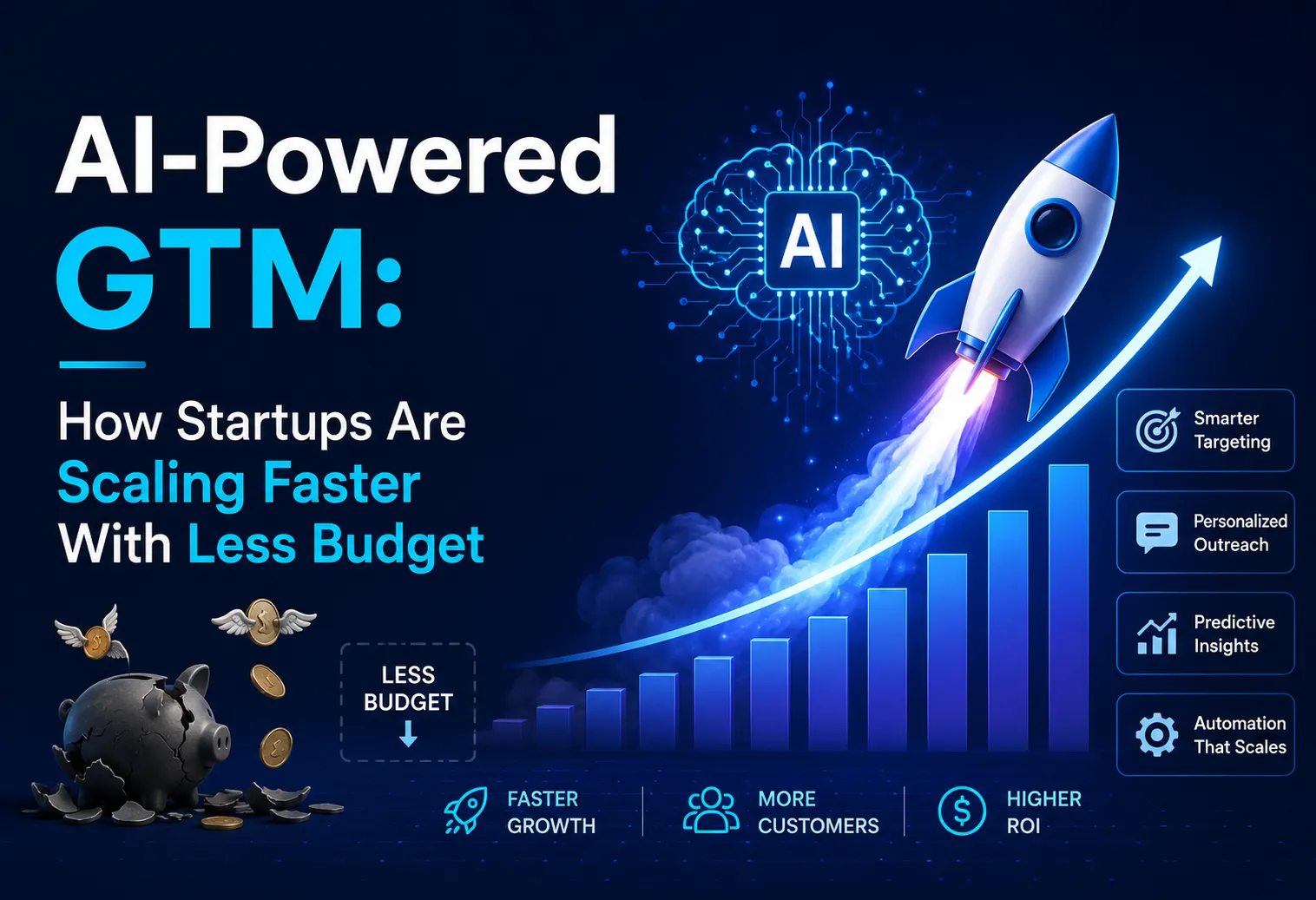

There's a quiet revolution happening in the way startups go to market. It doesn't involve bigger sales teams, splashier ad budgets, or hiring a fleet of consultants. It involves something far more accessible artificial intelligence woven directly into the go-to-market (GTM) playbook.
A few years ago, a startup chasing aggressive growth had one real option: spend more. More headcount, more paid acquisition, more agency fees. Today, founders are doing things that would have seemed impossible on a lean budget hyper-personalized outreach at scale, real-time competitive intelligence, content pipelines that run on autopilot and they're doing it with tools that cost a fraction of what a single senior hire would.
This isn't hype. It's a structural shift in how early-stage companies compete, and the startups paying attention are pulling ahead fast.
The Old GTM Playbook Was Built for Companies With Cash
Traditional GTM motions were expensive by design. You hired a demand generation team to run paid campaigns. You built a sales development team to do cold outreach. You paid a content agency to keep the blog alive. Each function had a headcount cost, a ramp-up period, and a long feedback loop before you knew what was working.
For well-funded startups, that model made sense. For everyone else, it was a slow bleed.
The problem wasn't ambition it was leverage. A team of five couldn't realistically compete with a team of fifty on volume, speed, or reach. Until now, the gap between "funded" and "scrappy" was mostly a resource gap.
AI is changing the math.
Where AI Is Actually Moving the Needle
Prospecting and Outreach
Cold outreach has always been a numbers game, but it used to be a trade-off: volume meant sacrificing personalization, and personalization meant sacrificing volume. AI eliminates that trade-off almost entirely.
Startups are now using AI tools to research prospects in seconds pulling in recent funding news, LinkedIn activity, job postings, and product launches and generating outreach messages that feel handcrafted. What used to take an SDR twenty minutes per prospect now takes under thirty seconds. A two-person sales team can cover ground that previously required ten.
The quality of the outreach matters too. Generic "just checking in" emails get ignored. Messages that reference a prospect's specific business challenge, a recent company announcement, or a strategic shift they're making those get replies. AI makes that level of specificity scalable.
Content and SEO
Content has always been one of the highest-leverage GTM channels for startups, but it's also one of the slowest to build. You write the posts, wait for Google to index them, wait for rankings to climb, and eventually maybe six months later organic traffic starts to move.
AI compresses the production side of that equation dramatically. Startups are using AI to identify content gaps, generate first drafts, build topical clusters, and optimize existing pages for search intent. A one-person marketing team can now publish at the cadence of a five-person team.
The key distinction successful startups are making: they use AI to accelerate production, not replace thinking. The strategy, the positioning, the editorial voice those still require a human. But the heavy lifting of research and drafting? AI handles it well.
Competitive Intelligence
Knowing what your competitors are doing used to require dedicated analyst time or expensive tools. Now, startups are using AI to monitor competitor websites, pricing pages, job postings, and review platforms in near real-time. Changes in a competitor's messaging can surface within hours. New product announcements get picked up before they're even widely circulated.
This kind of intelligence used to be a luxury. For startups competing against better-funded players, it's become a genuine advantage knowing when a competitor raises prices, shifts their ICP, or launches a new feature gives you a window to respond.
Customer Conversations and Insights
One of the most underrated applications of AI in GTM is what happens after the sales call. Startups are feeding call transcripts, support tickets, and customer interviews into AI tools and getting back structured summaries of objections, buying signals, frequently asked questions, and unmet needs.
This feedback loop used to be informal and inconsistent. Someone would take notes, those notes would sit in a Notion doc nobody read, and institutional knowledge would quietly evaporate when people left. AI-powered analysis makes it systematic. Your entire sales motion sharpens because you actually know why deals are won and lost.
What Separates the Startups Getting It Right
Not every startup experimenting with AI-powered GTM is seeing results. The ones that are share a few common traits.
They start with a clear GTM problem, not a technology fascination. The question isn't "how can we use AI?" It's "where is our GTM motion breaking down, and can AI fix it?" That specificity matters. Startups that chase every shiny tool end up with a stack of subscriptions and no coherent strategy.
They keep humans in the loop for judgment calls. AI is excellent at volume and pattern recognition. It is not yet excellent at reading the room, navigating a sensitive negotiation, or knowing when a prospect needs a personal touch rather than another automated touchpoint. The best GTM teams use AI to handle the repetitive and the scalable, and humans to handle the nuanced and the relational.
They measure ruthlessly. The beauty of AI-powered GTM is that almost everything is trackable. Open rates, reply rates, conversion rates at every stage, content performance by cluster and keyword the data is there. Startups that actually look at it and adjust quickly compound their advantage. Startups that "set and forget" plateau fast.
The Budget Reality
The economics here are genuinely remarkable for early-stage companies. A startup today can build a full GTM stack AI-powered outreach, content generation, competitive monitoring, CRM enrichment, and conversation intelligence for roughly what a single mid-level marketing hire used to cost. Sometimes less.
That doesn't mean headcount doesn't matter. It means headcount goes further. The right people, equipped with the right AI tools, can execute a GTM motion that would have required a much larger team just three years ago. For pre-Series A companies watching every dollar, that's not a marginal improvement. It's a different game.
A Few Honest Caveats
AI-powered GTM is not a magic fix. Garbage in, garbage out still applies if your ICP is fuzzy, your positioning is weak, or your product hasn't found its market, no amount of AI will paper over those gaps. The tools amplify what's working. They don't invent product-market fit from scratch.
There's also a real risk of over-automation. Prospects are increasingly good at sniffing out AI-generated outreach that wasn't carefully reviewed. Sequences that feel robotic, content that feels generic, chatbots that clearly can't handle real questions these erode trust faster than they build pipeline. The human layer isn't optional. It's what makes the AI layer credible.
Conclusion
The era of AI-powered GTM is not coming it's already here, and it's already separating the startups that move quickly from those still running the old playbook.
What makes this moment particularly meaningful is that the advantage no longer belongs exclusively to companies with the biggest budgets. A scrappy team with clear strategy, good judgment, and the right AI tools can out-execute a bloated competitor with twice the headcount. That's a genuine leveling of the playing field, and for founders who've always had to do more with less, it feels long overdue.
The startups winning right now aren't waiting for AI to mature further or for best practices to be established. They're building their GTM muscle with the tools available today, learning fast, and iterating. By the time everyone else catches up, they'll have a year's worth of compounding advantage.
If you're an early-stage founder or a GTM leader at a lean startup, the question isn't whether to bring AI into your go-to-market motion. The question is how quickly you can do it without losing the human judgment that makes it actually work.
That balance speed plus intentionality is the real competitive edge.



























Sign in to leave a comment.