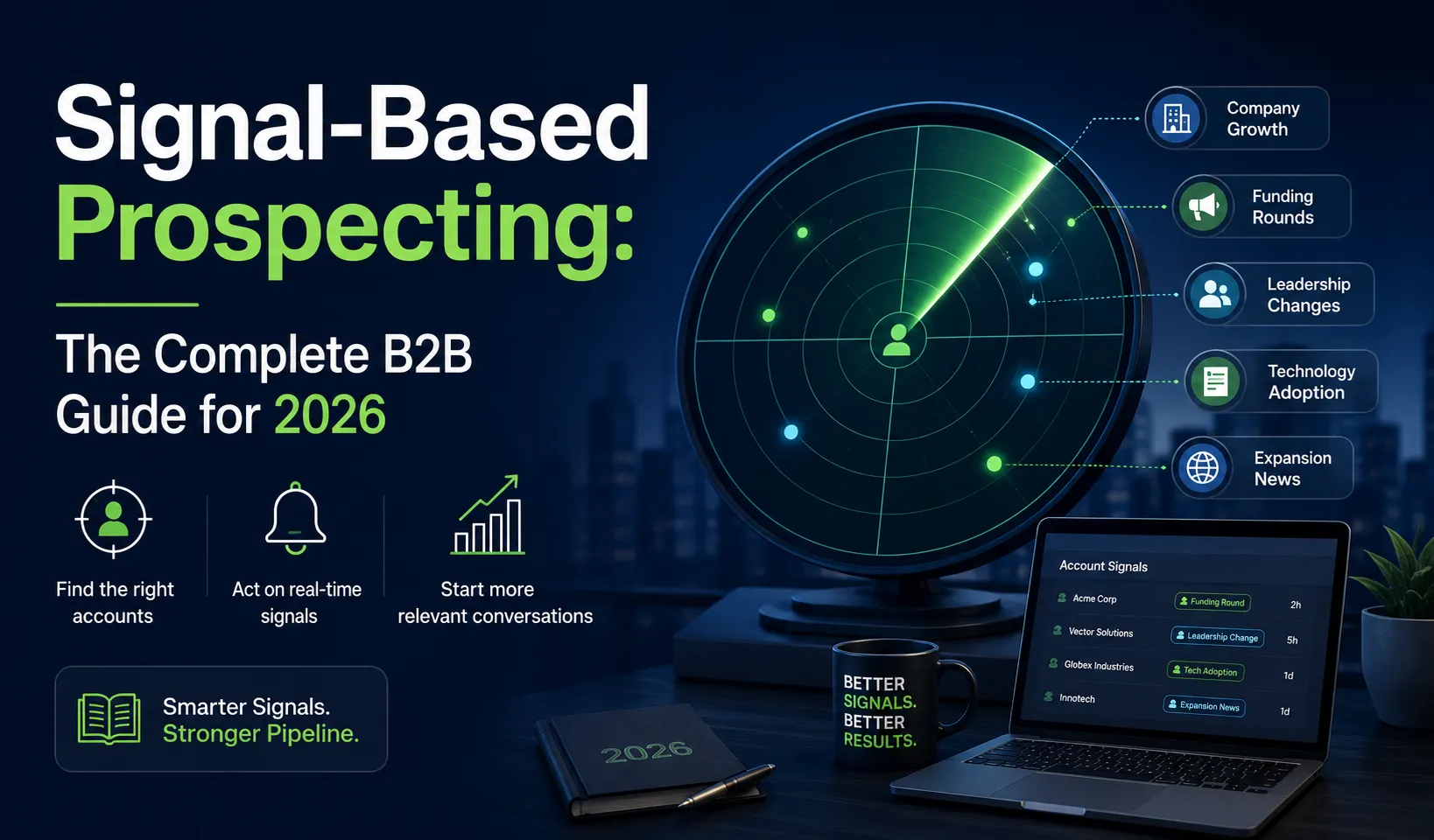

What Is Signal-Based Prospecting?
The old playbook is dead. Cold outreach built on static lists, job titles, and firmographic data alone no longer moves the needle. Buyers have grown immune to generic pitches, and the cost of spray-and-pray prospecting in time, money, and brand reputation is too high to justify.
Signal-based prospecting replaces guesswork with evidence. Instead of reaching out to anyone who fits a profile, you reach out to accounts that are actively showing intent through their behavior, their digital footprint, and real-time triggers happening inside and outside their organization. In 2026, it's the defining difference between reps who consistently book meetings and those who don't.
Why Signals Matter More Than Ever
Three forces have converged to make signal-based prospecting not just useful but essential.
Buyer behavior has shifted. Today's B2B buyers complete 60–70% of their decision-making journey before ever contacting a vendor. By the time a prospect fills out a demo form, they've already shortlisted competitors. Signals let you show up before the form is filled.
Data is everywhere. The digital exhaust generated by businesses content consumption, hiring patterns, technology installs, funding announcements, job postings, review site activity is richer and more accessible than at any point in history. The reps who know how to read it win.
AI has made synthesis possible. Manually tracking dozens of signals across hundreds of accounts used to be impossible. AI-powered tools now aggregate, prioritize, and surface the right signal at the right moment, making it practical for individual reps to run intelligent, high-volume prospecting at scale.
The Signal Stack: Types of Signals to Track
Not all signals are created equal. The most effective prospecting programs layer multiple signal types to build a composite picture of account readiness.
Intent signals reveal what a company is researching. Third-party intent data providers track content consumption across the web if an account is reading three articles a week about cybersecurity compliance, they're likely in-market. Pair this with first-party intent (e.g., your website visitors, content downloads) and you get a sharp picture of where interest lives.
Hiring signals are chronically underused and extraordinarily powerful. When a company posts five new sales operations roles, they're scaling revenue infrastructure. When they hire a Chief Revenue Officer from a competitor of yours, strategic priorities are shifting. When they post for a "Salesforce Administrator," they may be dissatisfied with their current CRM. Hiring signals reveal organizational intent before any press release does.
Technographic signals tell you what tools an account uses and what they might be replacing. If a prospect runs an outdated marketing automation platform and your solution integrates natively with their CRM, you have a compelling, specific conversation to open.
Funding and growth signals venture rounds, acquisitions, expansion announcements, new office openings indicate that budget is available and priorities are being reset. Fresh capital almost always precedes fresh vendor evaluation.
Engagement signals track how a prospect interacts with your brand. Did someone from the account attend your webinar? Visit your pricing page twice this week? Reply to a LinkedIn post from your CEO? These are warm signals that should immediately escalate an account's priority score.
Trigger events executive changes, product launches, regulatory shifts, earnings calls are time-sensitive and powerful. A new VP of Marketing is rebuilding the stack. A company entering a new market needs new tools. Acting on these within days, not weeks, is the difference between being first and being too late.
Building a Signal-Based Prospecting Workflow
Knowing what signals exist is only half the battle. The operational layer is where most teams fall short.
Step 1: Define your signal priorities. Not every signal is equally relevant to your ICP. Work with sales and marketing leadership to agree on which five to eight signals most reliably correlate with pipeline in your business. Rank them by urgency and buying likelihood.
Step 2: Set up your signal sources. Common sources include intent data platforms (Bombora, G2, TechTarget), LinkedIn for hiring and engagement signals, Crunchbase or PitchBook for funding, BuiltWith or Similartech for technographics, and your own CRM and marketing automation for first-party engagement. Many modern sales intelligence platforms Apollo, Clay, Cognism, 6sense aggregate several of these in one place.
Step 3: Score and prioritize accounts. Build a simple scoring model. Assign point values to each signal type based on urgency and relevance. An account that hits three or more high-value signals simultaneously should jump to the top of your outreach queue regardless of where they sat yesterday.
Step 4: Personalize outreach around the signal. This is the most critical step. The signal is your opening reference it directly. "I noticed you recently brought on a new VP of Sales and are scaling your SDR team we work with several companies in similar growth stages to help…" That one sentence out-performs any generic opener because it demonstrates you've done the work.
Step 5: Build signal-triggered sequences. Use automation to create workflows where specific signals automatically enroll an account in a relevant sequence. A pricing page visit triggers a timely follow-up. A funding announcement triggers a congratulatory note with a relevant use case. Speed and relevance together are unstoppable.
Common Mistakes to Avoid
Many teams collect signals but fail to act on them fast enough. A trigger event has a short shelf life a new executive is most open to vendor conversations in their first 90 days, not after they've settled in and locked a budget. Build processes that create urgency around signal response time.
Avoid over-indexing on a single signal type. Intent data alone can mislead; a company researching your category may be a competitor doing market research. Layering signals reduces false positives and sharpens targeting.
Finally, don't let personalization become performative. Mentioning a signal just to mention it without connecting it to a genuine value proposition reads as hollow. The signal should be the reason you're reaching out, not decoration on an otherwise generic pitch.
The Bottom Line
Signal-based prospecting isn't a tactic it's a philosophy shift. It moves B2B sales from interruption to relevance, from volume to precision, from cold to contextual. In 2026, the teams that build systematic, AI-assisted signal workflows will consistently outperform those still dialing from static lists. The signals are already out there. The only question is whether you're listening.




























Sign in to leave a comment.