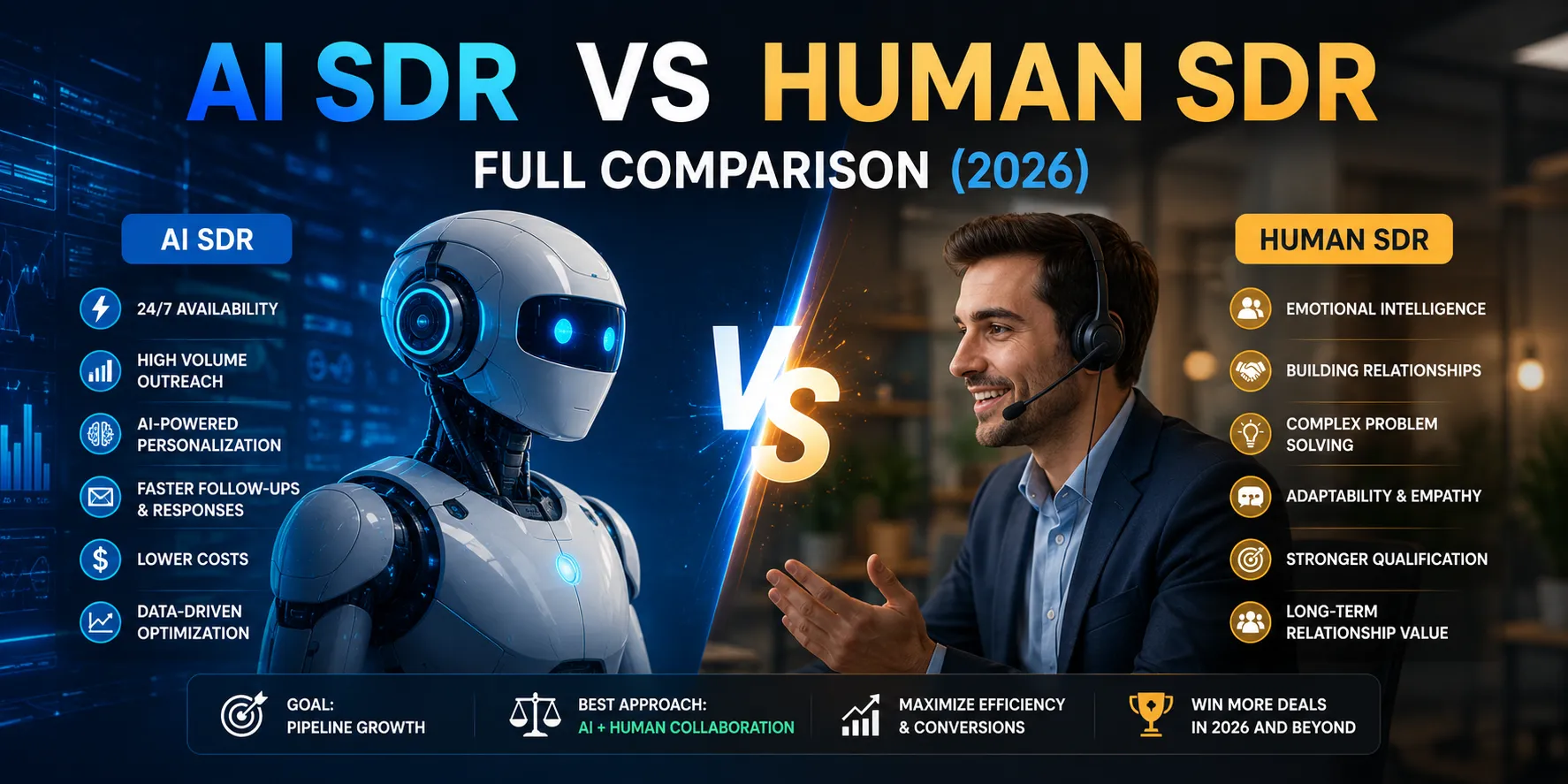

The sales development world is splitting in two and which side you're on could define your revenue for the next decade.
In 2026, the question isn't "Should we use AI for sales development?" anymore. Every serious sales org has already answered that. The real question is: Where does AI stop and where does the human begin?
AI SDRs are booking meetings while sales teams sleep. Human SDRs are closing deals that no chatbot could touch. Both are real. Both matter. But using the wrong one for the wrong job is one of the most expensive mistakes a go-to-market team can make right now.
Let's break it all down no fluff, no vendor hype.
What Is an AI SDR?
An AI SDR (Sales Development Representative) is a software-driven system that automates outbound prospecting. It identifies leads, crafts personalized outreach, sends emails and LinkedIn messages, follows up automatically, qualifies responses, and books meetings all without human intervention.
Top tools in 2026 include platforms like Artisan, 11x, Regie.ai, and AI layers built directly into CRMs like Salesforce and HubSpot. These systems run 24/7, process thousands of accounts simultaneously, and learn from every interaction.
What makes 2026 different from 2023's early chatbot wave? Context awareness. Modern AI SDRs don't just fill in a name and company field. They read recent LinkedIn posts, hiring signals, funding announcements, and product reviews and write outreach that actually sounds relevant.
What Is a Human SDR?
A human SDR is a salesperson focused entirely on the top of the funnel. They research prospects, write and send outreach, handle objections in real-time, and pass qualified opportunities to account executives.
Human SDRs bring empathy, creativity, adaptability, and genuine relationship-building things that remain extraordinarily difficult to replicate at scale with software. They can read between the lines of a prospect's hesitation, pivot a conversation on the spot, and build the kind of trust that closes enterprise contracts.
The average human SDR costs $60,000–$90,000/year in salary alone, plus benefits, training, tools, and ramp time (typically 3–6 months before full productivity).
The Head-to-Head Breakdown
1. Volume & Speed
AI SDR wins decisively.
A human SDR can realistically manage 50–80 personalized outreach touches per day. An AI SDR can execute thousands. In high-velocity, high-volume markets SaaS, fintech, e-commerce tools this gap is a massive competitive advantage. AI doesn't take PTO, doesn't have slow Mondays, and doesn't miss follow-ups.
2. Personalization Quality
Humans win for complex deals. AI wins for scale.
Here's the nuance most teams miss: AI personalization in 2026 is genuinely impressive at the surface level it references the right context, mirrors tone, and avoids the robotic templates of 2022. But for enterprise accounts where real relationship context matters shared connections, nuanced pain points, political dynamics inside a buying committee a sharp human SDR still outperforms.
For SMB and mid-market outreach? AI personalization is now good enough that prospects often can't tell the difference.
3. Cost Efficiency
AI SDR wins significantly.
A capable AI SDR platform costs $1,500–$5,000/month. That's $18,000–$60,000/year to run sequences across your entire ICP, 24/7. Compare that to the fully-loaded cost of one human SDR ($80,000–$120,000/year), and the math is stark especially when AI can do the work of 5–10 SDRs in terms of pure volume.
For early-stage startups and resource-constrained teams, this is a game-changer.
4. Handling Objections & Live Conversations
Humans win and it's not close.
This is where AI SDRs hit a wall. The moment a prospect replies with something unexpected a nuanced concern, a competitor comparison, an emotional reaction AI responses become noticeably generic or awkward. Human SDRs thrive in real-time dialogue. They can improvise, empathize, challenge, and pivot.
Any sales motion that requires back-and-forth before booking a meeting still needs a human in the loop.
5. Targeting & ICP Precision
It depends on your data quality.
AI SDRs are only as smart as the data they're fed. With clean ICP definitions and enriched data, AI targeting is excellent. But with messy CRM data or vague ideal customer profiles, AI spray-and-pray just happens faster. Human SDRs apply intuition and judgment that can compensate for imperfect data they'll skip a prospect that "looks right on paper" but feels off.
6. Compliance & Brand Safety
Humans have the edge but it's narrowing.
AI SDRs can send non-compliant emails (violating CAN-SPAM, GDPR, or cold outreach rules) if not carefully governed. They can damage brand reputation by sending tone-deaf messages at scale. A single bad prompt or misconfigured sequence reaching 10,000 prospects is a PR problem. Human SDRs make mistakes too but they're slower and more recoverable.
The best AI SDR platforms in 2026 now include compliance guardrails, but human oversight remains critical.
Who Should Use What?
Use AI SDRs when:
- You're targeting SMB or mid-market at scale
- Your ICP is well-defined and your data is clean
- You need coverage across multiple geographies or time zones
- You want to test new markets without hiring headcount
- Your ACV is under $20,000
Use Human SDRs when:
- You're selling into enterprise or strategic accounts
- Your sales cycle involves multiple stakeholders and political navigation
- Brand perception and trust are critical to the deal
- You're entering a new vertical that requires creative, adaptive outreach
- Your ACV is $50,000+
The smartest teams in 2026 use both AI SDRs handle volume prospecting and initial outreach, flagging hot responses for human SDRs to take over. It's not replacement. It's leverage.
The Honest Truth About Replacement
Will AI replace human SDRs entirely?
Not in 2026. Probably not in 2028. But the SDR role is fundamentally changing. The human SDRs who thrive are the ones who learn to work with AI using it to amplify their output, not compete against it. The ones who ignore this shift are in a difficult position.
What's already happening: companies are hiring fewer junior SDRs and investing more in AI tooling + senior reps who can manage complex conversations and close higher-value pipeline.
The SDR role isn't dying. It's evolving faster than most sales orgs are ready for.
Final Verdict
| Factor | AI SDR | Human SDR |
|---|---|---|
| Volume | ✅ Wins | ❌ |
| Cost | ✅ Wins | ❌ |
| Speed | ✅ Wins | ❌ |
| Live objection handling | ❌ | ✅ Wins |
| Enterprise relationship building | ❌ | ✅ Wins |
| Personalization (SMB) | ✅ Wins | — |
| Brand safety | ⚠️ Needs oversight | ✅ Wins |
| Adaptability | ❌ | ✅ Wins |
The future of sales development isn't human or AI. It's human and AI with each doing what it does best.
The teams winning in 2026 figured that out early. The question is whether yours has too.

























Sign in to leave a comment.