
Search has quietly changed shape. Instead of ten blue links, more and more queries now surface a synthesized answer at the very top of the page — pulled together by Google's AI Overviews, or generated conversationally inside AI Mode in Google Search. For brands, this shift means visibility no longer depends only on where you rank, but on whether an AI system trusts your content enough to quote, summarize, or cite it. Welcome to the era of AI search optimization.
Why Traditional SEO Alone No Longer Cuts It
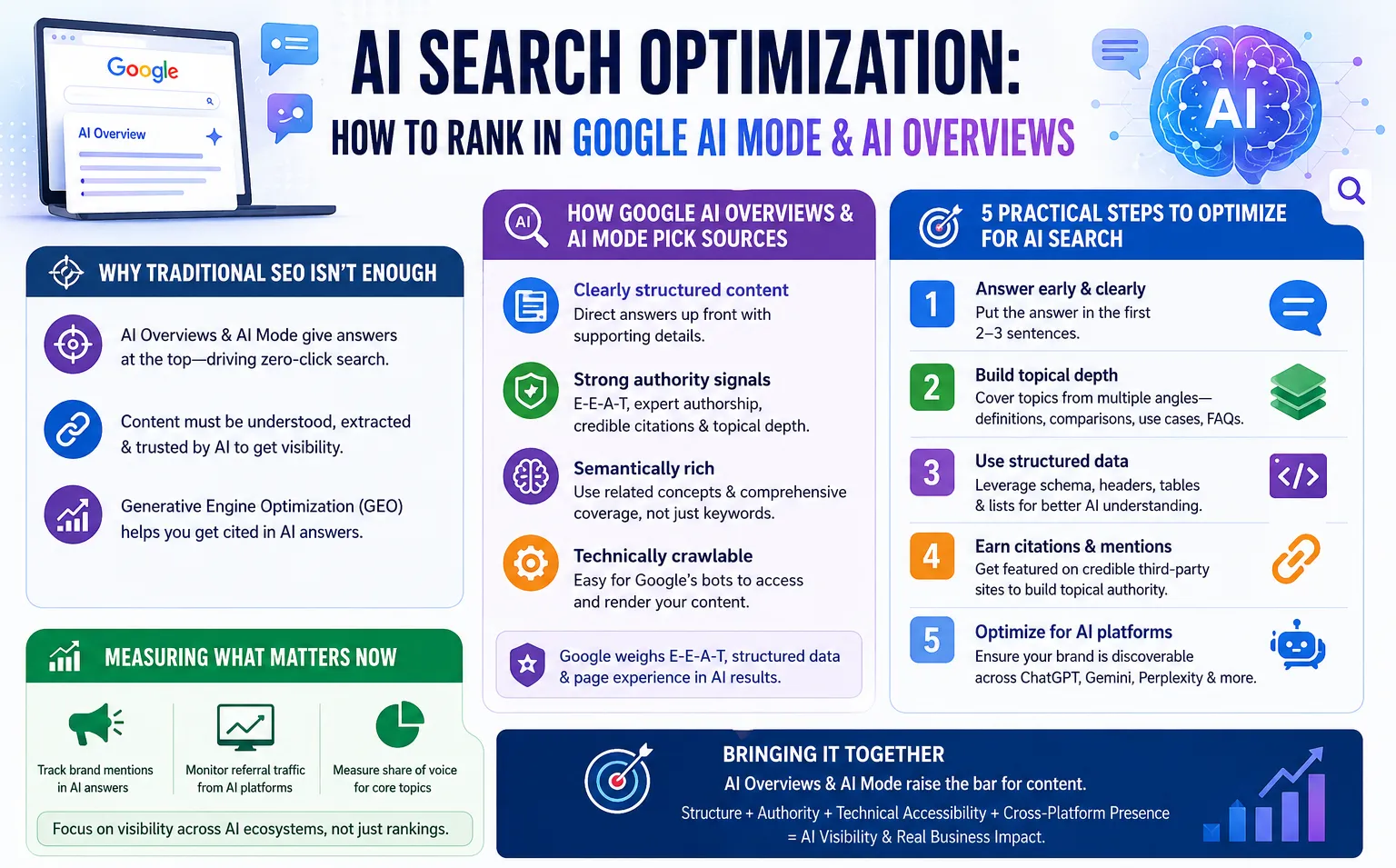
Classic SEO was built around ranking a page for a keyword. AI Overviews and AI Mode work differently — they pull fragments from multiple sources, synthesize them into a single answer, and often skip the click altogether. This has accelerated what's called zero-click search, where users get their answer directly on the results page. If your content isn't structured to be understood, extracted, and trusted by AI systems, you risk becoming invisible even if you technically "rank."
This is where Generative Engine Optimization (GEO) comes in — a discipline built specifically to help brands get cited inside AI-generated answers rather than just listed below them.
How Google AI Overviews and AI Mode Actually Pick Sources
AI Overviews don't randomly select content. They favor pages that are:
- Clearly structured, with direct answers near the top, followed by supporting detail
- Backed by authority signals — expert authorship, credible citations, consistent topical depth
- Semantically rich, using related concepts and terminology rather than just repeating one keyword
- Technically crawlable, since Google's various bots need to access and render your content properly. Understanding how Googlebot actually crawls and renders pages is now a prerequisite for AI visibility, not just traditional indexing.
Google has also confirmed it weighs long-established quality signals — E-E-A-T, structured data, and page experience — when selecting which sources to surface in AI-generated results. Brands that have already done the work outlined in guides like how to appear in Google AI Overviews tend to see a compounding advantage as AI Mode expands further.
Practical Steps to Optimize for AI Search
1. Answer the question in the first 2–3 sentences. AI systems extract concise, self-contained answers. Bury your point in the fifth paragraph, and it likely won't get pulled.
2. Build topical depth, not just keyword density. Cover a subject from multiple angles — definitions, comparisons, use cases, FAQs — the same way strong content targets "People Also Search For" and "People Also Ask" clusters. AI models reward comprehensive coverage over thin, single-intent pages.
3. Use structured data and clean formatting. Schema markup, headers, tables, and bullet lists all help AI crawlers parse and lift your content accurately.
4. Earn citations and mentions beyond your own site. AI Overviews often cross-reference multiple sources. Being mentioned across credible third-party sites strengthens your topical authority — a principle central to broader search everywhere optimization strategies that extend visibility across Google, YouTube, Reddit, and AI platforms alike.
5. Optimize for large language models too. Ranking in Google AI Overviews is only part of the picture. Buyers are increasingly discovering brands through ChatGPT, Gemini, and Perplexity as well, making it worth understanding how to get your brand discovered across AI chat platforms.
Measuring What Matters Now
Rankings alone won't tell the full story anymore. Track brand mentions inside AI answers, referral traffic from AI platforms, and share of voice for your core topics — not just position-one rankings. This is the same evolution reflected across modern SEO in the new era of search, where visibility is measured across an ecosystem of AI-driven touchpoints, not a single results page.
Bringing It Together
AI Mode and AI Overviews aren't replacing SEO — they're raising the bar for what "optimized" content actually means. Structure, authority, technical accessibility, and cross-platform presence all now matter together, not in isolation.


























Sign in to leave a comment.