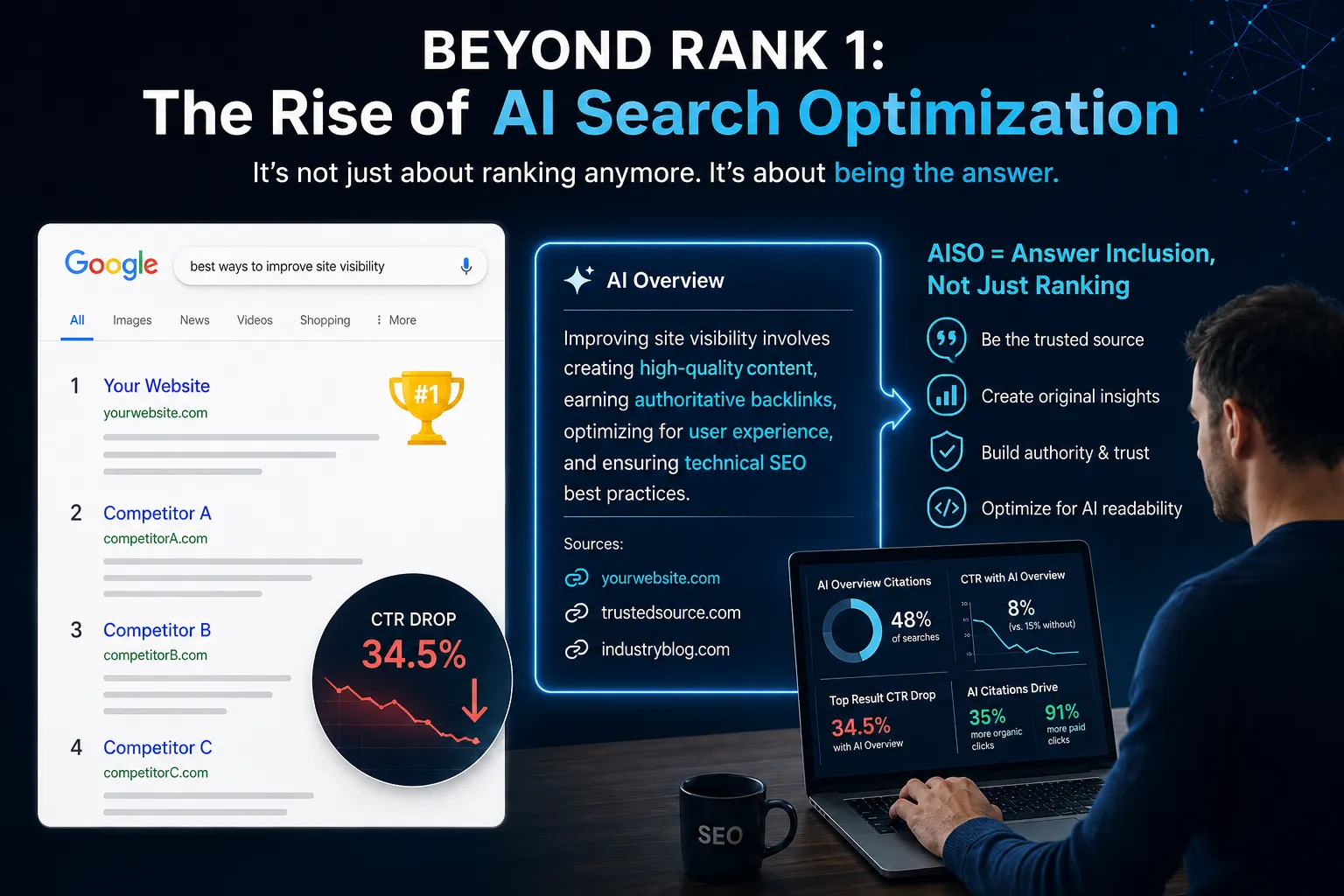
Ranking first used to be the whole game. Now it's possible to hold position one and watch the click go somewhere else entirely, because an AI-generated summary already answered the question before anyone scrolled that far.
Where the clicks actually went
AI Search Optimization (AISO) is changing what success in search looks like. Ranking first on Google used to be the ultimate goal, but today it's possible to hold the top organic position and still lose clicks because an AI-generated summary answers the user's question before they ever reach the search results. As AI Overviews become more common, visibility is no longer just about rankings—it's about becoming a trusted source that AI systems choose to cite.
None of these numbers came from the same research team, which is worth noting. Pew tracked real browsing behavior on consenting participants' devices, Ahrefs pulled from crawled SERPs at scale, and Seer Interactive ran a longitudinal study across 53 brands and 2.43 billion impressions. Three separate methodologies landed on the same conclusion, and that kind of convergence is rarer in SEO research than people assume.
Google disputes some of the framing, arguing its own data shows AI features send people to a wider range of sites, and its developer documentation on AI features and websites describes Overviews as a way to help people get the gist of a topic while still surfacing links to go deeper. Maybe both things are true at once. A feature can genuinely broaden discovery for some queries and still shrink the click-through rate for the page that used to sit at the top.
What "AI Search Optimization" is actually asking for
Old-school SEO had one target: rank high enough that a human scanning the page would click you. AISO, if the acronym has to exist, is chasing a second and arguably harder target now, which is getting quoted inside the answer itself rather than listed below it.
Those two goals don't reward the same things. Ranking still leans on keyword relevance, backlinks, and page experience, the stuff that's been true since roughly the Panda update. Getting cited leans on something closer to how well a claim can be lifted out of your page intact and checked against what three or four other sources say. A page sitting at position one can still get skipped entirely by the AI summary if what it says is too hedged, too scattered, or impossible to verify against anything else on the web.
Seer's 2026 numbers make the stakes concrete: brands that got cited inside an AI Overview picked up 35 percent more organic clicks and 91 percent more paid clicks than brands sitting at position one underneath that same Overview. Ranking well and getting nothing, or ranking lower and getting cited, are now two very different outcomes on the same results page.
Why the citation matters more than the rank
Here's the part a lot of AISO advice skips over. Google has said plainly that a page has to already be indexed and snippet-eligible in classic search before it can ever show up as a supporting link in an AI feature. So technical SEO isn't obsolete, it's just become table stakes rather than the whole strategy.
What sits above that baseline is a different kind of evaluation. Both AI Overviews and AI Mode use what Google calls query fan-out, firing off several related searches behind the scenes before stitching a response together. A single question a user types might trigger a dozen quiet sub-searches, and a page earns its citation by nailing one narrow slice of that fan-out cleanly, not by being the single best all-around page for the broad topic.
There's also a distribution question worth sitting with. Muck Rack's May 2026 analysis of over 25 million links found 84 percent of AI citations traced back to earned media and third-party editorial coverage, not brand-owned pages. Owned content still does the heavy lifting for conversion. But if the goal is showing up inside the answer, getting written about somewhere credible may matter more than publishing another page on your own site.
Writing content that gets pulled into the answer
Answer the actual question in the first couple of sentences of a section before you add the nuance. Save the caveats for after. Retrieval systems, much like an editor skimming for the lede, tend to grab the cleanest early statement of a claim rather than dig for it three paragraphs down.
Generic overviews of a topic have gotten close to worthless for citation purposes, and it's not hard to see why: a model can already synthesize that same generic summary from ten other pages without needing yours. What tends to get pulled instead is the thing none of those other nine sources said, a number nobody else ran, a method with a name, an outcome someone actually documented. Small original data beats large restated consensus almost every time.
Google keeps pointing back to E-E-A-T, experience, expertise, authoritativeness, trustworthiness, as the underlying bar for both rankings and AI features. In practice that means writing grounded in something the author actually did or measured tends to survive scrutiny better than research assembled secondhand. It's also one of the few places where mass-produced AI content is at a real disadvantage, since a model summarizing other summaries has no firsthand experience to lean on in the first place.
The technical groundwork underneath all of it
Strategy above doesn't matter if a crawler can't parse the page cleanly. Semantic HTML still helps here, and so does structured data, FAQ, HowTo, and Article schema where it genuinely fits the content rather than being bolted on for the sake of it. Page speed and mobile usability remain baseline requirements too, since AI features only draw from pages already eligible to appear in standard results with a snippet.
Site owners who want tighter control over how their content gets used can lean on standard robots.txt directives, or Google's newer AI-specific preview controls, both of which Google documents directly for anyone managing a site.
What to actually do about it this quarter
Start by auditing which of your existing pages already show up as AI Overview citations, then look for what they have in common. That pattern usually says more than any generic checklist floating around LinkedIn. Original research and documented case studies, the kind a model genuinely can't source from ten other places, have quietly become one of the better content investments a team can make right now. And it's worth putting real effort into earning mentions on other credible sites, since that's apparently where most citations are actually coming from.
Most seo agencies are also starting to fold citation tracking into their standard reporting, right alongside the usual rank tracking. The two numbers don't move together anymore, so treating them as one metric stopped making sense.
Where this is heading
Gartner predicted back in 2024 that AI assistants would absorb around a quarter of traditional search volume by 2026. Looking at the traffic data coming out of publishers this year, that call looks about right, maybe even conservative in a few verticals. That doesn't mean organic search is dying. It means what counts as a successful organic result now includes being the source an AI system trusts enough to say your name.
The teams handling this well aren't throwing out their SEO playbook. They're building a citation-first layer on top of it, writing every page so it holds up for a human reader and a retrieval system checking its claims at the same time.























Sign in to leave a comment.