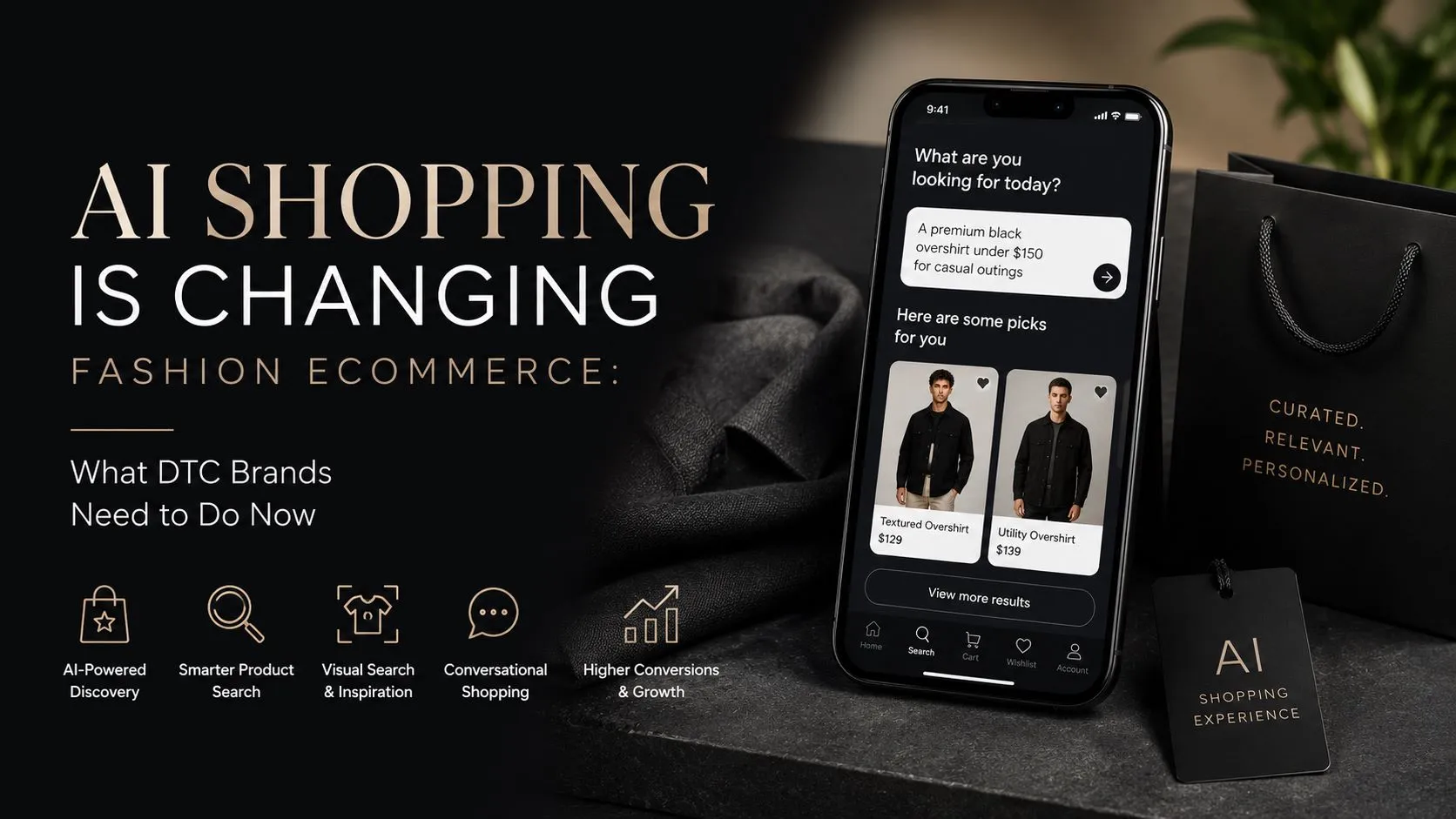

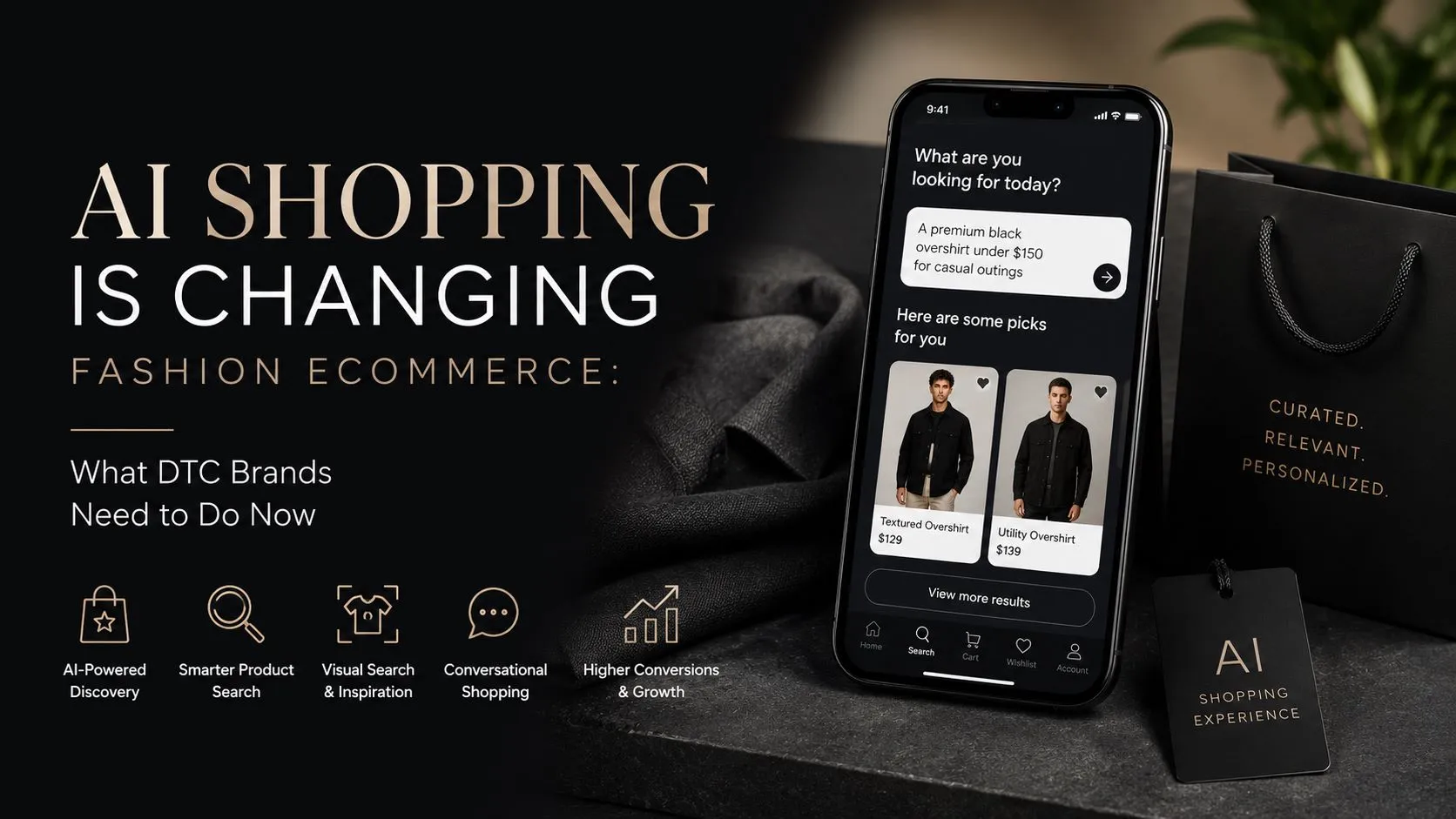
For years, fashion ecommerce was built around a familiar journey: a customer searches Google, discovers a brand through social media or an ad, visits the website, browses products, and eventually checks out.
That journey is changing.
AI shopping is moving product discovery from traditional search and scrolling toward conversations, recommendations, comparisons, and increasingly agent-assisted purchases. Google has expanded AI shopping experiences across Search and Gemini, while Shopify has introduced infrastructure that allows eligible merchants to make products discoverable across AI shopping channels.
For DTC fashion brands, this creates a major opportunity—but also a new marketing problem.
The question is no longer simply:
"How do we rank for fashion keywords?"
It is becoming:
"How do we make our products understandable, trustworthy, and recommendable to AI systems?"
What Is AI Shopping?
AI shopping refers to ecommerce experiences where artificial intelligence helps customers discover, compare, evaluate, and potentially purchase products.
Instead of searching:
"black leather jacket men's medium"
a customer might ask:
"What's a premium black leather jacket under $500 that works for smart-casual outfits and has strong customer reviews?"
The AI system can interpret the intent, compare products, consider attributes such as price and reviews, and present recommendations.
Google's current AI shopping experience can surface product information, prices, reviews, inventory information, visual inspiration, and comparisons. In India, Google has also expanded conversational shopping capabilities through AI Mode and Gemini.
That changes what fashion brands need to communicate.
Why AI Shopping Matters for Fashion Ecommerce
Fashion is particularly suited to AI-assisted shopping because customers often have complicated questions.
They may want to know:
- Which jacket works for winter?
- What trousers match these sneakers?
- Which dress is best for a wedding?
- Which jeans suit a particular fit preference?
- Is this product worth its premium price?
- How does one fabric compare with another?
Traditional product pages often answer only some of these questions.
AI shopping creates a new layer of product discovery where detailed product information can become a competitive advantage.
For AI shopping fashion ecommerce, product data is no longer just technical information for a website. It increasingly becomes part of the brand's discoverability strategy.
1. Make Your Product Data Extremely Clear
AI systems need information they can understand.
A product page should clearly communicate:
Product name: Avoid vague names that provide little context.
Category: Clearly identify whether the item is a jacket, overshirt, trouser, dress, sneaker, or accessory.
Materials: Explain fabric composition and meaningful characteristics.
Fit: Include slim, relaxed, oversized, tailored, regular, or other relevant fit descriptions.
Color: Use recognizable and consistent terminology.
Sizing: Provide measurements and fit guidance.
Use case: Explain where and when the product is designed to be worn.
Availability: Keep inventory information accurate.
Pricing: Maintain current pricing and promotional information.
The objective is simple: remove ambiguity.
If a human shopper has to guess what makes a product different, an AI shopping assistant has less useful information to work with.
2. Think Beyond Keywords
Traditional ecommerce SEO often encourages brands to focus on keyword placement.
AI search changes the importance of context.
A product shouldn't only say:
"Premium cotton shirt."
It should explain what makes it useful.
For example:
"A lightweight 100% cotton shirt designed for warm-weather business casual wear, with a relaxed fit and breathable construction."
That sentence provides far more context.
It tells an AI system—and a customer—what the product is, who it is for, and when it might be relevant.
Google has also stated that its generative AI search experiences continue to rely on core Search ranking and quality systems. In other words, traditional SEO fundamentals remain important even as the interface changes.
3. Product Reviews Become More Important
Reviews have always influenced conversion.
They can become even more valuable in AI-assisted shopping because they provide contextual evidence about products.
Consider two products.
Product A has:
"Great jacket. Love it."
Product B has:
"The jacket runs slightly oversized, but the fabric is heavyweight and works well for temperatures around 10°C. I normally wear a medium and chose a small."
The second review contains far more useful information.
Fashion brands should therefore encourage detailed reviews that discuss:
- Fit
- Quality
- Material
- Comfort
- Durability
- Sizing
- Styling
- Real-world use
This creates a richer information layer around the product.
4. Visual Search Makes Fashion Even More Interesting
Fashion is inherently visual.
Google has highlighted how users can use visual search tools to identify pieces from images and discover similar products. Its Circle to Search experience is already being used for fashion-related shopping discovery.
That means your product photography needs to do more than look beautiful.
Images should clearly communicate:
- Silhouette
- Color
- Texture
- Fit
- Details
- Styling
- Product context
This doesn't mean abandoning premium creative.
It means combining brand aesthetics with useful visual information.
Veicolo's existing work around virtual models for clothing brands is relevant here because AI-assisted fashion imagery can help brands create more variations for product discovery and creative testing.
5. Your Brand's Content Needs to Answer Questions
AI shopping doesn't eliminate content marketing.
It changes what useful content looks like.
Instead of publishing generic articles designed only to attract traffic, fashion brands should create content that answers commercial questions.
Examples include:
"What is the difference between relaxed and oversized fit?"
"How should linen trousers fit?"
"What should you wear to a summer wedding?"
"How do you style a heavyweight overshirt?"
"Is merino wool good for travel?"
These topics create opportunities to connect informational searches with relevant products.
The goal is to become a useful source of product knowledge—not simply another ecommerce catalog.
6. AI Shopping Makes Merchandising More Important
When customers browse a website, your merchandising team controls what they see.
When an AI system recommends products, the recommendation depends on how clearly the products can be understood and compared.
This means merchandising should define:
- Product relationships
- Complementary products
- Style categories
- Occasion-based collections
- Price positioning
- Product attributes
- Bestsellers
- New arrivals
- Seasonal relevance
Think beyond individual SKUs.
Create product ecosystems.
A customer buying a linen shirt might also need linen trousers.
Someone shopping for a blazer may need dress trousers.
Someone buying a technical jacket may be interested in travel pants.
AI-assisted shopping makes these relationships increasingly valuable because recommendation systems can use product context to create more relevant shopping journeys.
7. Don't Abandon Performance Marketing
AI shopping does not mean paid advertising is disappearing.
It means the role of each channel is evolving.
Paid social can still create demand.
Creators can still build trust.
Email can still drive retention.
SEO can still capture intent.
AI can increasingly influence how customers research and compare products.
The winning strategy is therefore not AI versus traditional marketing.
It is an integrated system.
Veicolo's performance creative strategy for fashion brands demonstrates the importance of combining creative testing, performance data, and iteration. AI shopping should become another layer in that system—not a replacement for it.
8. Prepare Your Store for Agentic Commerce
The biggest change may eventually come when AI doesn't just recommend products but acts on behalf of the shopper.
Shopify is already enabling eligible merchants to make products discoverable through AI channels, while agentic commerce infrastructure is being developed to support product discovery, carts, checkout, and other commerce actions within AI experiences.
For DTC brands, preparation means getting the fundamentals right:
- Accurate product catalogs
- Structured product information
- Reliable inventory
- Clear pricing
- Transparent shipping
- Clear return policies
- Detailed reviews
- High-quality imagery
- Consistent product attributes
The brands that treat these as strategic assets will be better positioned as AI commerce expands.
The New Fashion Ecommerce Advantage
AI shopping isn't simply another traffic source.
It represents a change in how customers discover and evaluate products.
Fashion brands that win in this environment will make their products easy for both people and machines to understand.
That means better product data, richer reviews, stronger visual content, useful educational pages, clear merchandising, and technically sound ecommerce foundations.
The opportunity is significant.
Instead of competing only for a position in a search result or a few seconds of attention in a social feed, brands can become part of the recommendation itself.
For DTC fashion, that's a fundamental shift.
FAQs
What is AI shopping in ecommerce?
AI shopping uses artificial intelligence to help consumers discover, compare, evaluate, and increasingly purchase products through conversational or agent-assisted experiences.
How can fashion brands prepare for AI shopping?
Brands should improve product data, descriptions, reviews, photography, inventory accuracy, structured information, and content that answers real customer questions.
Will AI shopping replace Google Search?
Not necessarily. AI shopping is becoming another discovery layer. Traditional SEO remains important because Google's AI experiences continue to use core Search systems and web content.
Is AI shopping important for Shopify fashion brands?
Yes. Shopify has introduced agentic storefront capabilities that can make eligible products discoverable through AI channels, although availability varies by merchant and channel.





























Sign in to leave a comment.