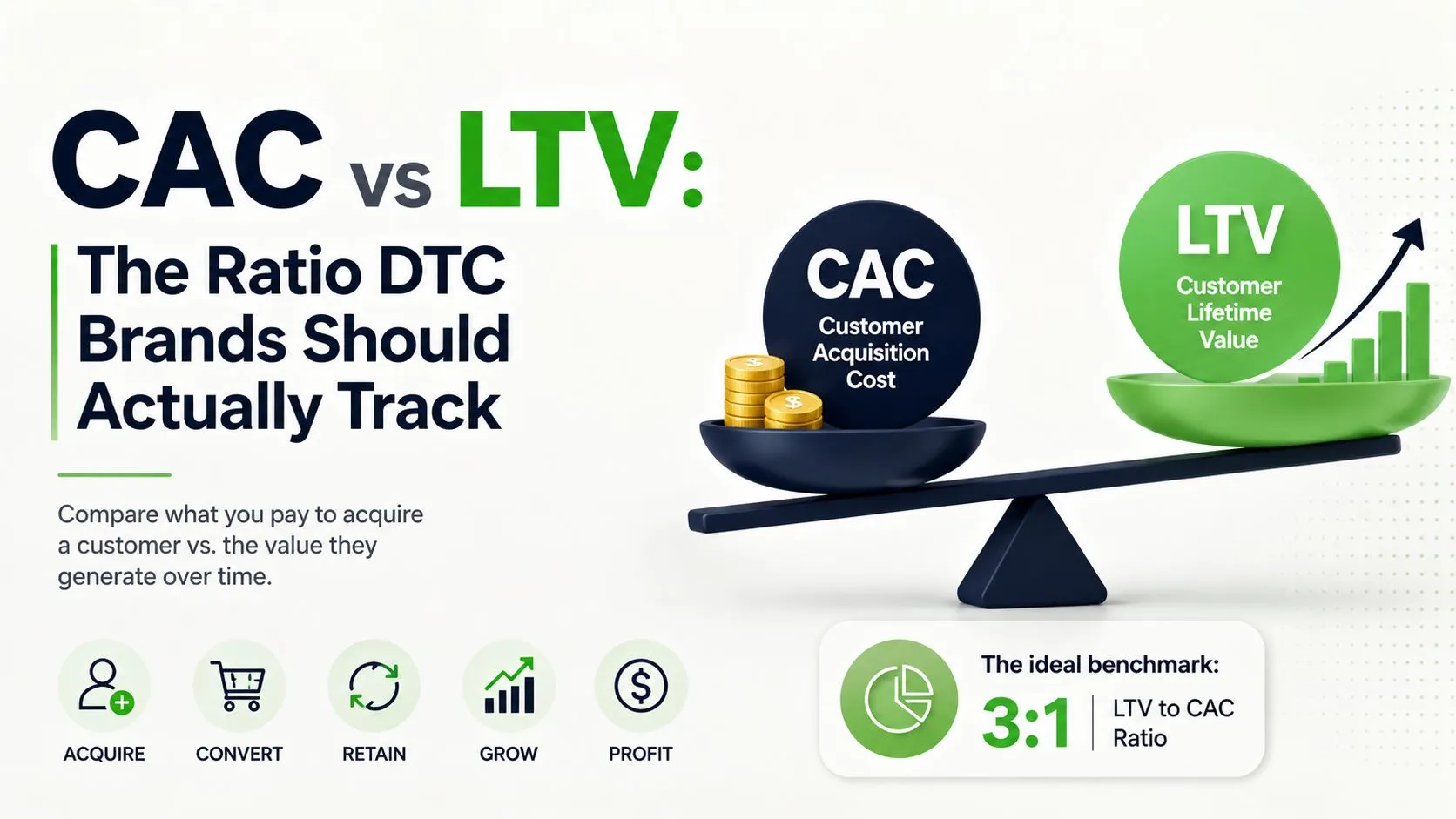

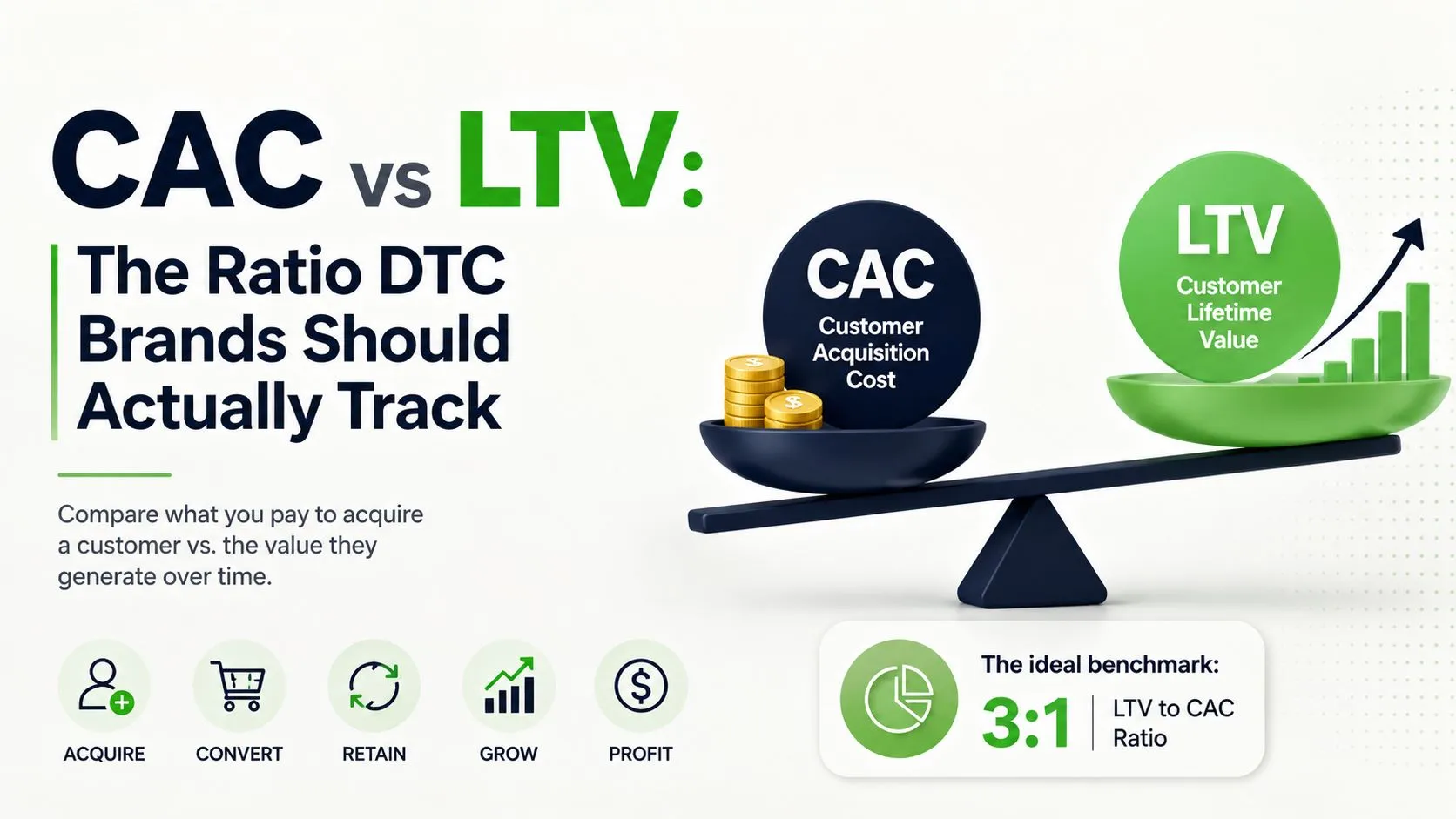
For DTC brands, revenue growth can look impressive while profitability quietly deteriorates. One of the clearest ways to understand whether customer acquisition is sustainable is by comparing Customer Acquisition Cost (CAC) with Customer Lifetime Value (LTV).
The CAC vs LTV relationship tells you how much a brand spends to acquire a customer compared with how much that customer is expected to generate over time. Tracking this relationship helps ecommerce brands make better decisions about advertising, retention, pricing, and DTC growth strategy.
What Is CAC?
Customer Acquisition Cost (CAC) measures how much your business spends to acquire a new customer.
A simple formula is:
CAC = Total Customer Acquisition Costs ÷ Number of New Customers
For example, if a DTC brand spends $20,000 on marketing and generates 500 new customers, its CAC is $40.
CAC should include more than just ad spend when you're evaluating the overall economics of your business. Depending on your reporting model, you may also consider creative, agency, technology, and other acquisition-related costs.
A rising CAC can be a warning sign that your acquisition channels are becoming less efficient.
What Is LTV?
Customer Lifetime Value (LTV) estimates the value a customer generates throughout their relationship with your brand.
A simplified calculation is:
LTV = Average Order Value × Purchase Frequency × Customer Lifespan
For example, if customers spend an average of $75 per order, purchase three times per year, and remain active for two years, estimated LTV would be $450.
However, revenue-based LTV isn't the same as profit-based LTV. Product costs, shipping, discounts, returns, and other variable expenses should be considered when determining whether the customer is actually profitable.
Why CAC vs LTV Matters
Looking at CAC alone can lead to poor decisions.
A $60 CAC may seem expensive, but if customers generate $500 in long-term value, acquisition may be sustainable.
On the other hand, a $20 CAC can look attractive until you discover that customers only generate $30 in revenue and rarely purchase again.
This is why CAC vs LTV should be evaluated together.
A commonly used benchmark is the 3:1 LTV-to-CAC ratio. In simple terms, a brand generating approximately $3 in customer value for every $1 spent acquiring that customer has a healthier starting point than a brand operating closer to 1:1.
However, the ideal ratio depends on gross margin, cash flow, purchase frequency, business model, and how quickly customers repay their acquisition cost.
How DTC Brands Can Improve the Ratio
If your CAC is too high, immediately cutting advertising isn't always the best answer.
Instead, look at the entire customer journey.
Lower CAC
Improve:
- Paid media targeting
- Ad creative
- Landing pages
- Conversion rates
- Channel efficiency
- Offer positioning
Better conversion means you can generate more customers from the same amount of traffic and marketing spend.
Increase LTV
Improving LTV often comes down to retention marketing.
DTC brands can increase customer value through:
- Email marketing
- SMS campaigns
- Post-purchase flows
- Cross-sells and upsells
- Product replenishment
- Loyalty programs
- Personalized offers
- Win-back campaigns
A customer who purchases three or four times is generally more valuable than a customer who makes a single purchase.
CAC vs LTV Should Guide Scaling Decisions
Before increasing your advertising budget, determine whether your customer economics can support additional acquisition.
Track CAC alongside LTV, AOV, repeat purchase rate, Marketing Efficiency Ratio (MER), ROAS, and contribution margin. Looking at these metrics together gives you a more complete picture of ecommerce profitability.
The goal isn't simply to achieve the lowest CAC or the highest LTV.
The goal is to build a system where customer value consistently exceeds the cost of acquiring customers.
For DTC brands, that is the foundation of sustainable and profitable growth.























Sign in to leave a comment.