
Introduction
The landscape of software testing is evolving faster than ever. As enterprises race toward digital transformation, the traditional approach of manual or semi-automated testing is proving insufficient. Complex applications, dynamic user interfaces, and rapid release cycles demand a more intelligent, adaptive, and scalable solution. This is where AI tools for testing redefine quality assurance—bringing machine learning, predictive analytics, and intelligent automation to every stage of the testing lifecycle.
AI tools not only accelerate the process but also enhance accuracy, eliminate redundancies, and enable self-learning capabilities. They help enterprises transition from reactive validation to proactive quality assurance, where systems can detect, predict, and even prevent issues before deployment. By integrating AI-driven testing, organizations gain a competitive edge in delivering flawless software faster and more efficiently.
Next-Gen AI Software Testing Transforming the Core of QA Strategy
Next-Gen AI Software Testing represents the new standard in test strategy—one that blends automation with cognitive intelligence. These solutions move beyond simple script-based execution to intelligent decision-making powered by data.
AI-driven systems automatically identify which tests to run, predict where defects are likely to appear, and continuously adapt to changing application behaviours. They analyze user journeys, historical defects, and production data to create smarter testing patterns. This predictive insight reduces redundant test runs and focuses resources where they deliver the most value.
In a continuous delivery environment, Next-Gen AI Software Testing ensures speed and accuracy go hand in hand—delivering releases that meet both functional and user experience benchmarks.
AI Software Testing Enabling Intelligent Test Case Generation
AI Software Testing introduces a paradigm where machines actively learn from historical projects to generate, prioritize, and optimize test cases automatically. By leveraging natural language processing (NLP), AI tools interpret requirement documents and user stories, translating them into executable test cases in seconds.
This eliminates the tedious manual effort typically required in test design and ensures consistency across test suites. Additionally, AI systems can assess code changes and identify which areas require retesting—making regression testing faster and more targeted.
Through AI Software Testing, organizations gain a continuously improving feedback loop. Every test execution feeds the AI model new data, refining future predictions and improving testing accuracy. This self-optimizing capability ensures that QA processes evolve with every release, maintaining long-term reliability and performance.
AI Software Quality Testing Ensuring End-to-End Reliability and Precision
AI Software Quality Testing plays a crucial role in validating performance, functionality, and user experience across environments. Modern software systems operate in complex, interconnected architectures, where even minor defects can trigger cascading failures. AI ensures complete coverage and precision through multi-layered analysis and continuous feedback.
By integrating machine learning, these systems monitor real-time performance metrics and adapt test cases to evolving system behaviours. Visual testing tools, powered by AI, validate user interfaces automatically detecting pixel-level anomalies or layout inconsistencies across devices and browsers.
In addition, AI-driven anomaly detection identifies subtle deviations in system response times or data flows that humans might overlook. As a result, software quality testing becomes predictive rather than reactive, enhancing resilience and trust in the final product.
AI Tools for Testing the Core of Intelligent Test Ecosystems
At the heart of this transformation lies the next-generation suite of AI tools for testing. These platforms integrate seamlessly into development pipelines, automating everything from test design and execution to analytics and maintenance.
AI tools like Sanciti Test AI use cognitive learning to understand application logic, identify potential defects, and validate functionality autonomously. Unlike conventional automation frameworks, these systems continuously refine their knowledge based on historical performance and testing outcomes.
Key capabilities include:
- Self-healing test scripts that automatically update when application elements change.
- Predictive test selection based on impact analysis and risk prioritization.
- Cross-platform automation ensuring consistency across web, mobile, and API environments.
- Real-time analytics dashboards offering actionable insights for developers and managers alike.
By centralizing intelligence across all QA stages, AI tools for testing help organizations build scalable, error-free software ecosystems capable of adapting to changing business demands.
AI Driven Testing Creating Predictive and Autonomous QA Workflows
AI Driven Testing brings the concept of automation full circle—evolving from simple script-based testing to systems that think, predict, and act autonomously.
These tools leverage deep learning models trained on vast datasets of historical test outcomes, production incidents, and performance metrics. Using this intelligence, they forecast failure points and automatically adjust testing strategies. For example, if the AI detects that a particular feature has a recurring issue post-deployment, it increases test coverage for that area in future cycles.
Furthermore, AI-driven testing integrates with continuous monitoring systems to detect performance degradation and trigger real-time remediation. This continuous, predictive testing cycle ensures that software remains stable even under rapidly changing conditions.
Through its self-learning architecture, AI-driven testing transforms quality assurance into a living, evolving process—one that grows smarter and more precise with each iteration.
AI in Test Automation Orchestrating the Complete Testing Lifecycle
AI in Test Automation acts as the orchestration layer that unites all testing activities under a single intelligent framework. It ensures end-to-end coordination—linking test creation, execution, reporting, and maintenance through automated workflows.
In traditional systems, automation frameworks require manual updates whenever application logic or structure changes. AI solves this by recognizing alterations through pattern analysis and adapting scripts autonomously. This not only reduces maintenance effort but also ensures tests remain relevant across evolving codebases.
Additionally, AI in Test Automation enhances collaboration between QA and development teams by providing unified dashboards with real-time insights into test coverage, defect trends, and performance benchmarks. Through intelligent orchestration, enterprises achieve continuous quality across agile pipelines—eliminating silos and accelerating product delivery.
Integrating AI Across the Software Testing Lifecycle
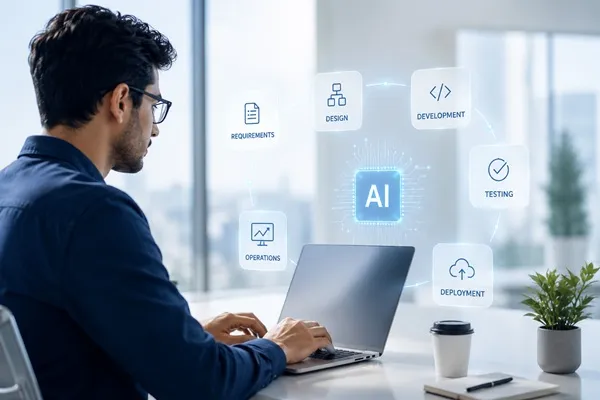
The effectiveness of AI tools lies in their holistic integration across the entire testing ecosystem. From requirement analysis to release validation, AI ensures a consistent, data-driven approach.
For instance:
- During requirement analysis, AI interprets functional specifications to auto-generate test cases.
- During test execution, AI prioritizes high-impact scenarios while monitoring system health.
- During maintenance, self-healing scripts adapt to evolving application architectures.
This continuous feedback loop ensures that each stage reinforces the next, creating an intelligent cycle of improvement. By embedding AI into every phase, testing evolves from a linear task into a dynamic, adaptive process aligned with business goals.
Business Advantages of AI Tools for Testing
The adoption of AI-powered testing tools brings measurable improvements across all key performance areas:
- Speed and Efficiency: Automation powered by AI cuts testing time drastically, enabling faster releases.
- Cost Reduction: Reduced manual intervention and self-maintaining systems minimize overheads.
- Enhanced Coverage: AI expands testing across functionalities, platforms, and user journeys.
- Predictive Accuracy: Data-driven insights anticipate failures and optimize future testing.
- Continuous Optimization: Every test cycle enhances the system’s learning and efficiency.
Collectively, these advantages drive digital agility, product reliability, and long-term cost efficiency—critical for enterprises competing in today’s high-velocity markets.
Conclusion
The era of traditional testing is ending. As applications grow more complex and customer expectations rise, enterprises must embrace intelligence-driven quality assurance. The new generation of AI tools for testing is redefining how software quality is managed—infusing automation, adaptability, and predictive power into every layer of the development lifecycle.
From Next-Gen AI Software Testing and AI Software Quality Testing to AI in Test Automation, these technologies empower organizations to achieve continuous, autonomous, and scalable QA processes.
AI doesn’t just make testing faster—it makes it smarter. By learning from data, predicting issues, and optimizing performance, AI tools are paving the way for a future where quality assurance becomes a strategic enabler of innovation and digital excellence.
Have Questions? Ask Us Directly!
Want to explore more and transform your business?
Send your queries to: [email protected]



























Sign in to leave a comment.