
If you spend any amount of time around tech Twitter, startup LinkedIn, or that one friend who won’t stop talking about the future, you’ve heard it already.
AI is taking over.
Quantum computing is about to change everything.
No, wait! AI will get there first.
Actually, quantum will make AI obsolete.
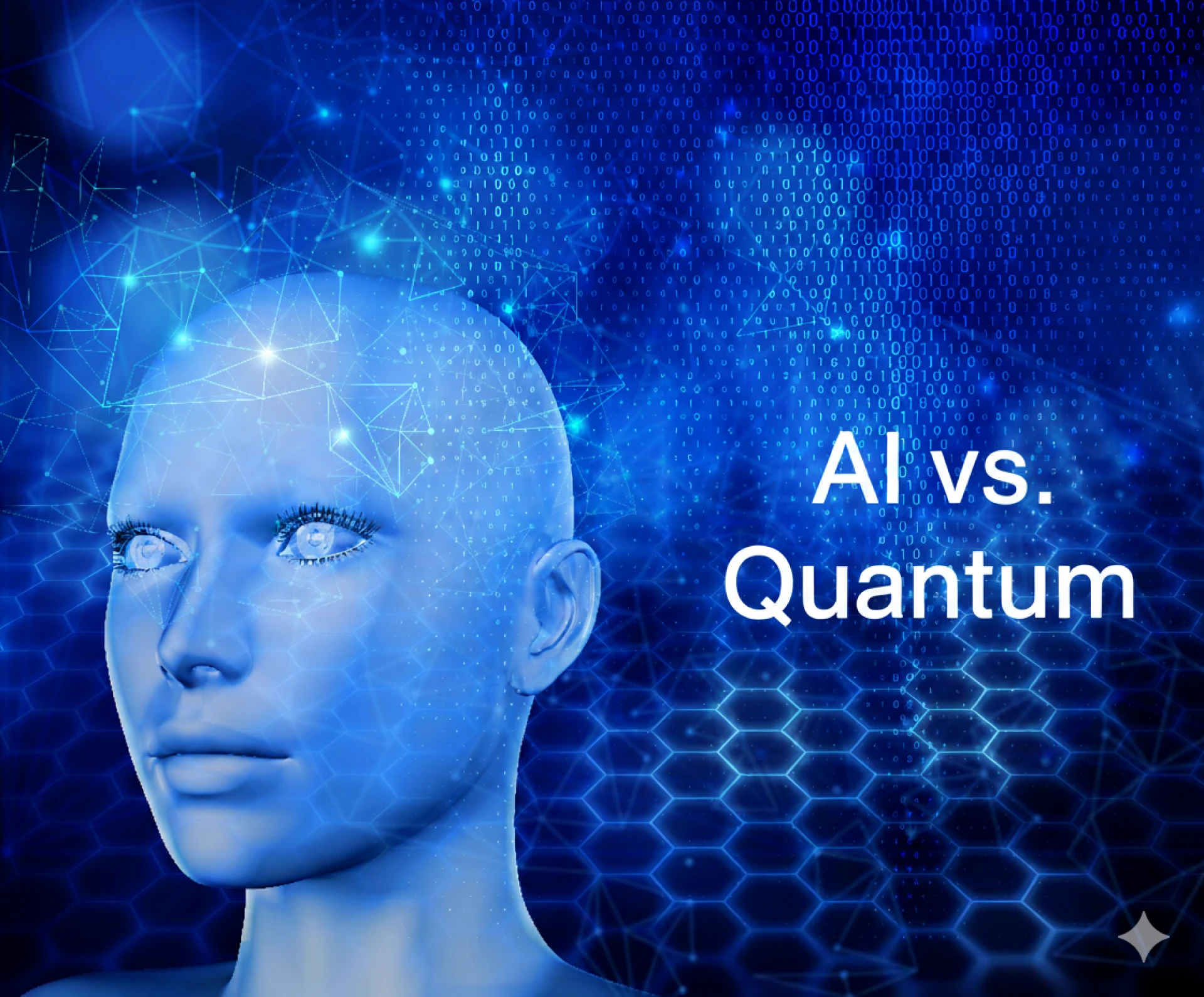
Welcome to the debate that won’t quit: AI vs. Quantum.
As we roll into 2026, both technologies are hitting major milestones. Artificial intelligence is already embedded in daily life. Examples include writing emails, driving cars, detecting fraud, and recommending what you watch next. Quantum computing, on the other hand, feels more mysterious, more theoretical, and way more sci-fi. But behind the scenes, it’s quietly leveling up.
So which one actually matters more?
Which one disrupts faster?
And are we wrong for thinking this is even a competition?
Let’s break it all down. No hype, no jargon dumps. As an AI and ML service provider, we will take a real look at Artificial Intelligence vs Quantum Computing and where things are headed next.
The State of AI in 2026: Not Hype, Just Everywhere
AI didn’t arrive with a single “aha” moment. It crept in. First autocomplete. Then recommendations. Then suddenly it’s doing customer support, medical imaging, coding assistance, and creative work.
By 2026, AI development isn’t about if companies use AI; it’s about how well they use it.
What AI is Actually Doing Right Now
AI today is practical, scalable, and profitable. That matters.
Here’s where AI is already delivering real impact:
- Predictive analytics in healthcare and finance
- Generative AI for writing, design, and video
- Autonomous systems in logistics and transportation
- Cybersecurity threat detection
- Personalized education and training
This isn’t experimental tech; it’s deployed tech.
The biggest shift happening in AI isn’t flashier models. It’s integration. AI is becoming invisible infrastructure, woven into software the same way cloud computing was a decade ago.
That’s why, in the AI vs. Quantum debate, AI feels like it’s already winning. Because it kind of is, at least for now.
Quantum Computing: The Slow Burn That Could Explode
Now let’s talk about the wildcard.
Quantum Computing isn’t new, but it’s finally moving out of the “academic curiosity” phase and into something closer to commercial reality.
Still early. Still fragile. Still expensive. But no longer theoretical.
What Makes Quantum Computing Different?
Classical computers process bits as 0s or 1s. Quantum computers use qubits, which can exist as 0, 1, or both at the same time (superposition). Add entanglement to the mix and things get weird fast.
The result?
Quantum systems can solve certain types of problems exponentially faster than classical machines.
That’s not a small upgrade. Its a category break.
Real Quantum Computing Breakthroughs
By 2026, we’re seeing:
- More stable qubits
- Reduced error rates
- Early fault-tolerant systems
- Practical quantum cloud access
- Hybrid quantum-classical workflows
These quantum computing breakthroughs aren’t replacing traditional computing—but they’re carving out very specific, very powerful niches.
And that’s where things get interesting.
Why AI vs. Quantum Is the Wrong Question (But Still Fun)
Here’s the hot take: AI and quantum computing aren’t actually competing.
They’re playing different games.
AI is about pattern recognition, learning, and decision-making at scale. Quantum computing is about solving mathematically complex problems that classical machines choke on. But they’re starting to overlap. That overlap is where the future lives.
Quantum Computing Impact on AI – The Underrated Angle
Most people frame this as AI versus quantum. But the more important conversation is quantum powering AI.
Training advanced AI models is brutally resource-intensive. It takes massive compute, huge datasets, and absurd amounts of energy.
Quantum computing could eventually:
- Speed up optimization problems
- Improve training efficiency
- Solve complex model tuning challenges
- Enhance probabilistic modeling
In other words, the quantum computing impact on AI might be bigger than quantum’s standalone impact on the world.
We’re not there yet, but the direction is clear.
AI’s Advantage: Speed, Scale, and Adoption
AI has three massive advantages over quantum computing heading into 2026.
1. Speed to Market
AI tools go from lab to product fast. Developers can build, test, and deploy in months, not decades.
2. Infrastructure Readiness
AI runs on existing hardware, cloud platforms, and enterprise systems. Quantum requires specialized environments and hardware.
3. Talent Pool
There are millions of AI engineers globally. Quantum experts? A tiny fraction of that. That’s why AI development keeps accelerating while quantum still feels niche.
Quantum’s Advantage – Solving the Impossible
Quantum’s strength isn’t convenience; it’s capability. There are entire classes of problems that classical computers just can’t solve efficiently, no matter how advanced AI gets.
Quantum shines in:
- Molecular simulation
- Drug discovery
- Cryptography
- Advanced materials science
- Complex financial modeling
This is where the future of Quantum Computing gets exciting. Not as a replacement for AI, but as a force multiplier.
AI and Quantum Technologies in 2026
Let’s ground this in reality.
In 2026:
- AI is mainstream, commercial, and everywhere
- Quantum is early-stage, specialized, and expensive
- Hybrid systems are emerging
- Governments and enterprises are investing heavily
- Startups are experimenting, not scaling
The companies winning right now aren’t choosing sides; they’re exploring both. That’s the real shift in AI and quantum technologies in 2026.
The Business Perspective
Big tech isn’t guessing. They’re hedging.
- AI gets immediate ROI
- Quantum gets long-term strategic value
Cloud providers are bundling quantum access alongside AI tools. Pharma companies are experimenting with quantum simulations. Financial institutions are testing quantum optimization models.
Artificial Intelligence vs Quantum Computing, Industry by Industry
Healthcare
AI dominates diagnostics and workflow automation. Quantum shows promise in drug discovery and protein folding.
Finance
AI handles fraud detection and trading strategies. Quantum targets portfolio optimization and risk modeling.
Cybersecurity
AI defends systems in real time. Quantum threatens current encryption—and forces a shift to post-quantum security.
Manufacturing
AI optimizes operations. Quantum explores materials and process optimization. Different tools. Different timelines. Same disruption potential.
The Human Factor: Why AI Feels More “Real”
AI interacts with people. Quantum doesn’t, at least not directly.
That matters.
When people see AI writing, speaking, and creating, it feels personal. Quantum computing operates behind the scenes, crunching math most of us will never see.
Perception drives adoption, and adoption drives disruption.
That’s another reason AI vs. Quantum feels lopsided right now.
AI and Quantum Innovation: The Collision Course
The most interesting developments aren’t happening within AI or quantum alone.
They’re happening at the intersection.
We’re seeing:
- AI-assisted quantum error correction
- Machine learning models optimizing quantum circuits
- Hybrid algorithms blending classical AI with quantum speedups
This is AI and quantum innovation at its best—each tech making the other better.
So… Who Wins?
If you’re forcing the question:
- AI wins the next 5 years
- Quantum wins the next 20
- Hybrid systems win the long game
The Future of Quantum Computing isn’t about replacing AI, it’s about expanding what AI can do.
And the future of AI might depend more on quantum than most people realize.
Final Thoughts
The AI vs. Quantum debate makes for great headlines, but it misses the point. These technologies aren’t rivals. They’re layers. AI is the interface. Quantum is the engine. Together, they’re shaping a future that looks very different from anything we’ve seen before, and 2026 is just the beginning. If you’re building, investing, or just trying to understand where tech is headed, don’t ask which one wins. Ask how they connect. That’s where the real disruption lives.



Sign in to leave a comment.