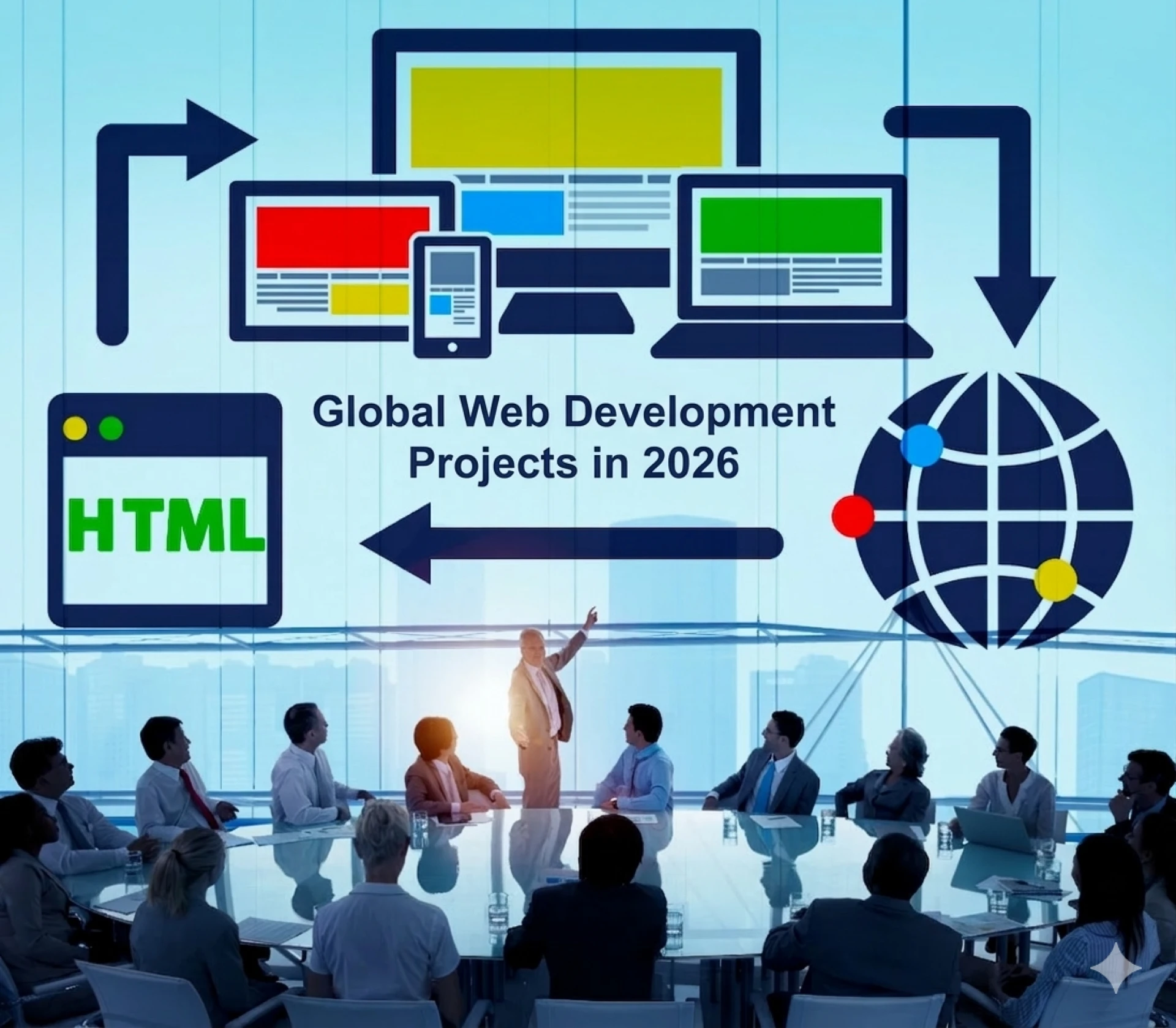

As we look forward to 2026, global web development projects will continue to be an exciting prospect while providing many difficulties in terms of strategy.
If you have ever attempted to work with a developer based in New York City, Berlin, or Singapore, then you know the timezone issue is real. There will be times when deadline dates get mixed up; there may be issues with hand-offs that have stalled, and there will be times when communicating can become difficult due to long time differences.
Those organizations that have been successful in managing these factors have taken advantage of their ability to utilize the latest technology to overcome the hurdles associated with distributed work globally, and as such, they are winning by providing faster delivery, higher quality, and using cutting-edge technology that spans any location in the world.
The following describes how some leading companies are turning this global distributed chaos into a globally unified method of working by addressing three very important questions that each CTO, CEO, and CMO is asking.
Key Takeaways
- Global web development is all about working together in a way that is structured but allows for flexibility.
- Time zone management in development projects relies on first establishing a Company Culture and then putting into place the proper Tools to facilitate Development.
- The Power of Artificial Intelligence is creating more predictable and efficient planning and delivery of work products and services.
- Having a unified and transparent communication will create accountability and trust across multiple countries.
- The future of global web development will be existing using automation, empathy, and intelligence together and balancing those components.
How Can Businesses Master Time Zone Management in Global Web Development?
To effectively manage a global team, you need to build an atmosphere where trust, visibility, and equilibrium exist among team members so that their project does not lose any momentum. To accomplish this, you must create a strategy built around the following elements:
Strategy 1: Adopt 24-Hour Productivity Models
One of the best approaches to maximize the productivity of your team members is to implement a follow-the-sun type of workflow where numerous developers from various regions take turns handing off the work they have done to the next developer. Your workflow should consist of tools for time zone management in development and well-established collaboration rituals.
Implement templates for the transfer between developers to ensure that nothing gets lost in the transition. Utilize any overlapping hours of availability for sync-ups on a scheduled basis.
Strategy 2: Use Smart Collaboration Tools
Not all tools are created equal. Think of them as the digital infrastructure for global innovation.
- Leverage leading web development project management tools like Jira, Asana, or ClickUp.
- Adopt platforms integrating chat + code + performance tracking in one place.
- Use asynchronous tools (Loom, Notion, Confluence) to preserve clarity between time zones.
Strategy 3: Prioritize Communication over Coordination
In global web development, communication is your invisible superpower. Encourage developers to over-communicate instead of assuming alignment.
- Introduce “clarity-first” communication norms.
- Use documentation as a living product asset.
- Make retrospectives a routine, not a post-mortem.
Strategy 4: Build a Culture That Transcends Time
Culture bridges what clocks divide. Unified teams don’t just share tools, they share trust.
- Celebrate wins across locations simultaneously.
- Rotate meeting times fairly to respect all time zones.
- Encourage flexible schedules to foster inclusion and reduce burnout.
Strategy 5: Optimize with Automation
Automation minimizes friction across time zones.
- Deploy continuous integration pipelines that work while your team sleeps.
- Automate testing, deployment, and reporting workflows.
- Use smart assistants to schedule, summarize, and analyze project communications.
What Are the Best Strategies for Managing Global Web Development Teams?
Building cohesion in global web development teams means understanding human collaboration beyond tools; it’s about empathy-driven leadership that scales across continents.
Practice 1: Build Around Strengths
Instead of standardizing roles, diversify them. Regional specialties can be leveraged uniquely.
- Encourage local teams to innovate based on their market experience.
- Create a knowledge-sharing rhythm: weekly “global syncs” help unify direction.
Practice 2: Embrace Hybrid Workflows
Modern teams thrive on flexibility. Blending synchronous and asynchronous workflows produces momentum without burnout.
- Use asynchronous documentation for clarity, synchronous sessions for creativity.
- Optimize developer hours for peak productivity, not rigid availability.
Practice 3: Set “North Star” Goals for Alignment
To keep everyone moving in rhythm, clearly define end goals linked to measurable impact.
- Align every sprint to business outcomes.
- Focus less on “what to do” and more on “why it matters.”
Practice 4: Foster Accountability Through Transparency
Global project delivery strategies thrive when everyone can track progress in real-time.
- Use dashboards to display KPIs, bugs, and velocity metrics.
- Share progress updates openly across all regions; transparency builds accountability.
Practice 5: Strengthen Cross-Cultural Empathy
Leading global web development teams is also about understanding differences: communication styles, feedback norms, and motivation.
- Train team leads on cross-cultural communication.
- Encourage peer recognition programs to strengthen bonds.
Unified Infotech, for example, has refined international collaboration models that balance flexibility with structure, reducing friction across continents without compromising delivery speed or quality.
How Is AI Transforming Quality and Delivery in Web Development in 2026?
The new frontier of web development in 2026 lies in intelligence, not just artificial intelligence but augmented intelligence, empowering developers to focus on creative, high-value tasks.
Trend 1: Predictive Project Planning
AI now predicts delays before they occur. Systems analyze workloads, bandwidth, and dependencies for proactive resolution.
- Integrate tools that flag bottlenecks automatically.
- Adapt schedules dynamically based on global velocity data.
Trend 2: AI-Driven Quality Assurance
Quality assurance in web development has evolved from manual checks to automated, insight-driven predictions.
- AI algorithms detect bugs, regressions, and performance issues early.
- Smart analytics offer improvement recommendations instantly after each deployment.
Trend 3: Continuous Localization and Personalization
The future of global web development focuses on experience, not just performance.
- AI ensures localized content and UX adaptations across markets.
- Smart CMS systems adjust design and layout for cultural contexts in real-time.
Trend 4: Sustainable Development Practices
As businesses scale globally, sustainability is becoming a quality metric.
- AI optimizes resource allocation to reduce cloud consumption.
- Predictive systems balance performance and environmental impact efficiently.
Trend 5: Collaborative AI for Documentation and Learning
AI copilots are now co-authors of code and team knowledge.
- Automated summaries keep remote teams updated asynchronously.
- Learning bots track team knowledge gaps and suggest micro-training.
Through AI-led strategies, global web development now achieves unprecedented quality while cutting delivery times dramatically , creating a competitive advantage that redefines innovation velocity worldwide.
Conclusion
By 2026, the line between local and global teams has blurred forever. Success in global web development no longer hinges on managing developers across time zones; it depends on nurturing a system where collaboration, quality, and innovation never sleep.
Organizations embracing AI in global web development are already witnessing faster cycles, smarter decisions, and unmatched scalability. For leaders navigating this shift, the best investment isn’t purely technological; it’s strategic alignment between people, process, and innovation.
When tech and teamwork move together, distance turns from a limitation into a growth engine. That’s the real art of modern web project delivery strategies, building systems where the sun never sets on development.

























Sign in to leave a comment.