

A Visitor Management System is one of the most impactful yet underutilized security tools available to Omani businesses today. Whether you operate a commercial office in Muscat, a logistics depot in Salalah, or a government-aligned facility anywhere across the Sultanate, knowing who enters your premises - when, why, and with whose authorization - is the bedrock of a defensible physical security posture.

Legacy paper logbooks cannot meet the auditability, speed, or accuracy requirements of Oman's evolving regulatory landscape. This article examines exactly how modern visitor management software hardens entry-point security, what features to prioritize, and how Omani organizations in different sectors are already benefiting from the transition.
1. Why Visitor Security Is a Strategic Priority in Oman
Oman's Vision 2040 economic diversification agenda is attracting record levels of foreign direct investment and international business travel, according to the Oman Investment Authority (2024). This growth translates directly into higher visitor volumes at commercial, industrial, and government facilities - making structured visitor tracking and identity verification a security necessity, not a luxury.
At the same time, the Royal Oman Police has tightened oversight of workplace access records in sensitive sectors, and TRA's Cybersecurity Framework 2024 requires organizations to maintain tamper-proof, auditable logs of physical access. Paper visitor books - vulnerable to illegible entries, lost pages, and deliberate falsification - fail this standard categorically.
2. How a Visitor Registration System Closes the Identity Gap
The first line of defense in any visitor security strategy is accurate identity capture. A Visitor Registration System replaces manual paper entries with a digital intake process that captures the visitor's full legal name, employer or organization, purpose of visit, host employee, vehicle registration, and a government-issued ID reference - all in under 60 seconds via a self-service kiosk or pre-arrival QR code link.
Pre-registration is particularly powerful for planned visits: a host sends the guest an invitation link 24 hours before arrival. The visitor completes their details on their own device, receives a unique check-in code, and simply scans it at the front desk. This workflow eliminates manual data-entry errors, prevents queue formation at busy receptions, and ensures that security teams have advance notice of who is expected - allowing background checks or clearance workflows to run before the visitor arrives.
- Instant Record Creation: Every visit generates a timestamped, encrypted digital record -searchable and retrievable in seconds for compliance audits or incident investigations.
- Pre-Visit Screening: Health declarations, NDA acknowledgements, or site induction confirmations can be embedded in the pre-registration flow, ensuring compliance before the visitor sets foot in the building.
- Watch-List Integration: Visitor identities can be cross-referenced against internal or third-party access denial lists in real time, flagging unauthorized individuals before they reach the front desk.
3. Visitor Identification: Verifying Who Is Really at the Door
Capturing a visitor's name is not enough - security requires verifying it. Visitor identification is the process of confirming that the person standing at the entrance is exactly who they claim to be. Modern visitor management software achieves this through three mechanisms:
- Photo Capture at Check-In: The system photographs each visitor at the point of arrival. The image is attached to their digital record and printed on their badge, enabling any staff member on the floor to visually verify identity without consulting a dashboard.
- Government ID Scanning: Integrated ID scanner modules extract data directly from national identity cards, passports, or driving licences - eliminating manual transcription errors and confirming the visitor's legal identity against their stated details.
- Badge Printing: A visitor badge bearing the guest's name, photo, host, permitted zones, and expiry time is printed in seconds. Colour-coded badge categories (visitor, contractor, VIP, temporary staff) give security personnel an at-a-glance access-level indicator.
4. Visitor Authentication: Adding a Second Layer of Security
For facilities that handle sensitive data, financial assets, or regulated materials, identification alone is insufficient. Visitor authentication adds a second verification factor to confirm not only who someone is, but that they are genuinely authorized to enter a specific area at that specific time.
Common authentication methods include an OTP (one-time password) sent to the visitor's pre-registered mobile number, biometric fingerprint capture for repeat contractor access, or host approval via a real-time push notification to the employee's smartphone. The host must actively approve entry before the system unlocks the door or prints a badge - creating a digital approval trail that is admissible as evidence in the event of a security incident.
For Omani government buildings, data centers, and financial offices in Muscat, multi-factor visitor authentication is rapidly becoming a compliance expectation rather than a premium feature
5. Visitor Tracking: Real-Time Visibility Across Your Entire Facility
Knowing who entered is valuable. Knowing who is still on-site right now is operationally critical - particularly during emergencies, fire evacuations, or security lockdowns. Visitor tracking provides a live dashboard showing every active visitor, their current permitted zone, their host, and their expected departure time, updated in real time as they move through check-in and check-out workflows.
For large facilities in Salalah's industrial and port zones - where hundreds of contractors may be on-site simultaneously across multiple access zones - real-time visitor tracking is the only practical way to enforce zone-specific permissions, ensure contractor induction status is current, and generate an accurate headcount within seconds during an emergency muster.
- Emergency Evacuation Lists: One click generates a complete list of everyone currently on-site, zone by zone - eliminating the dangerous delays caused by manual paper-roll headcounts during incidents.
- Overstay Alerts: Automated notifications flag visitors who have not checked out by their expected departure time, prompting security to verify their status.
- Contractor Zone Compliance: Access permissions are enforced per zone, and the system logs every movement - creating an auditable trail that satisfies HSE and insurance requirements.
6. Visitor Management System Oman: Regional Deployment Profiles
Visitor Management System Muscat - Corporate, Hospitality & Mixed-Use
Muscat's Class-A commercial buildings, luxury hotels, and government-adjacent offices demand seamless visitor flows without compromising perimeter integrity. A cloud-hosted Visitor Management System Muscat enables multi-tenant buildings to maintain individually partitioned visitor logs per company, issue company-branded badges, and integrate with Outlook and Google Calendar so invitation links fire automatically when a meeting is scheduled. Mobile credential issuance and license-plate recognition for car park access are now standard expectations in Muscat's Al Khuwair and Al Azaiba business districts.
Visitor Management System Salalah - Industrial, Port & Free Zone
Salalah's deep-water port and Special Economic Zone (SEZAD) manage thousands of contractor, logistics, and freight operator visits daily. A ruggedized, offline-capable Visitor Management System Salalah is engineered for environments where internet connectivity may be intermittent and contractor induction status must be verified before physical site access is granted. Vehicle access control barriers synchronized with pedestrian entry, explosion-proof hardware options, and HSE compliance module integration make industrial deployments in Salalah functionally distinct from corporate rollouts in Muscat.
7. The Visitor Management Device: Hardware That Delivers the Experience
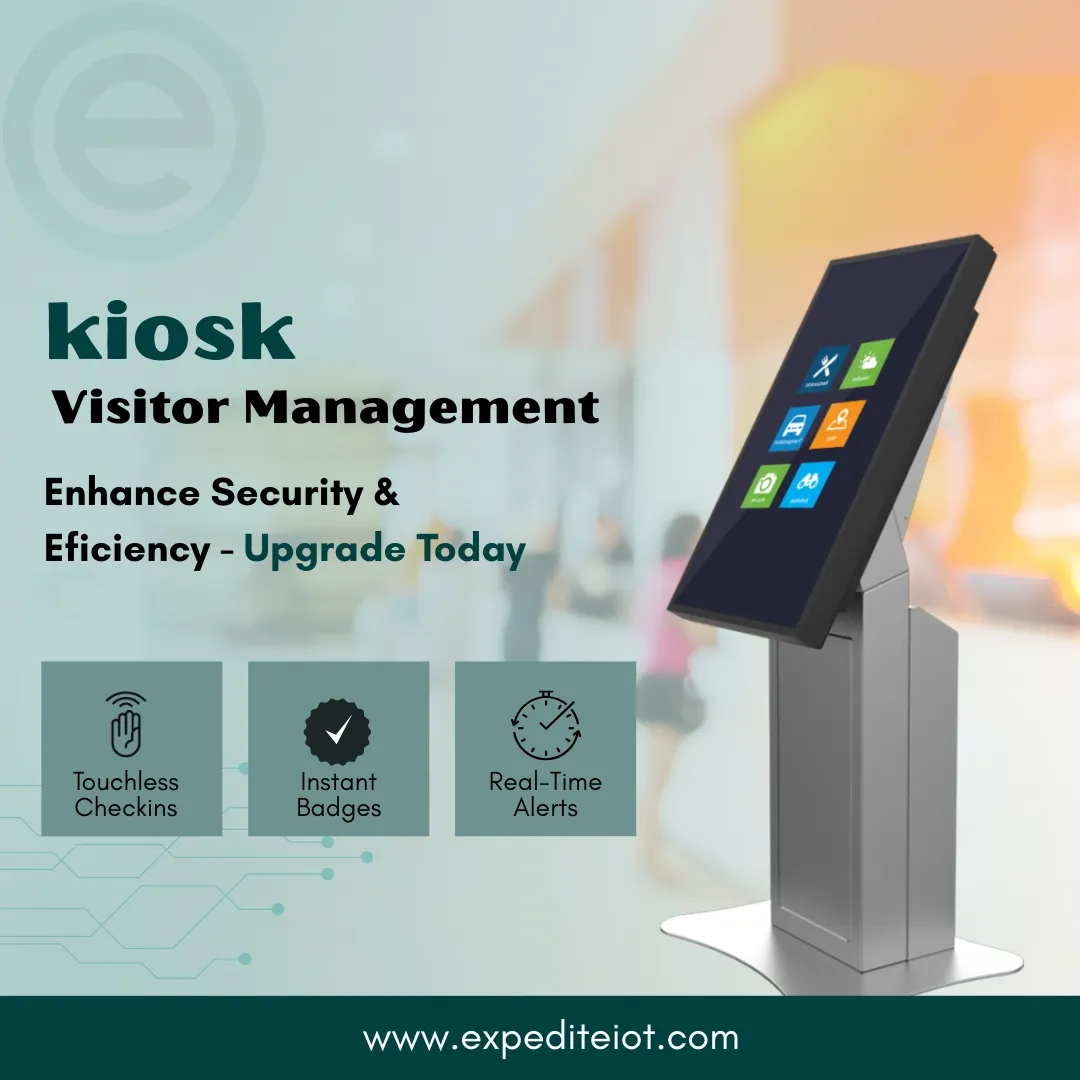
The Visitor Management Device is the physical endpoint through which every check-in, photo capture, badge print, and authentication event is executed. A purpose-built device - typically a wall-mounted or counter-top touchscreen tablet running dedicated visitor management software - provides a consistent, branded, and intuitive experience for every guest.
Key hardware considerations for Omani deployments include offline mode capability (for locations with intermittent connectivity), IP-rated enclosures for industrial environments, integration ports for badge printers and ID scanners, and open APIs that connect the device to door access control panels and CCTV platforms. The visitor management device is the point where physical security and digital identity management converge - its reliability directly determines the integrity of the entire system.
8. Why Omani Organizations Trust Expedite IoT for Visitor Security
Expedite IoT has delivered integrated physical security ecosystems across the GCC for over a decade, with proven deployments in Saudi Arabia, Qatar, and Oman. Their Visitor Management System platform is purpose-built for the operational realities of SMEs and enterprise facilities alike: rapid deployment (typically under 48 hours for a single site), trilingual Arabic-English-Hindi interfaces for Oman's diverse workforce, and modular licensing that lets organizations start with core check-in and scale into advanced analytics, multi-site management, and access control integration as needs evolve.
Every Expedite IoT deployment begins with a workflow audit and compliance mapping against Oman's security standards - ensuring the system is not just technically capable but legally defensible in the event of a TRA review or Royal Oman Police inspection. Post-deployment, a dedicated local support team provides 24/7 monitoring, firmware updates, and scheduled system health reviews.
Conclusion
A properly deployed Visitor Management System does more than log who walks through the door - it creates a layered, auditable security infrastructure that protects people, assets, and data at the most vulnerable point of any facility: the entry. Through structured visitor registration, rigorous visitor identification, multi-factor visitor authentication, and real-time visitor tracking, Omani organizations can meet today's regulatory expectations and tomorrow's security challenges simultaneously.
For businesses in Muscat's corporate towers or Salalah's industrial zones, the investment in a purpose-built visitor management device and visitor management software platform pays for itself through reduced security incidents, streamlined compliance, and the professional credibility that wins contracts with government entities and international partners.
Expedite IoT is ready to design, deploy, and support a Visitor Management System in Oman tailored to your facility, sector, and growth trajectory. Contact the team today for a no-obligation site assessment and compliance mapping.
FAQs
1. What specific security risks does a Visitor Management System address in Oman?
A Visitor Management System addresses unauthorized physical access, credential sharing between individuals, tailgating at entry points, and the absence of auditable records during compliance reviews or incident investigations. In Oman's regulatory environment, where the TRA Cybersecurity Framework and Royal Oman Police directives require tamper-proof physical access logs, the system also mitigates legal and licensing risk for organizations operating in sensitive sectors.
2. How does visitor authentication differ from visitor identification in practice?
Visitor identification confirms who someone is - through photo capture, ID scanning, or badge verification. Visitor authentication confirms they are authorized to enter a specific area at that specific time - through an OTP, biometric scan, or real-time host approval via push notification. High-security facilities in Oman, such as data centers, government buildings, and bank branches, typically require both layers before granting access.
3. Can visitor tracking integrate with our existing access control and CCTV systems?
Yes. Modern visitor management software provides open APIs that connect with door access control panels, IP camera platforms, and HR systems. When a visitor checks in, their profile can automatically trigger a door unlock event, populate a CCTV audit feed, and notify the host - creating a unified security record that links identity, movement, and visual verification in a single searchable database.
4. How long does it take to deploy a Visitor Management Device at our Muscat or Salalah facility?
For a single-site deployment with standard check-in, badge printing, and host notification, Expedite IoT typically completes hardware installation, software configuration, and staff training within 24 to 48 business hours. Multi-site enterprise rollouts with biometric authentication, access control integration, and custom compliance workflows may require one to two weeks. A pre-deployment workflow audit significantly reduces go-live time and post-installation adjustments.
5. Is visitor management software compliant with Oman's data protection requirements?
A reputable visitor management software platform stores personal data on encrypted servers, applies role-based access controls to visitor records, supports configurable data retention and automated deletion policies, and provides a Data Processing Agreement (DPA) as part of the service contract. Organizations should verify that their chosen vendor's data residency options are compatible with Oman's emerging Personal Data Protection Framework and any sector-specific requirements from TRA or the Royal Oman Police.
Visitor Management System Oman






























Sign in to leave a comment.