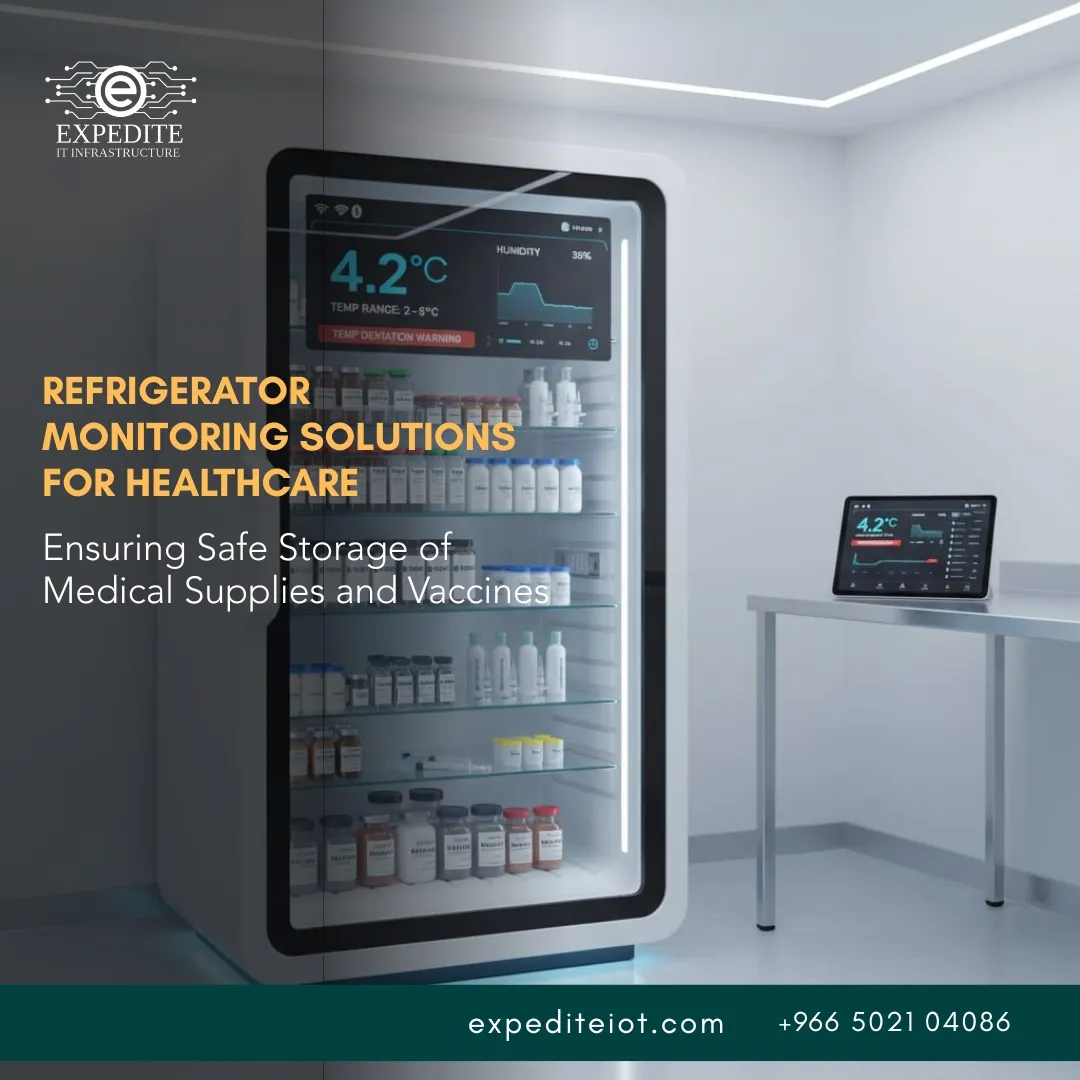

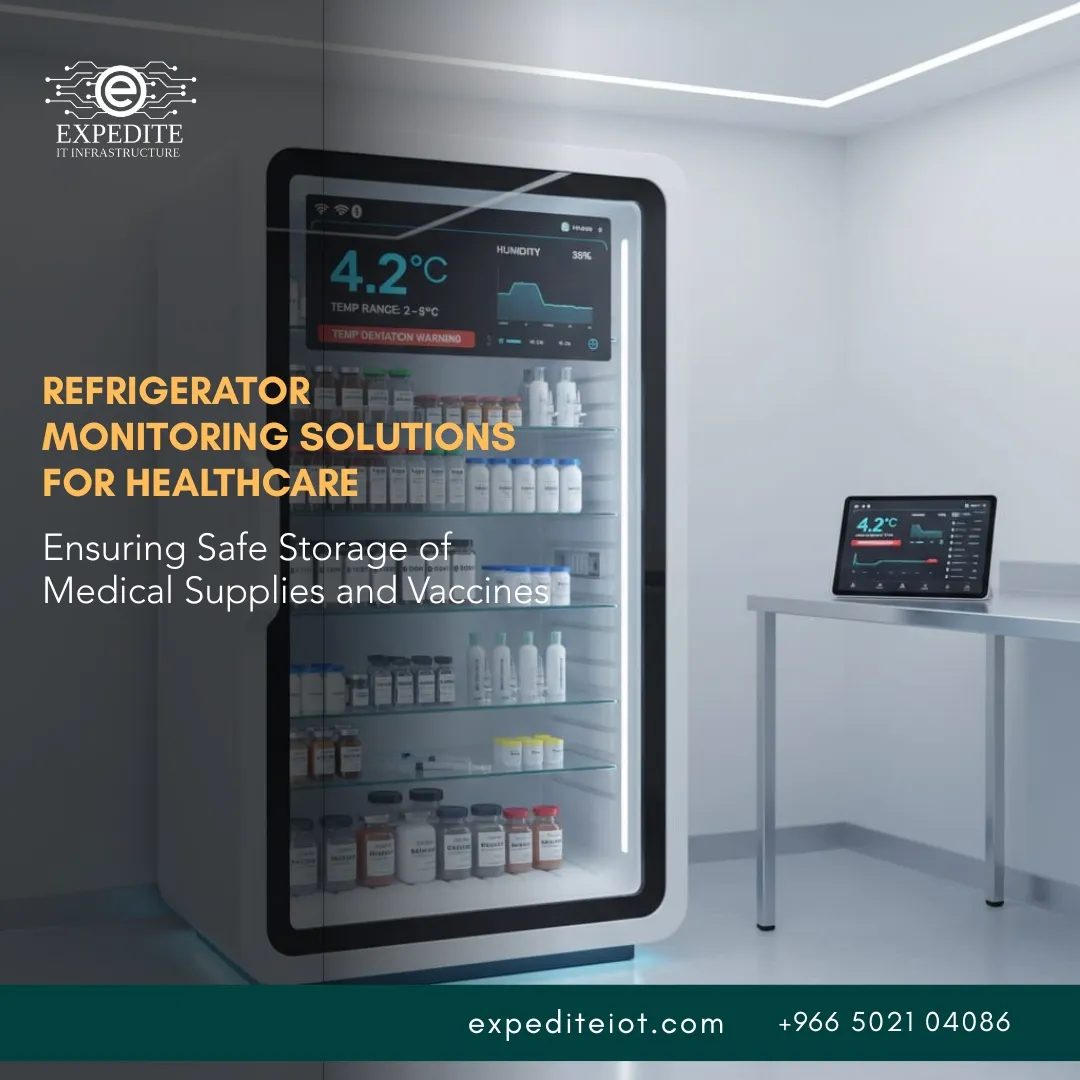
Refrigerator Monitoring is no longer a luxury in modern healthcare — it is an operational necessity. Across Oman's rapidly evolving healthcare landscape, hospitals, pharmacies, blood banks, and vaccine storage facilities are turning to intelligent IoT-powered solutions to ensure the integrity of temperature-sensitive medical assets. Expedite IoT's smart refrigerator monitoring platform delivers real-time visibility, automated alerting, and regulatory compliance for healthcare providers from Muscat to Salalah.
With the Sultanate of Oman accelerating its Vision 2040 digital transformation agenda — and the Ministry of Health tightening cold-chain compliance requirements — investing in smart sensors and connected monitoring infrastructure has become a strategic priority for healthcare organisations of every scale.
Why Cold-Chain Integrity Is Critical in Oman's Healthcare Sector
Oman's climate is one of the hottest and most humid in the Arabian Peninsula, with summer temperatures regularly exceeding 45 °C in interior governorates. This creates an extreme operating environment for pharmaceutical cold storage, biologics, and laboratory reagents. Even a brief excursion outside the recommended 2 °C–8 °C range can render vaccines ineffective, spoil blood products, or degrade insulin — leading to patient harm and costly waste.
Key risks that make temperature monitoring indispensable include: power outages during peak summer demand, ageing refrigeration units in district hospitals, manual logging errors, and the logistical complexity of multi-site pharmacy chains operating across Muscat, Sohar, Nizwa, Sur, and Salalah.
What Is Smart Refrigerator Monitoring and How Does It Work?
Smart refrigerator monitoring is an integrated IoT ecosystem that combines hardware sensors, wireless communication protocols, cloud analytics, and automated notification workflows. Rather than relying on manual twice-daily temperature logs — a practice that leaves 22 hours of unobserved exposure — connected monitoring captures and records data continuously, typically every one to five minutes.
Core Components of a Connected Monitoring System
- Smart Sensors & Probes: Calibrated digital probes are placed inside refrigeration units to measure internal air and product temperatures with ±0.1 °C accuracy. Modern smart sensors also capture humidity, door-open events, and compressor status.
- Wireless Communication Gateways: Data travels over Wi-Fi, cellular (4G/5G), LoRaWAN, or Zigbee networks to a central cloud platform. Wireless temperature monitoring eliminates the need for costly wired infrastructure and is ideal for retrofitting existing cold storage units.
- Cloud-Based Temperature Data Loggers: All readings are timestamped, encrypted, and stored in audit-ready temperature data loggers. These logs satisfy WHO PQS and ISO 17025 documentation requirements and can be exported for regulatory inspection at any time.
- Temperature Alerts & Escalation Rules: When a reading falls outside the pre-set range, the system triggers immediate temperature alerts via SMS, email, or push notification — escalating through a defined chain of staff if the first responder does not acknowledge within a configurable window.
- Dashboard & Analytics: A centralised web and mobile dashboard provides historical trends, excursion reports, Mean Kinetic Temperature (MKT) calculations, and predictive maintenance flags for ageing compressor units.
Remote Temperature Monitoring: Managing Multi-Site Healthcare Networks
Remote temperature monitoring is particularly transformative for healthcare networks operating across Oman's geographically dispersed governorates. A central pharmacy manager in Muscat can view live temperature readings from a cold room in Duqm, acknowledge an alert from a blood bank in Nizwa, and pull a compliance report for a WHO audit — all from a single browser tab or mobile app.
Expedite IoT's platform supports unlimited site hierarchies, meaning a healthcare group can aggregate data from dozens of facilities into one unified view while still drilling down to individual refrigeration units. Role-based access control ensures that biomedical engineers, pharmacists, quality managers, and executives each see the information relevant to their remit.
Wireless Temperature Monitoring: Installation Without Disruption
One of the most significant adoption barriers in Omani healthcare has historically been the perceived complexity of installing monitoring systems in live clinical environments. Wireless temperature monitoring eliminates this barrier entirely. Expedite IoT's plug-and-play sensors are battery-powered (3–5 year life), require no drilling or cabling, and can be commissioned in under 30 minutes per unit.
The wireless architecture also provides resilience: if a gateway loses connectivity, sensors continue to log data locally and upload the backlog once connectivity is restored — ensuring zero data gaps in the audit trail. This edge-buffering capability is especially important in Salalah and remote interior facilities where network reliability can be intermittent.
Refrigerator Monitoring Oman: Region-Specific Use Cases
Refrigerator Monitoring in Muscat
Refrigerator monitoring in Muscat addresses the high density of private hospitals, polyclinics, and retail pharmacies concentrated in the capital. Facilities such as multi-specialty hospitals in Al Khuwair, Qurum, and Madinat Sultan Qaboos require enterprise-grade monitoring with integration into existing LIMS, ERP, and building management systems (BMS). Expedite IoT's open API architecture supports seamless data exchange with third-party platforms, enabling a single pane of glass for facility operations teams.
Refrigerator Monitoring in Salalah
Refrigerator monitoring in Salalah presents unique challenges due to the Khareef monsoon season, which drives exceptionally high humidity levels between June and September. Humidity spikes accelerate refrigerant leakage and compromise door seals. Expedite IoT's multi-parameter sensors track both temperature and relative humidity simultaneously, providing early warning of condensation-related risks that conventional monitoring systems miss entirely.
Temperature Data Loggers: Regulatory Compliance and Audit Readiness
Regulatory bodies including Oman's Ministry of Health, the Gulf Cooperation Council (GCC) drug regulatory framework, and WHO prequalification programmes require tamper-proof, traceable temperature data loggers for cold-chain documentation. Manual paper logs are increasingly rejected during inspections, and spreadsheet records are considered insufficient for high-risk pharmaceutical products.
Expedite IoT's cloud-based logging system automatically generates timestamped, cryptographically signed records for every sensor reading. Reports can be filtered by date range, asset, location, or excursion status and exported in PDF or CSV format within seconds — reducing audit preparation time from hours to minutes.
Temperature Alerts: From Detection to Resolution in Minutes
The difference between a recoverable cold-chain excursion and a write-off can be measured in minutes. Effective temperature alerts must be instantaneous, contextual, and actionable. Expedite IoT's alerting engine supports:
- Multi-channel notifications (SMS, WhatsApp, email, webhook) with configurable delivery sequences.
- Delay timers to suppress false alarms from brief door openings while still catching genuine failures.
- Shift-aware escalation matrices that route alerts to the on-duty pharmacist or biomedical technician rather than a fixed contact.
- Automated work-order creation integrated with CMMS platforms for immediate maintenance dispatch.
- Post-excursion impact assessments that calculate time-out-of-range and MKT to support product quarantine decisions.
Why Expedite IoT? Experience, Expertise, and Regional Authority
Expedite IoT has deployed cold-chain monitoring solutions across healthcare facilities in Saudi Arabia, Qatar, and Oman — building deep regional expertise in GCC regulatory requirements, local network infrastructure constraints, and Arabic-language user experience. The company's IoT engineers hold certifications in industrial IoT architecture, and its platform has been validated against ISO/IEC 17025 and WHO good storage practice guidelines.
Unlike generic off-the-shelf loggers, Expedite IoT's solution is purpose-built for healthcare environments where sensor failure is not merely inconvenient — it is a patient-safety event. The platform's 99.9 % uptime SLA, 24/7 Arabic and English support team, and on-ground implementation resources in Muscat make it the trusted partner for Omani healthcare providers navigating cold-chain digitalisation.
Learn more about the full solution at Expedite IoT's Smart Refrigerator Monitoring for Oman.
Implementation Roadmap: Getting Started with IoT Cold-Chain Monitoring
- Site Survey & Asset Inventory: Identify all refrigeration assets, cold rooms, and freezers. Map Wi-Fi or cellular signal coverage and flag connectivity gaps.
- Sensor Sizing & Placement: Select the appropriate probe type (immersion, ambient, surface) for each asset. Multi-sensor probes are recommended for large cold rooms to capture spatial temperature gradients.
- Gateway & Network Deployment: Install LoRaWAN or Wi-Fi gateways as required. Cellular backup ensures continuity during planned maintenance windows.
- Platform Configuration: Define alert thresholds, escalation contacts, reporting schedules, and integration endpoints (LIMS, ERP, BMS).
- Staff Training & Go-Live: Brief pharmacists, biomedical technicians, and quality managers on dashboard navigation, alert acknowledgement, and report generation.
- Ongoing Optimisation: Quarterly calibration checks, firmware updates, and performance reviews keep the system accurate and compliant.
Return on Investment: The Business Case for Smart Monitoring in Oman
Healthcare organisations that have deployed connected cold-chain monitoring typically report the following measurable benefits within the first 12 months of operation:
- 70–90 % reduction in manual temperature logging labour hours.
- Elimination of regulatory non-compliance penalties linked to inadequate documentation.
- 30–50 % reduction in pharmaceutical write-offs due to earlier excursion detection.
- Faster audit response times — from days of manual retrieval to minutes of automated reporting.
- Extended equipment lifespan through predictive maintenance alerts that identify compressor degradation before failure.
Conclusion
The convergence of Oman's healthcare modernisation ambitions, stringent cold-chain regulatory requirements, and extreme climatic conditions makes a compelling, urgent case for adopting intelligent refrigerator monitoring solutions. From the busy hospital pharmacies of Muscat to the humidity-challenged storage facilities of Salalah, connected IoT monitoring platforms deliver the real-time visibility, automated temperature alerts, and tamper-proof temperature data loggers that modern healthcare demands.
Expedite IoT's purpose-built solution — combining calibrated smart sensors, resilient wireless temperature monitoring, and enterprise-grade remote temperature monitoring capabilities — empowers Omani healthcare providers to protect patient safety, achieve regulatory compliance, and drive measurable operational efficiency.
FAQs
1. What temperature range should pharmaceutical refrigerators maintain in Oman?
Most pharmaceutical products and vaccines require storage between 2 °C and 8 °C, in line with WHO cold-chain guidelines and Oman's Ministry of Health standards. Certain biologics may require ultra-cold storage at –20 °C or –70 °C. Expedite IoT's temperature monitoring platform supports all these ranges with configurable alert thresholds per asset.
2. How does wireless temperature monitoring handle network outages?
Expedite IoT's wireless temperature monitoring sensors incorporate onboard flash memory that stores up to 30 days of readings locally. When connectivity is restored — whether via Wi-Fi, cellular failover, or manual USB retrieval — the buffered data is uploaded automatically, ensuring a complete, unbroken audit trail with no gaps in the log.
3. Are temperature data loggers accepted for regulatory inspections in Oman?
Yes. Digital, cloud-based temperature data loggers that produce timestamped, tamper-evident records are accepted — and increasingly preferred — by Oman's Ministry of Health, the WHO, and GCC drug regulatory authorities. Expedite IoT's logs meet ISO/IEC 17025 traceability requirements and can be produced on demand in PDF format during inspections.
4. How quickly can Expedite IoT deploy a refrigerator monitoring system in Muscat or Salalah?
For standard deployments of up to 20 refrigeration units, Expedite IoT can complete site survey, installation, configuration, and staff training within 3–5 business days. Larger enterprise deployments — such as multi-site hospital networks requiring refrigerator monitoring in Muscat and across governorates — follow a phased rollout plan agreed during the scoping stage, typically completed within 4–6 weeks.
5. What types of smart sensors does Expedite IoT use, and are they calibrated?
Expedite IoT deploys industrial-grade smart sensors with ±0.1 °C to ±0.3 °C accuracy (model-dependent), factory-calibrated to NIST-traceable standards. Annual recalibration is recommended and available as part of the managed service package. Sensors are available in immersion probe, ambient air, surface contact, and multi-point configurations to suit different refrigerator types, cold rooms, and cryogenic freezers encountered in Omani healthcare facilities.
Contact Us:
+966 5021 04086






























Sign in to leave a comment.