

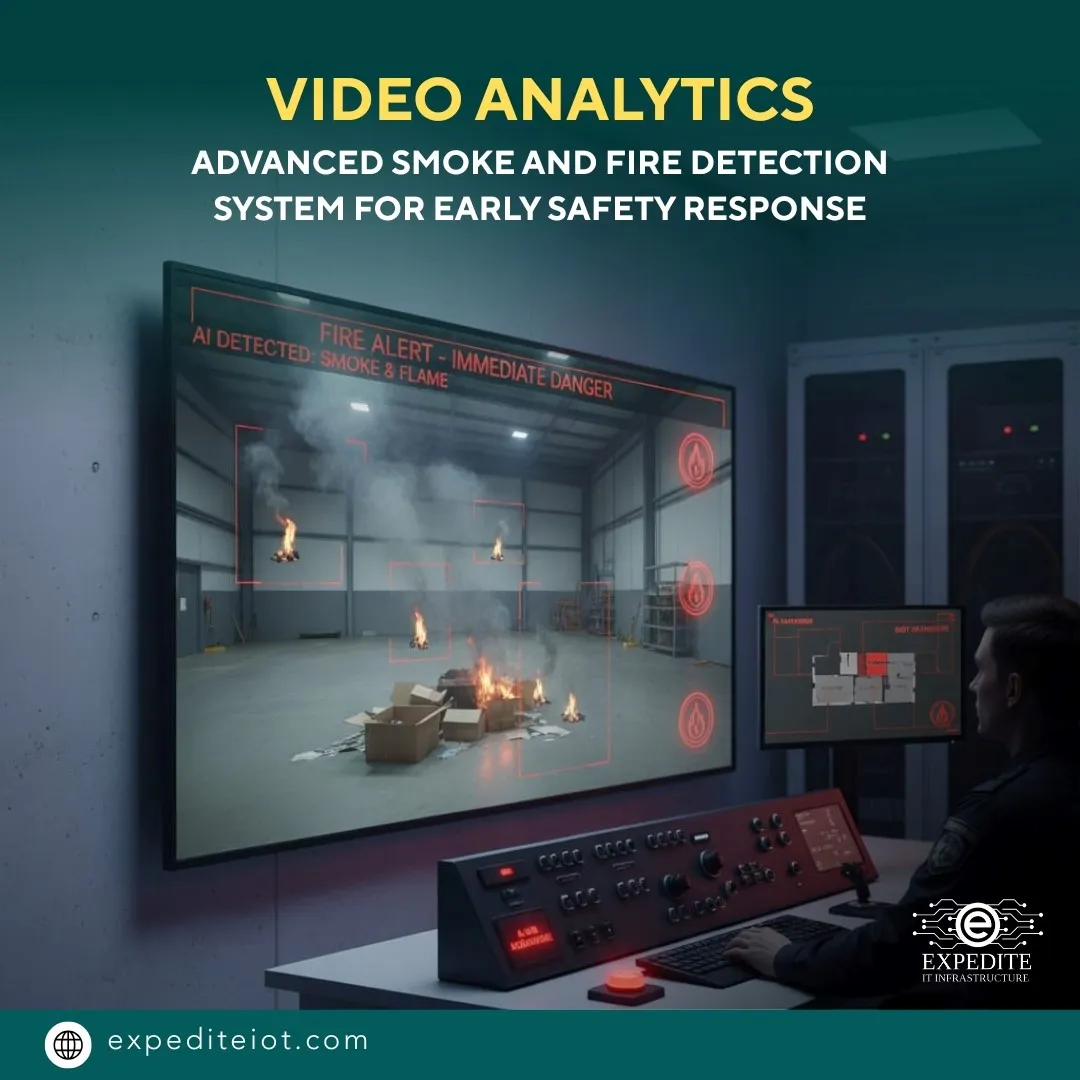
Video Analytics is fundamentally changing how facilities across the UAE detect, respond to, and recover from fire and smoke emergencies. Traditional heat and photoelectric smoke detectors — while essential — operate in isolation, triggering alerts only after a threat has already developed to a detectable physical threshold. By contrast, intelligent camera-based detection analyses live visual data continuously, identifying the earliest visual signatures of combustion — flame flicker patterns, rising smoke plumes, abnormal heat signatures — and escalating alerts within seconds, not minutes.
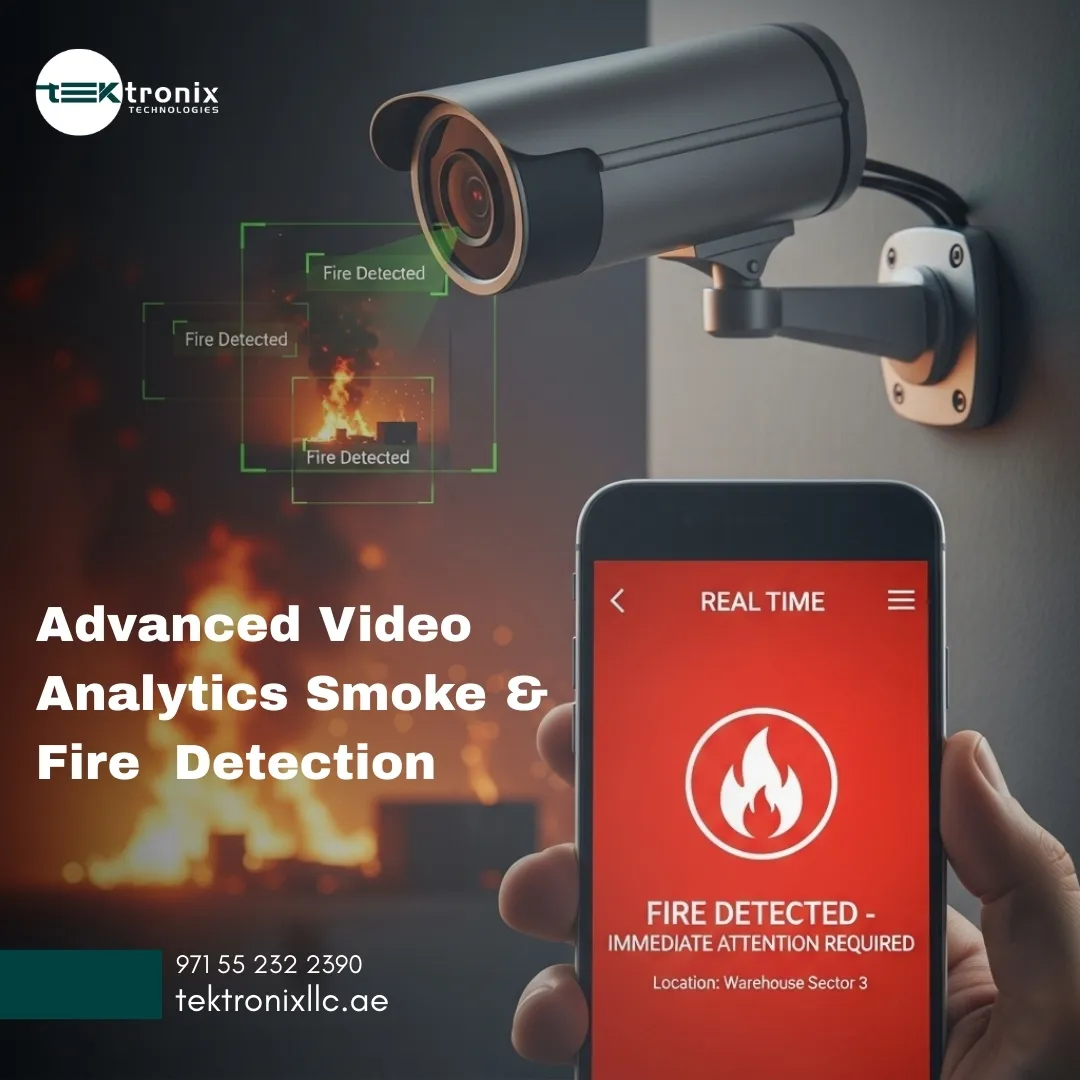
For facility managers, safety officers, and security directors operating in Dubai, Abu Dhabi, and across the Emirates, this represents a transformational leap in life safety capability. Tektronix LLC delivers this capability through proven, enterprise-grade solutions tailored to the UAE's regulatory environment and built environment.
Why Traditional Fire Detection Falls Short in Modern UAE Facilities
The UAE's built environment — characterised by high-rise towers, large-footprint logistics hubs, sprawling industrial facilities, and high-occupancy hospitality venues — presents fire detection challenges that conventional point detectors were simply not designed to address. Smoke stratification in high-ceiling atriums, airflow interference in heavily air-conditioned spaces, and the sheer physical scale of warehouse and campus environments all reduce the effectiveness of traditional detection technologies.
The consequences of detection failure — or late detection — are severe:
- Evacuation delays that cost lives and trigger regulatory penalties under UAE Civil Defence requirements
- Suppression system activation after a fire has already escalated beyond containment
- Business interruption losses that dwarf the cost of the detection system many times over
- Reputational damage and insurance premium increases following preventable incidents
Addressing these challenges requires a fundamentally different approach — one built on continuous, intelligent visual monitoring rather than passive environmental sampling. That approach is AI-Powered Video Analytics.
How AI-Powered Video Analytics Detects Fire and Smoke
AI-Powered Video Analytics leverages convolutional neural networks (CNNs) and deep learning models trained on millions of fire, smoke, and flame event sequences to recognise the precise visual signatures of an emerging fire — distinguishing genuine threats from environmental noise such as steam, dust, fog, or light reflections that routinely trigger false positives in conventional systems.
The detection pipeline operates as follows:
- Continuous frame analysis: Every camera frame is processed by the analytics engine in real time, analysing pixel patterns, motion vectors, and colour spectra associated with fire and smoke behaviour
- Multi-stage classification: Candidate events are classified through multiple AI model layers, each progressively refining confidence scores to minimise erroneous triggers
- Contextual validation: The system cross-references detection events with environmental context — time of day, zone designation, historical baseline — before escalating an alert
- Alarm escalation: Verified events trigger immediate, prioritised alerts to the monitoring station, fire panel integration, and mobile responders simultaneously
This architecture is the backbone of robust Real-Time Hazard Detection — enabling operators to act on verified, high-confidence alerts rather than chasing noise across a busy alarm management console.
Video Analytics Software: The Intelligence Behind the Detection
Video Analytics Software is the computational engine that transforms raw camera feeds into actionable safety intelligence. For fire and smoke applications, the software layer must simultaneously manage detection accuracy, processing latency, integration breadth, and audit trail generation — all without introducing the computational overhead that degrades performance in large camera estate deployments.
Leading platforms deployed by Tektronix LLC — including Milestone XProtect with built-in analytics modules, Genetec Security Center with Mission Control, and dedicated fire analytics engines from Bosch AVIOTEC and Axis Communications — deliver:
- Sub-five-second detection latency from flame or smoke appearance to alarm escalation
- Camera-agnostic compatibility supporting ONVIF-compliant devices from all major manufacturers
- Edge and server-side processing flexibility to match deployment architecture and bandwidth constraints
- Comprehensive audit logging with timestamped video evidence for post-incident investigation and insurance claims
- Role-based operator dashboards providing security teams with geo-referenced alert maps and live camera feeds on a single screen
When evaluating Video Analytics Solutions for fire safety applications, the depth of AI model training, the software's track record in high-challenge environments, and the vendor's regional support capability are the three criteria that most reliably predict deployment success — criteria that Tektronix LLC evaluates rigorously on every client engagement.
Video Analytics Solutions: Applications Across UAE Sectors
Video Analytics Solutions for fire and smoke detection are being deployed across every major sector of the UAE economy, driven by Civil Defence mandates, insurance requirements, and the recognition that life safety infrastructure is a non-negotiable component of responsible facility management.
Warehousing and Logistics
The UAE's position as a global logistics hub — anchored by Jebel Ali Free Zone, Dubai South, and KIZAD — means that enormous quantities of flammable goods are stored and processed in facilities where conventional detectors are defeated by ceiling heights exceeding 15 metres and HVAC-driven airflows. Video Analytics Dubai deployments in these environments are detecting fire events up to ten times faster than conventional systems — and doing so without the suppression-triggering false alarm rates that have historically plagued high-rack warehouse environments.
Oil, Gas, and Industrial Facilities
Petrochemical facilities, power generation plants, and manufacturing campuses in Abu Dhabi and across the Northern Emirates operate in environments where a single undetected ignition event can escalate to a catastrophic incident within minutes. Video Analytics Abu Dhabi deployments in these high-consequence environments integrate directly with distributed control systems (DCS) and safety instrumented systems (SIS), enabling automated shutdown and suppression sequences that do not depend on human intervention.
High-Rise Residential and Commercial Towers
Dubai and Abu Dhabi's iconic skylines are home to some of the world's tallest residential and mixed-use towers — environments where stairwell, lobby, and plant room monitoring via video analytics provides a critical supplementary detection layer that complements existing sprinkler and alarm infrastructure, particularly during the overnight hours when occupancy and response capacity are lowest.
Hospitality, Retail, and Entertainment Venues
Hotels, shopping malls, and large entertainment venues present complex fire risk profiles — high occupancy, diverse ignition sources, and the reputational consequences of an evacuation incident. Video Analytics UAE deployments in these environments are enabling operators to detect kitchen fires, electrical faults, and arson events earlier and with greater confidence than any previous generation of detection technology.
Reduced False Alarms: The Operational and Financial Case
Reduced False Alarms is not merely a convenience metric — it is a critical operational and financial outcome. In large UAE facilities, false fire alarms carry a substantial cost burden: Civil Defence callout fees, business disruption costs from unnecessary evacuations, staff desensitisation to alarm signals (the "cry wolf" effect that directly endangers lives in a real emergency), and the maintenance overhead of investigating and resetting triggered suppression systems.
Conventional smoke detectors in challenging environments — including those affected by dust, steam, exhaust fumes, or high airflow — can generate false positive rates that make the alarm system an operational liability rather than an asset. AI-powered video analytics, by contrast, applies multi-stage visual classification before escalating any alert, achieving false positive rates up to 90 percent lower than conventional point detectors in equivalent environments.
This dramatic improvement in signal-to-noise ratio is one of the most consistently cited return-on-investment drivers among Tektronix LLC clients across Video Analytics Dubai and wider UAE deployments — and it translates directly into measurable reductions in Civil Defence interaction costs and business interruption losses.
Automated Emergency Response: From Detection to Action in Seconds
Automated Emergency Response is the logical extension of accurate, real-time detection. When a verified fire or smoke event is detected, the value of that detection is determined by how quickly and correctly the facility's response infrastructure is activated. Manual notification chains — where a monitoring operator must interpret an alert, locate the affected zone, and make a series of phone calls — introduce delays measured in minutes. In a developing fire, minutes are the difference between containment and catastrophe.
Tektronix LLC's integrated response architecture connects AI-Powered Video Analytics detections directly to:
- Fire alarm control panels (FACPs) — triggering audible and visual alarms, PA announcements, and door release sequences
- Building Management Systems (BMS) — activating smoke control, stairwell pressurisation, and HVAC shutdown
- Access control systems — releasing magnetic door locks on escape routes and securing entry points to the affected zone
- CCTV recording and evidence preservation — locking affected camera feeds into tamper-evident storage
- Mobile and email alerting — pushing geo-referenced incident notifications to facility managers, security teams, and Civil Defence liaisons
This end-to-end automation capability — transforming a camera detection event into a coordinated, multi-system emergency response within seconds — is the defining differentiator of a mature Video Analytics Software deployment versus a simple camera monitoring installation.
UAE Regulatory Compliance: Civil Defence and Beyond
The UAE Civil Defence Authority — operating under the Ministry of Interior — sets the mandatory fire safety standards that all commercial, industrial, and residential facilities must meet. Relevant standards include UAE Fire and Life Safety Code of Practice (FLSC), NFPA 72 (National Fire Alarm and Signalling Code), and emirate-specific guidelines issued by Dubai Civil Defence and Abu Dhabi Civil Defence.
Video analytics-based fire detection is increasingly recognised within these frameworks as a valid and, in certain high-challenge environments, preferred detection methodology. Tektronix LLC's engineering team maintains active relationships with Civil Defence authorities in both Dubai and Abu Dhabi, ensuring that every Video Analytics UAE fire detection deployment is designed, documented, and commissioned in a manner that satisfies the authority having jurisdiction (AHJ) and supports the client's overall fire safety certificate obligations.
Tektronix LLC: UAE's Trusted Partner for Intelligent Fire and Safety Analytics
Tektronix LLC has been delivering physical security, fire safety, and intelligent building solutions across the UAE for over a decade. Our team of certified engineers combines deep expertise in video surveillance, fire detection, and building automation with an intimate knowledge of the UAE's regulatory landscape — ensuring that every deployment we deliver is both technically excellent and fully compliant.
We are an authorised integrator for Milestone Systems, Genetec, Bosch Security, Axis Communications, and Honeywell — enabling us to design and deliver Video Analytics Solutions that integrate seamlessly with your existing security and building management infrastructure, regardless of the incumbent vendor ecosystem.
Expertise, Experience, Authority, and Trust
Our engineers hold certifications including Milestone Certified Integration Technician (MCIT), Genetec Certified Professional, Bosch Security Systems Certified Installer, and NEBOSH International General Certificate in Occupational Health and Safety. Tektronix LLC is a registered member of ASIS International and SIRA (Security Industry Regulatory Agency, Dubai), and all fire safety designs are produced by engineers with demonstrable competence under UAE Civil Defence submission requirements. Our project portfolio includes deployments in DIFC, Abu Dhabi Global Market (ADGM), KIZAD, and major logistics operators across Jebel Ali Free Zone.
Conclusion
Video Analytics for fire and smoke detection represents the most significant advance in life safety technology available to UAE facility operators today. By combining the visual acuity of AI with the speed of automated systems integration, organisations can achieve levels of Real-Time Hazard Detection accuracy, Reduced False Alarms, and Automated Emergency Response that conventional detection technologies simply cannot match.
From high-ceiling warehouses in Video Analytics Dubai deployments to petrochemical facilities served by Video Analytics Abu Dhabi integrations, the technology is proving its value in the most demanding environments the region has to offer. Whether you are upgrading an existing fire safety system or specifying detection for a new facility, intelligent Video Analytics Software should be central to your life safety architecture.
FAQs
1. How does Video Analytics detect fire faster than conventional smoke detectors?
Video Analytics analyses live camera feeds frame by frame, identifying the visual signatures of flame and smoke — including colour spectra, motion patterns, and rising plume behaviour — before combustion products reach the ceiling-mounted detectors that conventional systems depend upon. In high-ceiling or open environments, this can reduce detection time from several minutes to under ten seconds, providing a critical early-warning advantage that conventional point detectors cannot replicate.
2. What environments are best suited to AI-Powered Video Analytics fire detection?
AI-Powered Video Analytics delivers the greatest performance advantage in environments where conventional detection is challenged: warehouses with ceiling heights above eight metres, atriums and large open-plan spaces, heavily air-conditioned environments, outdoor and semi-outdoor areas, and facilities with high levels of ambient dust, steam, or fumes. These are precisely the environments most common in Video Analytics UAE industrial and logistics deployments, where the ROI case for AI-based detection is strongest.
3. Can Video Analytics Software integrate with our existing fire alarm panel?
Video Analytics Software platforms deployed by Tektronix LLC support integration with all major fire alarm control panel brands — including Honeywell Notifier, Siemens Cerberus, Hochiki, and Napco — via relay outputs, open-protocol interfaces, and proprietary integration modules. This means organisations can add visual fire detection capability to existing infrastructure without replacing compliant alarm panels, protecting prior investment whilst upgrading detection capability.
4. How significant is the Reduced False Alarms benefit in UAE deployments?
Clients across our Video Analytics Dubai and broader UAE portfolio consistently report false alarm reductions of between 70 and 95 percent compared to their previous conventional detection systems. Beyond the direct cost savings — Civil Defence callout fees, evacuation disruption, and suppression system reset costs — this improvement eliminates the alarm fatigue that is one of the most insidious threats to genuine emergency response preparedness in high-activity facilities.
5. What is involved in deploying an Automated Emergency Response system with video analytics?
Deploying Automated Emergency Response capability begins with a site survey and integration mapping exercise — identifying the fire alarm panel, BMS, access control, and notification systems that should be connected to the analytics platform. Tektronix LLC then designs the integration architecture, installs and configures the Video Analytics Solutions platform, commissions the automated response workflows, and conducts scenario-based testing before handover. Most deployments are completed without disruption to live facility operations.
Video Analytics, Video Analytics UAE, AI-Powered Video Analytics,Video Analytics Incident Detection, Video Analytics Threat Detection




















Sign in to leave a comment.