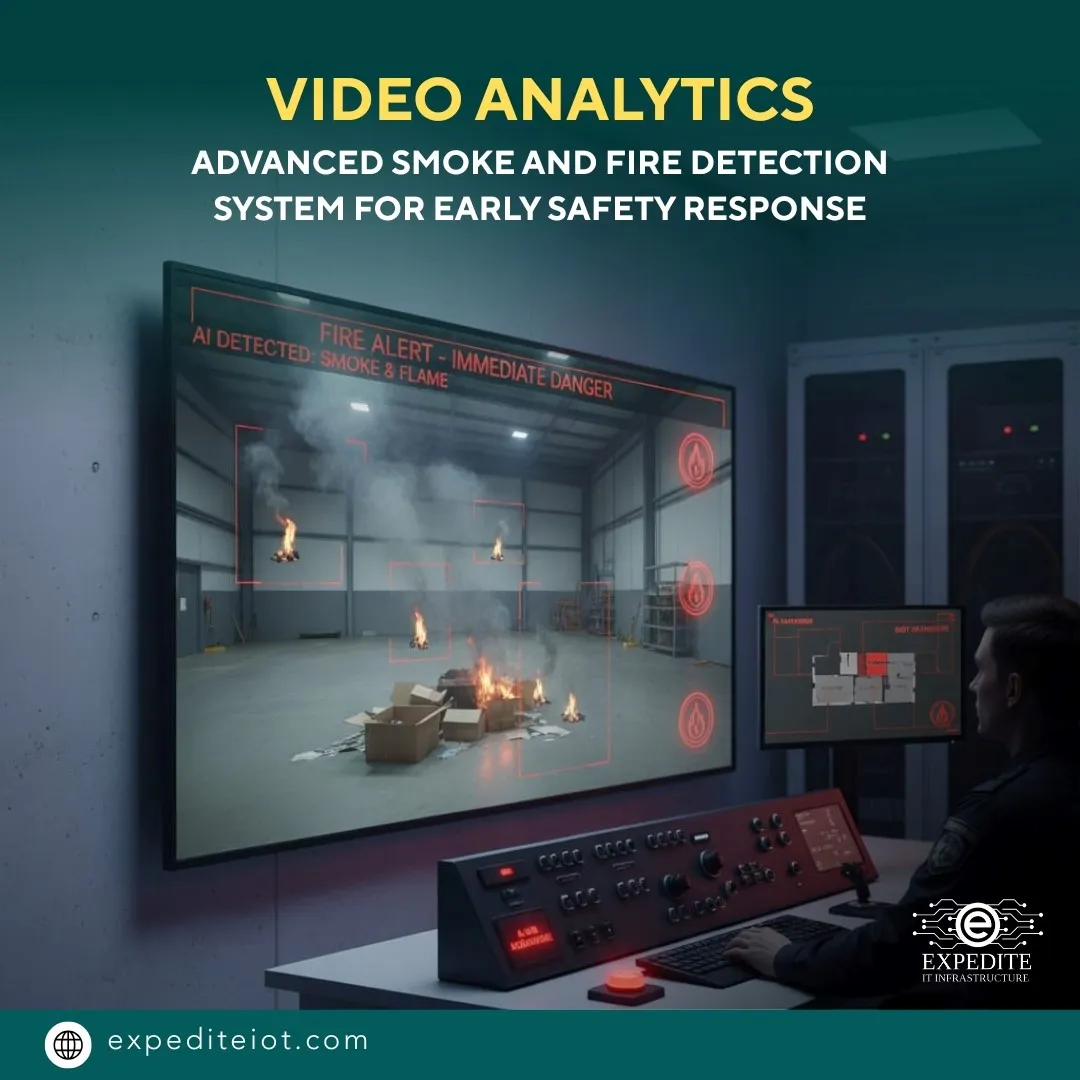

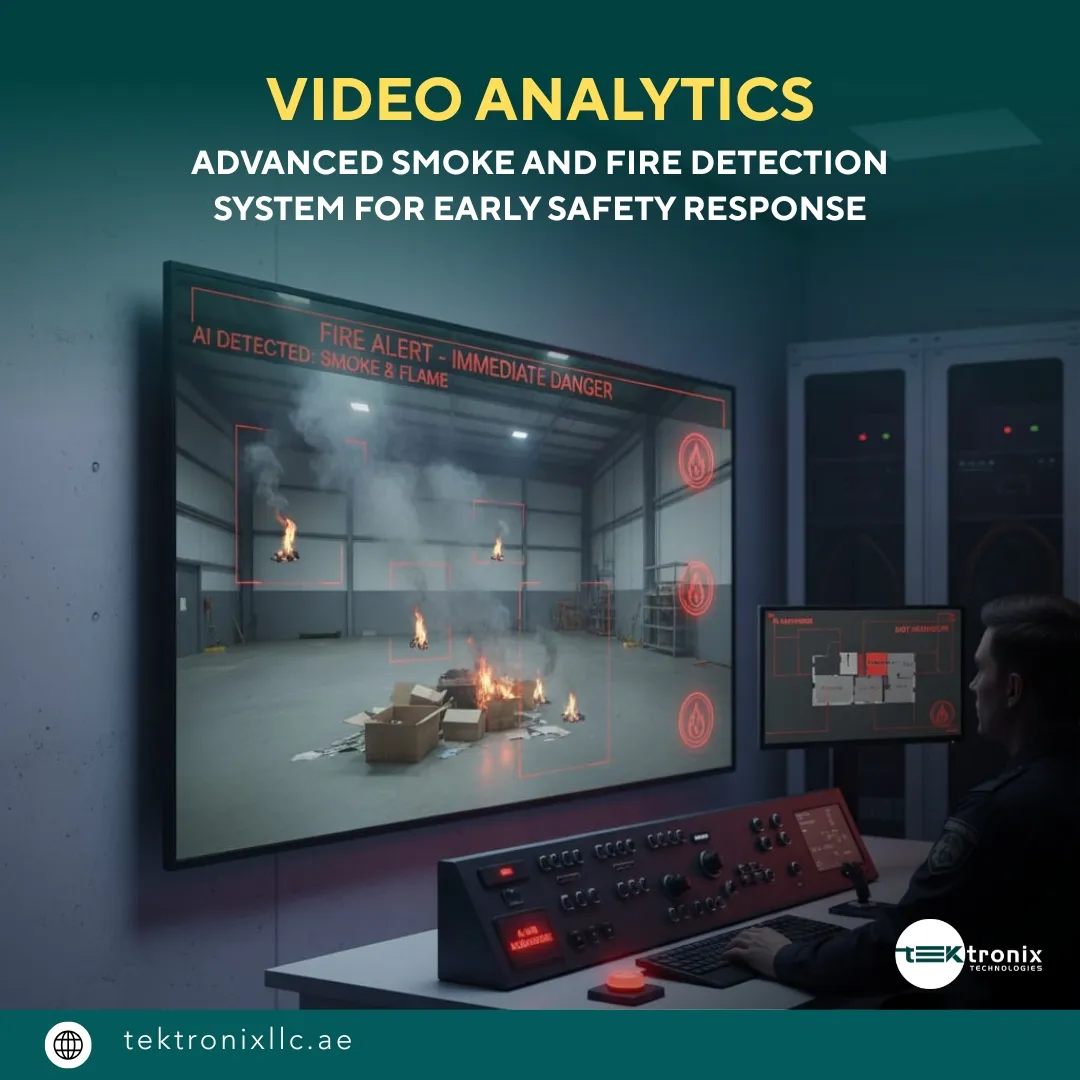
Deploying intelligent Video Analytics for fire prevention and smoke detection is transforming how UAE facilities protect lives, assets, and business continuity. Traditional point-type heat and smoke detectors respond only after combustion products reach the sensor, a detection delay that can be fatal in large open spaces, high-bay warehouses, and outdoor petrochemical environments where airborne dilution prevents detector activation until a fire is already established. Tektronix LLC, a SIRA-approved physical and cybersecurity systems integrator headquartered in Dubai, designs and deploys AI-driven camera-based fire and smoke detection systems that identify ignition-stage events in real time, trigger automated suppression and evacuation responses, and generate the forensic documentation required by UAE Civil Defence, SIRA, and insurance underwriters.
Why Camera-Based Fire and Smoke Detection Outperforms Traditional Systems in the UAE
The UAE's built environment presents detection challenges that exceed the design parameters of conventional point detectors. High-ceiling logistics halls in Jebel Ali Free Zone (JAFZA), open-sided aircraft hangars at Dubai International Airport and Al Maktoum International, outdoor storage yards in Abu Dhabi's Khalifa Industrial Zone (KIZAD), and atrium spaces in mixed-use towers along Sheikh Zayed Road all share one characteristic: the air volume between a heat source and a ceiling-mounted detector is large enough to dilute combustion products below activation thresholds for minutes, sometimes tens of minutes, after ignition.
Camera-based systems overcome this limitation by analysing the visual signature of flame and smoke at the source rather than waiting for products of combustion to travel to a fixed sensor. Detection range extends to hundreds of metres, coverage is continuous across the entire camera field of view, and the system begins generating alerts the moment visible smoke or flame pixels appear in the scene, typically within three to eight seconds of ignition, compared to minutes for ceiling-mounted point detectors in the same environment.
This performance advantage aligns directly with the UAE Civil Defence requirement, codified in UAE Fire and Life Safety Code of Practice (FLSC) and referenced in NFPA 72, that detection systems must be designed to achieve reliable activation within the time-temperature curve of the anticipated fire scenario. For environments where point detection fails this criterion, video-based fire detection is increasingly accepted by Civil Defence inspectors as a compliant alternative or supplementary system, provided it is installed and tested by a licensed contractor.
AI-Powered Video Analytics: How the Detection Engine Works
Tektronix LLC's AI-Powered Video Analytics platform for fire and smoke detection is built on deep convolutional neural networks (CNNs) trained on millions of labelled fire, smoke, and non-fire video frames captured across diverse environments, indoor warehouses, outdoor petrochemical yards, tunnel environments, and high-ceiling atriums. The inference engine runs on-camera or on an edge appliance co-located with the video management system (VMS), delivering detection decisions without dependence on cloud connectivity, a critical requirement for industrial sites where network outages must not compromise fire detection availability.
Real-Time Hazard Detection: Sub-10-Second Ignition-Stage Alerting
The platform achieves Real-Time Hazard Detection by processing every video frame through a multi-class classifier that simultaneously evaluates flame texture, colour temperature gradient, smoke plume morphology, and motion vectors, distinguishing genuine ignition events from visually similar non-fire phenomena such as steam vents, vehicle exhaust, dust clouds, and reflective surface glare. Upon classification, an alert is generated within three to eight seconds of first pixel appearance, transmitted to the security operations centre (SOC) dashboard, and simultaneously injected into the fire alarm control panel (FACP) via dry-contact or BACnet integration to trigger zone-specific suppression and evacuation sequences. Detection range extends to 150 metres per camera in standard conditions, and thermal-optical fusion cameras extend this to 300 metres for outdoor petrochemical and airport perimeter applications.
Automated Emergency Response: From Detection to Suppression in Seconds
Speed of response determines the difference between a contained incident and a catastrophic loss. Tektronix LLC integrates Automated Emergency Response workflows that link the video analytics alert directly to building management system (BMS) outputs, activating pre-action sprinkler zones, closing fire-rated dampers, unlocking emergency egress doors, triggering public address (PA) evacuation announcements, and notifying the UAE Civil Defence command centre via the IGRP protocol, all within a programmed response sequence that executes in under 30 seconds from first alert. Integration with Genetec Security Center's automated incident response module enables operators to verify the alert on a live camera feed and confirm or cancel the automated response within a configurable hold window, preventing unnecessary suppression discharge in environments where accidental activation carries significant asset risk.
Reduced False Alarms: Protecting Operational Continuity
False alarms represent one of the most significant operational and reputational risks of any fire detection system. In industrial and logistics environments, a single spurious evacuation can cost hundreds of thousands of dirhams in lost production, damaged perishable cargo, and emergency service mobilisation fees, and repeated false activations erode staff compliance with genuine emergency procedures. Tektronix LLC's analytics platform achieves Reduced False Alarms through a multi-stage verification pipeline: the CNN classifier filters non-fire events at the pixel level; a secondary temporal consistency check confirms that the detected signature persists across consecutive frames rather than appearing as a single-frame anomaly; and an operator video-verification step, supported by a live pop-up feed in the SOC dashboard, provides a human confirmation layer before automated suppression commands are issued. In independent benchmark assessments conducted against NFPA 72 Chapter 11 (video-based detection) test protocols, the platform achieved a false alarm rate below 0.5 events per camera per month in high-complexity industrial environments.
Detailed Incident Reporting: Forensic Documentation for Compliance and Insurance
Every detection event generates Detailed Incident Reporting output, including a timestamped video clip from the triggering camera, GPS-tagged incident location on the facility floor plan, response timeline log showing elapsed time between detection and each automated output, and a PDF incident summary exportable for submission to UAE Civil Defence, the facility's insurance underwriter, and HSE management teams. This forensic documentation satisfies the UAE Occupational Health and Safety Law (Federal Law No. 8 of 1980) and its implementing regulations, which require employers to maintain records of all fire incidents and near-misses. For facilities subject to Abu Dhabi Occupational Safety and Health (OSHAD) or Dubai Municipality's Health and Safety Management System requirements, the structured incident log provides the audit evidence required during annual regulatory inspections.
Video Analytics Software Platform: Features and Integration Architecture
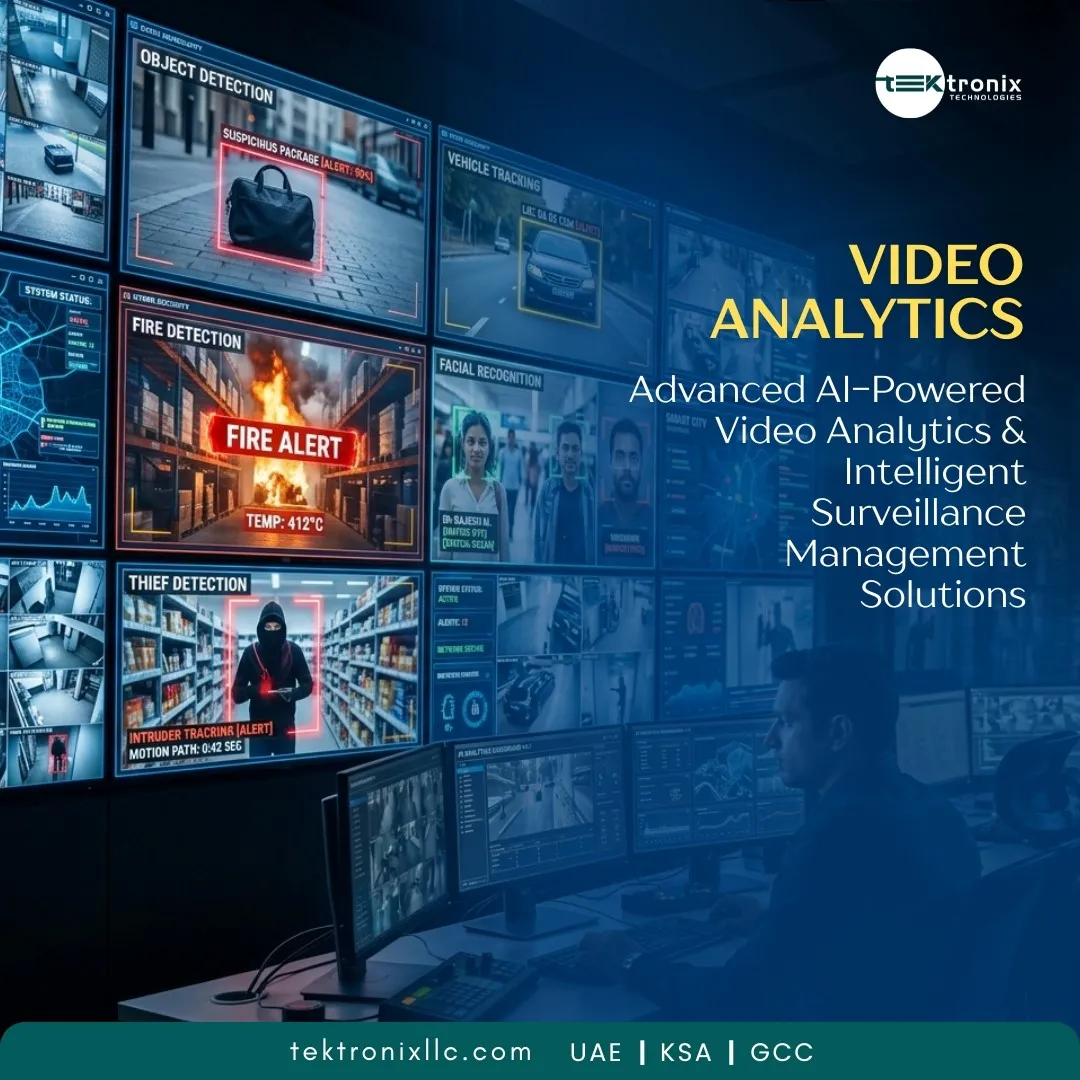
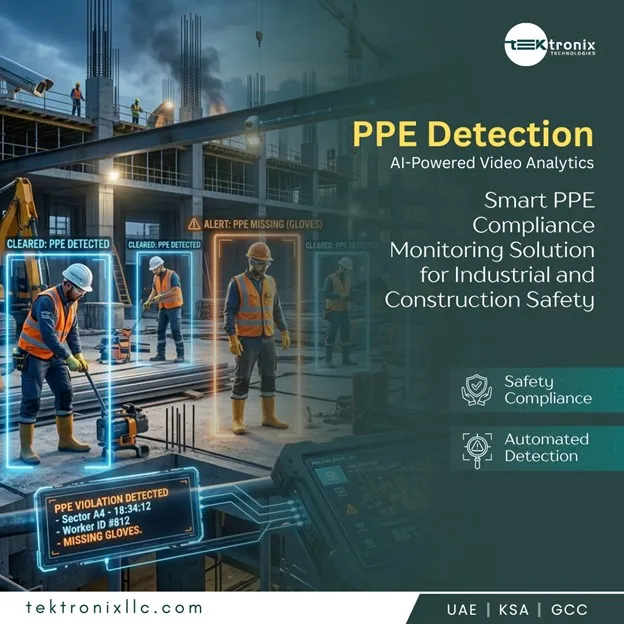
The Video Analytics Software layer deployed by Tektronix LLC consolidates fire and smoke detection with a broader suite of safety and security analytics, including perimeter intrusion detection, crowd density monitoring, slip-and-fall detection, and PPE compliance verification, into a single unified platform. Core platform capabilities include:
- Multi-Camera Fusion: Overlapping camera zones create redundant detection coverage, and the platform fuses alerts from adjacent cameras to confirm incident location with sub-metre accuracy on the facility floor plan.
- Edge and Hybrid Processing: On-camera inference via Dahua WizSense and Hikvision AcuSense NPU-equipped cameras, or centralised GPU appliance processing for existing camera estates, both architectures eliminate cloud dependency.
- VMS Integration: Native plugins for Genetec Security Center, Milestone XProtect, and Dahua DSS/DSM enable alert pop-ups, automated camera PTZ positioning, and incident workflow management within the operator's existing VMS interface.
- FACP and BMS Integration: Dry-contact relay outputs, BACnet/IP, and Modbus TCP interfaces enable direct integration with Notifier, Hochiki, Apollo, and Siemens fire alarm control panels, as well as Johnson Controls and Honeywell building management systems.
- Calibration and Sensitivity Management: Per-camera sensitivity zones allow operators to define detection-active regions and exclusion masks, preventing alerts from known non-fire heat sources such as furnace vents, welding bays, or vehicle exhaust zones.
Video Analytics Solutions Across UAE Industry Sectors
Logistics, Warehousing, and Free-Zone Industrial Facilities
High-bay warehouses in JAFZA, Dubai South, and KIZAD store high-value, combustible goods under rack systems that extend to 15 metres or more, heights at which ceiling-mounted point detectors routinely fail to activate within NFPA 72 design time-temperature requirements. Tektronix LLC's Video Analytics Solutions for these environments deploy wide-angle 4K cameras at rack-top level and aisle intersection points, achieving full volumetric coverage with detection sensitivity calibrated to the specific commodity storage classification. Integration with Automatic Sprinkler System (ASS) pre-action panels enables zone-specific suppression activation that protects unaffected rack sections from unnecessary water damage.
Petrochemical, Energy, and Critical Infrastructure
Refineries, LNG terminals, and power generation facilities operated by ADNOC, DEWA, and ENEC in Abu Dhabi and Dubai face hydrocarbon fire scenarios that evolve explosively within seconds of ignition. Tektronix LLC deploys Ex-rated (ATEX Zone 1/2 certified) thermal-optical fusion cameras with AI fire detection at flare stacks, tank bunds, compressor stations, and pipeline manifolds, providing detection at distances up to 300 metres in outdoor conditions subject to the UAE's extreme ambient temperatures, sandstorm visibility degradation, and solar radiation interference. All installations comply with IEC 62443 cybersecurity requirements for networked safety systems in industrial control environments and reference NFPA 72 Chapter 11 and the International Fire Code (IFC) for video-based flame and smoke detection system design.
Healthcare, Education, and High-Occupancy Public Buildings
Hospitals accredited by HAAD (Department of Health Abu Dhabi) and Dubai Health Authority (DHA), along with schools and universities regulated by ADEK and KHDA, have duty-of-care obligations that make early fire detection a life-safety imperative. Tektronix LLC integrates video fire detection with the facility's existing fire alarm infrastructure, operating as a supplementary detection layer that triggers staff notification and evacuation-assist workflows before conventional detectors activate. Automated PA announcements in Arabic and English are triggered simultaneously across the affected zone, and emergency egress door controllers are released to facilitate rapid patient or student evacuation.
Geographic Coverage: Deployments Across the UAE and GCC
Video Analytics in Dubai
Tektronix LLC's deployment of Video Analytics in Dubai spans logistics parks, mixed-use towers, retail malls, and government facilities. All installations comply with SIRA's Electronic Security Systems (ESS) Regulations and Dubai Civil Defence's fire system approval process. Our SIRA-licensed technicians manage authority submissions, system design drawings, and commissioning test reports, ensuring facilities receive Civil Defence No Objection Certificates (NOC) without project delays. Recent Dubai projects include video fire detection upgrades at cold-chain warehouses in Dubai South and high-bay storage facilities in Dubai Investment Park (DIP).
Video Analytics in Abu Dhabi
Abu Dhabi's Vision 2030 infrastructure programme has accelerated investment in intelligent building safety systems for new commercial, industrial, and government developments. Our Video Analytics in Abu Dhabi deployments align with OSHAD's Safety Management System (SMS) Framework, Abu Dhabi Civil Defence fire safety requirements, and ADNOC's Process Safety Management (PSM) standards for petrochemical environments. Recent Abu Dhabi projects include thermal-optical fire detection at a gas processing facility in Ruwais and early-warning smoke detection in server rooms at a government ministry campus on Corniche Road.
Video Analytics Across the Wider GCC
Tektronix LLC extends its video fire and smoke detection expertise across the GCC. Bahrain deployments for BAPCO refinery facilities and logistics operators in the Khalifa Bin Salman Port area align with Civil Defence Bahrain fire system requirements and CBB Technology Risk Management (TRM) framework mandates for business continuity. In Oman, projects for PDO (Petroleum Development Oman) and logistics operators in Sohar Industrial Port reference OPAL HSE standards and Royal Oman Police Civil Defence guidelines. Our regional spare-parts inventory and certified field engineering team ensure consistent SLA performance across all markets.
Why Tektronix LLC Is the Preferred Video Analytics Partner for Fire Safety in the UAE
Tektronix LLC combines deep fire safety domain knowledge, AI video analytics engineering expertise, and UAE regulatory familiarity in a single integrated delivery team. Our E-E-A-T credentials include:
- SIRA-Licensed Installation: All Dubai projects executed by SIRA-approved technicians holding current ESS installation certificates.
- UAE Civil Defence Approved Contractor: Authorised to design, supply, and install fire detection and alarm systems in compliance with UAE FLSC and NFPA 72.
- ISO 9001:2015 Quality Management: Documented processes from site survey through commissioning, handover, and post-installation AMC support.
- Vendor Certifications: Genetec Certified Professional (GCP), Dahua Certified Engineer, Milestone Certified Integration Technician (MCIT), and Hikvision Certified Security Associate (HCSA) credentials held across our technical team.
- 24/7 AMC Support: Annual Maintenance Contracts with 4-hour on-site response SLAs, remote health monitoring, and algorithm update management across the UAE, Bahrain, and Oman.
Conclusion
The UAE's high-ceiling warehouses, petrochemical facilities, landmark towers, and critical infrastructure demand a fire detection approach that conventional point sensors cannot reliably deliver. Intelligent Video Analytics, powered by an enterprise-grade AI-Powered Video Analytics engine, unified through purpose-built Video Analytics Software, and deployed as a comprehensive suite of Video Analytics Solutions, closes this detection gap by identifying flame and smoke at the ignition stage, enabling Real-Time Hazard Detection and Automated Emergency Response that save lives and limit asset damage. The result is a measurable reduction in Reduced False Alarms, combined with Detailed Incident Reporting that satisfies UAE Civil Defence, OSHAD, and insurance requirements simultaneously. Whether your priority is Video Analytics in Dubai, Video Analytics in Abu Dhabi, or a pan-GCC fire safety upgrade programme, Tektronix LLC brings the certified expertise, regulatory alignment, and long-term support commitment your facility demands.
FAQs
1. How does AI-Powered Video Analytics detect fire and smoke faster than traditional detectors?
Traditional point detectors rely on combustion products, heat, smoke particles, or carbon monoxide, physically reaching the sensor, which requires those products to travel from the fire source through the air volume to a ceiling-mounted device. In large or high-ceiling environments, this travel time can exceed several minutes. AI-Powered Video Analytics analyses the visual signature of flame and smoke at the source, identifying the characteristic pixel patterns of fire glow, smoke plume morphology, and flame flicker within every video frame, and generates an alert within three to eight seconds of first appearance, regardless of the air volume between the ignition point and the nearest ceiling. This speed advantage is why UAE Civil Defence increasingly accepts camera-based detection as a compliant supplementary system under NFPA 72 Chapter 11 for environments where point detection cannot meet design time-temperature requirements.
2. How does the Automated Emergency Response workflow integrate with existing fire alarm systems?
Tektronix LLC integrates the video analytics platform with existing fire alarm control panels (FACPs), including Notifier, Hochiki, Apollo, and Siemens, via dry-contact relay outputs, BACnet/IP, or Modbus TCP interfaces, depending on the panel's available integration protocols. Upon confirmed detection, the analytics platform sends a trigger signal to the designated zone on the FACP, which activates the facility's programmed fire response sequence, sprinkler pre-action release, smoke damper closure, PA evacuation announcement, and Civil Defence notification — within the normal fire alarm response workflow. This integration approach means video detection enhances rather than replaces the existing life-safety infrastructure, simplifying Civil Defence approval and preserving existing panel certifications.
3. What measures are taken to ensure Reduced False Alarms in industrial environments?
Industrial environments present numerous non-fire phenomena, steam vents, vehicle exhaust, welding sparks, dust clouds, and reflective surface glare, that can trigger false alerts in less sophisticated systems. Tektronix LLC addresses this through three layers of false-alarm suppression: first, the CNN classifier is trained on a dataset that explicitly includes these industrial non-fire scenarios, enabling it to distinguish them from genuine fire events at the inference stage; second, per-camera exclusion masks are configured to disable detection in known non-fire zones such as welding bays and exhaust stacks; third, a temporal consistency filter requires the detected signature to persist across a configurable number of consecutive frames, typically three to five seconds, before an alert is issued. Together these measures achieve a false alarm rate below 0.5 events per camera per month in validated industrial deployments.
4. Does Video Analytics Software comply with UAE Civil Defence and SIRA regulations for fire detection systems?
Yes, subject to correct system design and installation by a licensed contractor. UAE Civil Defence accepts camera-based video fire detection as a compliant supplementary or primary detection system for environments where conventional point detection cannot meet the design requirements of UAE FLSC and NFPA 72, provided the system is designed, installed, and commissioned by a Civil Defence-approved contractor and the detection performance is validated through a site-specific acceptance test. Tektronix LLC holds both SIRA installation licences for Dubai and Civil Defence contractor approvals, manages all authority submissions including system design drawings and commissioning test reports, and ensures that deployed systems achieve the required detection sensitivity thresholds before facility handover.
5. What ongoing support does Tektronix LLC provide for Video Analytics in UAE facilities?
Tektronix LLC provides structured Annual Maintenance Contracts (AMC) for all video analytics deployments, covering quarterly preventive maintenance visits including camera lens cleaning and IR sensitivity calibration, remote health monitoring of edge inference appliances, algorithm and model updates released by the analytics vendor, false-alarm review and sensitivity tuning based on operational feedback, and corrective maintenance with a guaranteed 4-hour on-site response SLA across the UAE. Our 24/7 helpdesk handles critical fault escalations, and our Spare Parts Management System maintains buffer stock of cameras, NPU appliances, and integration hardware.
Video Analytics, Video Analytics UAE, AI-Powered Video Analytics,Video Analytics Incident Detection, Video Analytics Threat Detection


























Sign in to leave a comment.