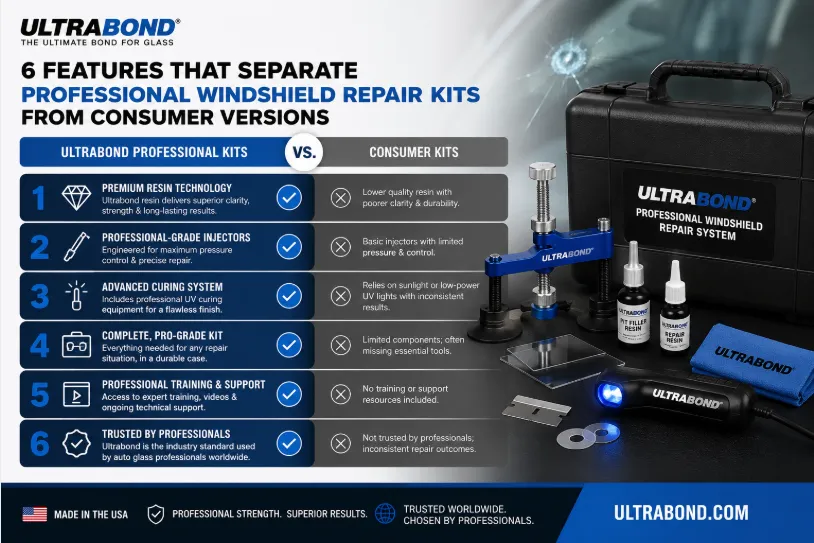

Professional windshield repair kits are not simply more expensive versions of what is sold at auto parts stores. They differ in design, materials, and application capability in ways that produce measurably different repair outcomes. These six features explain why professional technicians do not use consumer kits.
1. Multi-Resin Formulation Systems
Professional kits include multiple resin viscosity options rather than a single resin for all damage types. Having low, medium, and high viscosity resins allows the technician to match material to damage geometry. Consumer kits use a single compromise viscosity that is acceptable for most damage but optimal for none.
2. Vacuum-Pressure Injection Control
Professional injectors provide precise, independently controllable vacuum and pressure cycles. This allows the technician to draw air from damage, then push resin in with measured pressure, then apply vacuum again to eliminate trapped air, cycling until the damage is fully filled. Consumer injectors combine these stages in a simplified mechanism that provides less control over the injection sequence.
3. Bridge and Pedestal Configurations
Professional kits include multiple bridge and pedestal configurations to accommodate different damage locations on the windshield and different glass thicknesses. A consumer kit with a single injector design cannot adapt to edge damage, damage near the mirror base, or damage on glass of unusual thickness.
The National Windshield Repair Association certifies professional repair equipment and materials against documented performance standards. Certified equipment is tested for optical clarity improvement, structural integrity, and repeatability across multiple technicians, providing objective quality differentiation from non-certified products.
4. UV Curing Tools
Professional kits include or are designed for use with UV curing lamps that provide controlled intensity and duration. Relying on sunlight for cure, as consumer kits typically instruct, produces variable results depending on cloud cover, time of day, and season. Controlled UV curing at the correct intensity produces consistent crosslinking and reduces over-cure and under-cure failures.
5. Pit Polish and Finishing Tools
Professional kits include razor blades, pit polish, and finishing compounds that level the cured resin flush with the glass surface and restore optical clarity. Consumer kits often include only basic finishing tools. The difference in final optical quality is visible to any driver looking through the repaired area.
6. Material Certification and Documentation
Professional materials include safety data sheets, technical data documentation, and in many cases, National Windshield Repair Association certification. This documentation matters when repair quality is evaluated against an insurance or warranty standard. Consumer kits have no equivalent documentation.
Research by the Auto Glass Safety Council confirms that repairs performed with professional-grade equipment and certified materials consistently achieve optical clarity measurements in the 90 to 95 percent range compared to undamaged glass, while consumer kit repairs average 65 to 75 percent under ideal conditions.
The Bottom Line
The differences between professional and consumer windshield repair kits are genuine and measurable. For repair quality that approaches professional results, the defining features are multi-viscosity resin options, vacuum-pressure injection control, and controlled UV curing. Consumer kits that include these features are a significant improvement over those that do not.


























Sign in to leave a comment.