

Nearly three in four employers worldwide struggle to find skilled talent. This shortage is pushing enterprises toward staff augmentation to access specialist skills, speed up delivery, and close capacity gaps.
However, expanding an engineering team with external developers also increases the number of contributors, dependencies, and parallel changes to govern. Moreover, architecture, testing, documentation, and release practices can become inconsistent when delivery capacity grows faster than the engineering controls that govern it. This is not a limitation of working with external talent, but an operating model challenge.
The blended squad model addresses this challenge by integrating internal and external professionals into one engineering unit. Both groups work through shared standards, tooling, decision rights, and quality controls.
This blog explains how the blended squad model works, when it is most appropriate, and how it protects code quality through shared ownership, architecture governance, CI controls, risk-based testing, release discipline, and long-term accountability.
Why Scaling an Engineering Team Makes Code Quality Harder to Govern
As engineering teams expand across applications, services, and release streams, the number of technical decisions grows faster than any one person can keep track of. More contributors are changing connected parts of the system simultaneously, often with varying levels of product knowledge, architectural context, and familiarity with historical decisions.
This creates several governance gaps.
- Code reviews can slow down because a small group of senior engineers becomes responsible for validating an increasing volume of changes. When those reviewers lack time to examine wider dependencies, reviews may confirm that the code works locally without identifying its impact on connected services.
- Implementation patterns can also diverge. Different contributors may solve similar problems in different ways, introduce overlapping abstractions, or interpret shared standards differently. These inconsistencies are rarely visible within an isolated task, but become apparent when workstreams converge.
- Integration risk rises for the same reason. A change may pass unit testing yet break an API contract, alter shared data behavior, or conflict with another release. The defect is then discovered later, when remediation is slower and more expensive.
- Team growth can also deepen dependence on a few system experts. When architecture decisions, business rules, and production history remain undocumented, new contributors must repeatedly rely on the same individuals for clarification and approval.
The result is not simply more defects. It is slower decision-making, higher rework, less predictable releases, and rising maintenance costs. These risks are not inherent to staff augmentation. They emerge whenever delivery capacity expands faster than the standards, technical context, and governance needed to coordinate it.
What is a Blended Squad, and When Should Enterprises Use It
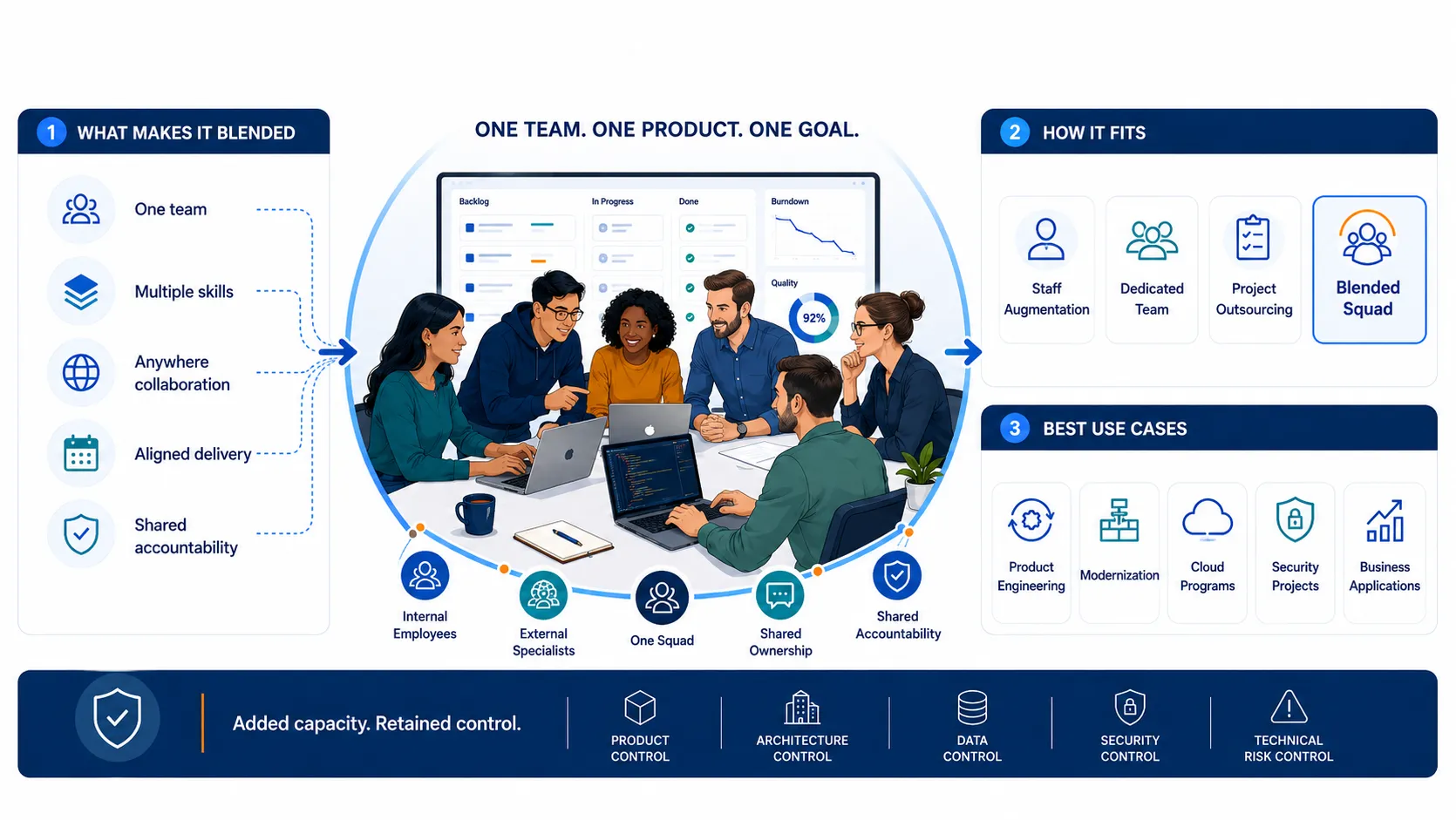
A blended squad is a specific, structured IT staff augmentation format, not a loose mix of contractors and employees. Understanding its structure and where it fits among other engagement models matters before adopting it.
What Makes the Squad "Blended"
A blended squad is a stable, cross-functional unit made of internal employees and external specialists. Both groups work through one product backlog, one architectural direction, and one source-control environment. They also share one delivery cadence, one Definition of Done, one testing and release process, and one set of quality measures. "Blended" describes integrated execution and shared accountability. It is not simply a team that includes people from different organizations.
How Does it Fit Within Staff Augmentation and Outsourcing
Enterprises can choose among several engagement models. The right choice depends on how much control the enterprise wants to retain, which capabilities already exist internally, and how much delivery responsibility should sit with an external partner. A broader comparison of outsourcing versus in-house app development can help leaders evaluate these trade-offs before selecting a specific model.
The models differ mainly in how talent, ownership, and execution are structured:
| Engagement model | How it works | Best suited for |
|---|---|---|
| IT staff augmentation | External specialists join an existing team to close skill or capacity gaps. The enterprise retains day-to-day delivery control. | Targeted expertise, temporary capacity needs, or faster team expansion |
| Dedicated development team | A stable external team works continuously on the client’s products or technology roadmap. | Long-term delivery requiring consistent external capacity |
| Project outsourcing | The service provider assumes responsibility for a defined scope, deliverable, or outcome. | Clearly bounded projects with established requirements |
| Blended squad | Internal and external specialists operate as one product engineering unit under shared standards, workflows, and accountability. | Complex or business-critical programs requiring added capacity without reducing enterprise control |
A blended squad, hence, is best understood as an advanced staff augmentation model, not a replacement for staff augmentation itself.
When is The Model Most Appropriate?
The blended squad model suits work where continuity and specialist skill matter most. That includes long-term product engineering, legacy modernization, cloud and platform programs, regulated or security-sensitive systems, and business-critical applications. It delivers the most value when an enterprise wants added engineering capacity while retaining authority over product priorities, architecture, data, security, and technical risk.
How a Blended Squad Protects Code Quality
A blended squad combines enterprise context with specialist expertise within a single engineering workflow. This improves design consistency, validation, testing, and release control as delivery scales.
It Preserves Architectural Consistency
Parallel teams can make locally valid changes that conflict with the wider platform. Internal leads bring knowledge of business rules and legacy constraints, while external specialists contribute technical depth in areas such as modernization, cloud, or platform engineering.
Shared design reviews establish how services, APIs, schemas, and dependencies should change before implementation begins. The team also records the decision, its trade-offs, and the systems affected.
This reduces incompatible interfaces, duplicated logic, and conflicting data models. It also prevents architectural reasoning from remaining with a few long-serving employees.
It Turns Quality Expectations into Verifiable Conditions
Terms such as secure, scalable, and resilient are too broad to guide implementation.
A blended squad converts them into measurable conditions. A performance requirement becomes a response-time target under a defined workload. Security becomes specific authorization, encryption, retention, and audit requirements. Integration rules define expected behavior during invalid requests, timeouts, version changes, and dependency failures.
These conditions give developers, reviewers, and testers one objective basis for deciding whether a change is ready.
It Makes Quality Enforcement Repeatable
As contributor numbers increase, senior engineers cannot manually enforce every coding, security, and release rule.
A shared repository and CI workflow place every change through the same validation path. The pipeline can block failed builds, exposed credentials, vulnerable dependencies, and policy violations. Sensitive modules can require approval from the relevant technical owner.
Automation handles repeatable checks, allowing reviewers to focus on architectural fit, business logic, failure handling, and downstream impact. This maintains consistent standards without turning internal experts into review bottlenecks.
It Matches Testing Effort to Business Risk
Not every change requires the same testing depth.
A minor interface update may need focused regression testing. Changes to authentication, payments, shared APIs, or customer data require broader validation, as a failure could affect multiple systems, users, or compliance controls.
The squad therefore tests according to component criticality, dependency impact, and the consequences of failure. This provides stronger assurance than code coverage alone, which shows execution but not whether critical failure scenarios were tested.
It Limits the Impact of Production Defects
Pre-release testing cannot reproduce every production condition. Production risk, therefore, depends on limiting exposure and detecting abnormal behavior quickly. The squad first verifies that the target environment matches the tested configuration. It then releases the change gradually. If error rates, latency, or transaction failures cross agreed thresholds, the rollout can stop or reverse automatically.
Deployment markers, logs, and traces connect abnormal behavior to the responsible release and help isolate the affected service or dependency. This reduces the blast radius of failure and shortens recovery.
How to Govern and Sustain Quality Throughout the Engagement
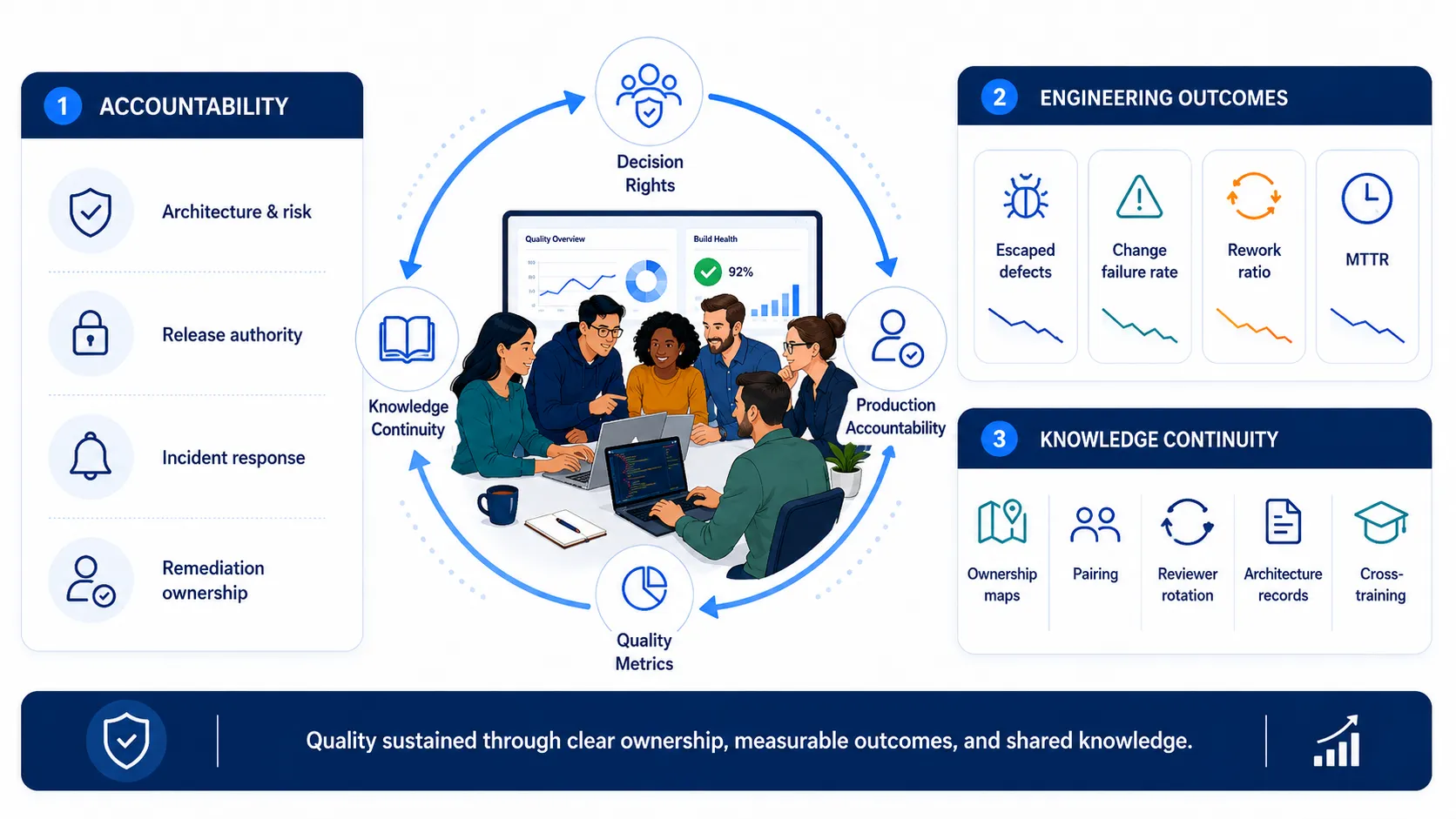
Delivery controls protect individual changes. Engagement governance ensures those controls remain effective as priorities, workloads, and squad composition change.
Define Accountability Through Production
Decision rights should be established before a time-sensitive release, or an incident forces the team to negotiate them. Internal leaders should retain authority over architecture direction, enterprise risk, security exceptions, and technical-debt acceptance. Release and incident responsibilities should specify who can stop a deployment, lead recovery efforts, and approve corrective actions.
External specialists should remain accountable for the maintainability and production performance of the components they own or modify. Their responsibility should include root cause analysis and remediation, ensuring ownership continues beyond code approval.
Measure Engineering Outcomes, Not Just Capacity
Performance measures should show whether additional capacity improves delivery or creates hidden costs. Escaped defects reveal weaknesses in pre-release validation. Change failure rate indicates how often deployments require rollback or remediation. The rework ratio shows how much engineering capacity is consumed by previously delivered work. Mean time to restore service measures how effectively the squad contains production failure.
Together, these metrics provide data-driven insights into release stability, engineering efficiency, and operational risk. Enterprises can use them to evaluate whether the engagement is improving roadmap predictability and reducing maintenance costs, rather than relying only on hours supplied, utilization, or completed tickets.
Build Knowledge Continuity Into Daily Delivery
Knowledge continuity should be built into how work is assigned and reviewed. Component ownership maps make concentrated expertise visible. Pairing and reviewer rotation expose more engineers to critical design decisions, while architecture records preserve the reasoning that cannot be inferred from code alone.
Cross-training and transition planning should occur throughout the engagement rather than begin when a specialist rotates out. This allows the squad to change composition without losing control of critical components or slowing future delivery.
The Takeaway: Scaling Capacity Within One Quality System
A blended squad is more than a mix of internal and external engineers. It is a staff augmentation model in which both groups operate under the same architecture, engineering standards, delivery controls, and quality measures. Global demand for this approach is rising alongside a staff augmentation market now valued at over $340 billion, according to Vantage Market Research. Designed correctly, the blended squad model lets enterprises tap specialist skills and speed up delivery. Maintainability, technical ownership, and release confidence all stay intact.



























Sign in to leave a comment.