
Introduction
Ask any engineering leader what they want from a Flutter hire, and the answer is predictable: someone who can ship cross-platform apps, write clean Dart, and deliver on time. That used to be enough.
It is not enough anymore.
Flutter is now being used in production environments where release speed, interface consistency, and cross-platform stability matter. Flutter’s official showcase includes examples from 2025 and 2026, such as Talabat moving from siloed native development to a unified Flutter codebase and NotebookLM shipping a 4.8-star Flutter app in seven months. The framework is no longer a startup tool. It is an enterprise infrastructure. This shift has also changed how engineering leaders evaluate talent for Flutter app development in complex enterprise environments, as it demands more than just development speed.
An enterprise Flutter app typically serves multiple user roles, spans regions and brands, powers both customer-facing and internal workflows, and is expected to evolve as AI features are layered in. A developer who can build screens is valuable. But a developer who can build the system that those screens live inside, complete with design tokens, component governance, theming architecture, and AI-ready interface patterns, is what enterprises actually need right now.
Flutter expertise is the baseline. The real differentiator is whether a developer can build a proprietary design system that holds up across teams, scales with the product, and is structured to absorb AI-driven experiences without requiring a rewrite.
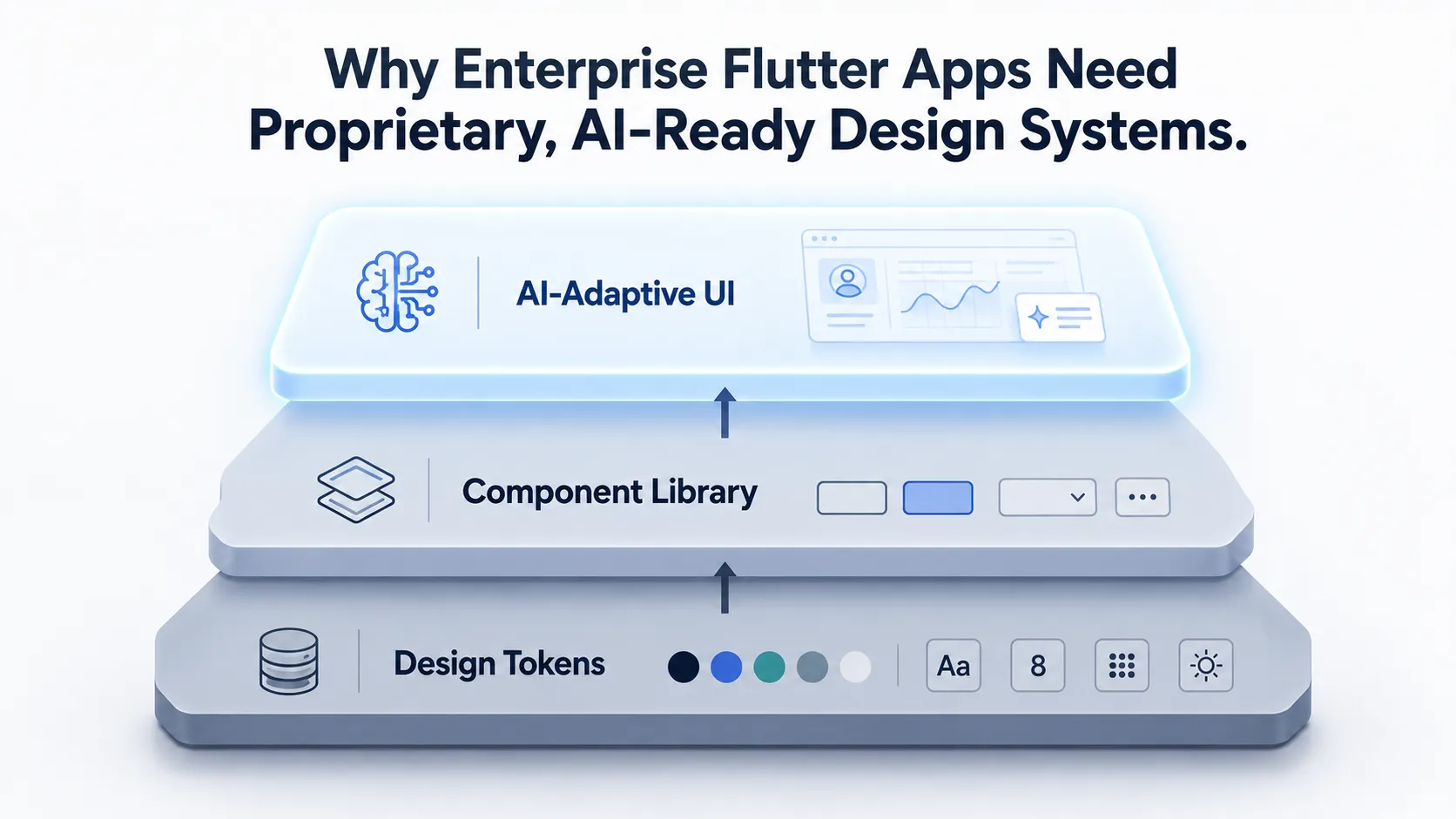
Why Enterprise Flutter Apps Need Proprietary, AI-Ready Design Systems?
Enterprise Flutter apps need more than reusable screens. They need a governed UI foundation that can maintain consistent, complex workflows today and support AI-driven interface changes tomorrow.
Why Proprietary Design Systems Matter?
Enterprise Flutter apps are rarely simple. A single app might serve a field technician in one region, a customer in another, and an internal operations team in a third, each with different workflows, permissions, and visual expectations. Managing UI consistency across that complexity without a structured design system is difficult.
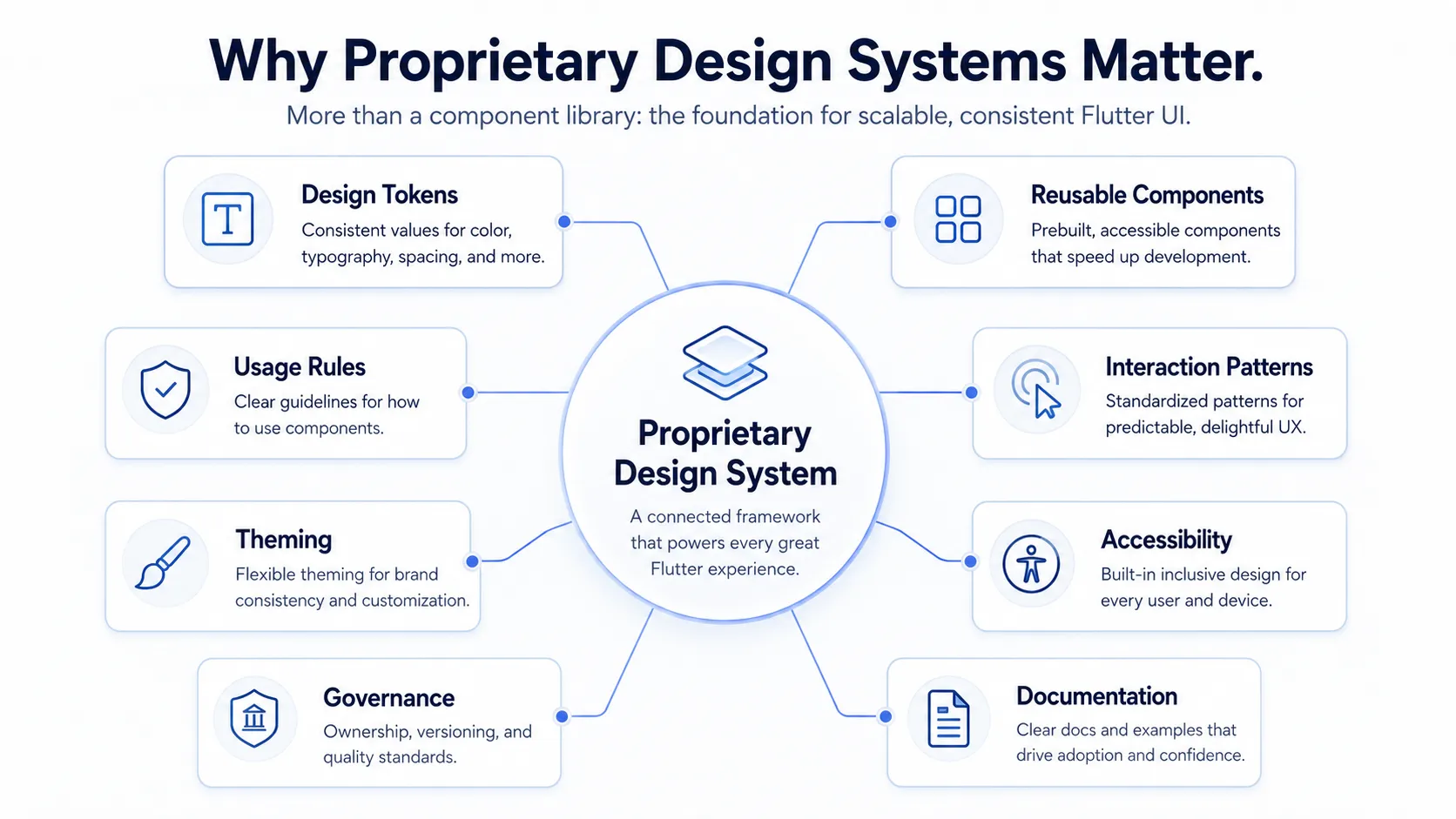
A proprietary AI-agnostic design system is not only a component library. In practice, it integrates design tokens, reusable widgets, theming logic, accessibility rules, and documentation into one governed front-end foundation. This organized UI infrastructure includes:
- Design tokens for spacing, typography, color, and elevation
- Reusable components with clear usage rules
- Defined interaction patterns and motion standards
- Theming support for multi-brand or multi-region deployment
- Accessibility rules enforced at the system level
- Governance around who can change components and how
Without this foundation, teams often build the same button, card, form, or error state in different ways. Components drift. Quality assurance cycles stretch. New features take longer because developers keep solving layout and interaction problems that should have been solved once.
This is why proprietary design systems matter in enterprise Flutter app development. They move UI decisions from individual screens to a governed system. The result is a cleaner interface and a more stable front-end foundation. Teams can add features without recreating basic UI logic, update patterns without touching every screen, and keep the product consistent as more teams contribute to the same codebase.
Why AI Readiness Changes the Requirement?
Here is where the requirement changes significantly. Enterprise interfaces are no longer static. AI is already reshaping what users expect from applications, and the pace of that shift is accelerating.
Enterprise apps are now being asked to support interface behaviors such as:
- Personalized dashboards based on user behavior
- AI-generated workflow recommendations
- Dynamic content areas that change based on model output
- Conversational interface patterns
- Role-based personalization
- Predictive prompts and next-best-action suggestions
- Fallback states when AI output is uncertain, incomplete, or unavailable
This is no longer a distant concern. McKinsey’s 2025 State of AI report found that 78% of organizations use AI in at least one business function, up from 72% in early 2024 and 55% a year earlier. The same report found that 71% of respondents regularly use generative AI in at least one business function. Another Gartner report predicts that up to 40% of enterprise applications will include integrated task-specific AI Agents by 2026, up from less than 5% in 2025. These numbers show that AI is already moving into everyday enterprise workflows, not sitting at the edge of experimentation.
This is precisely where the design system question becomes a hiring question.
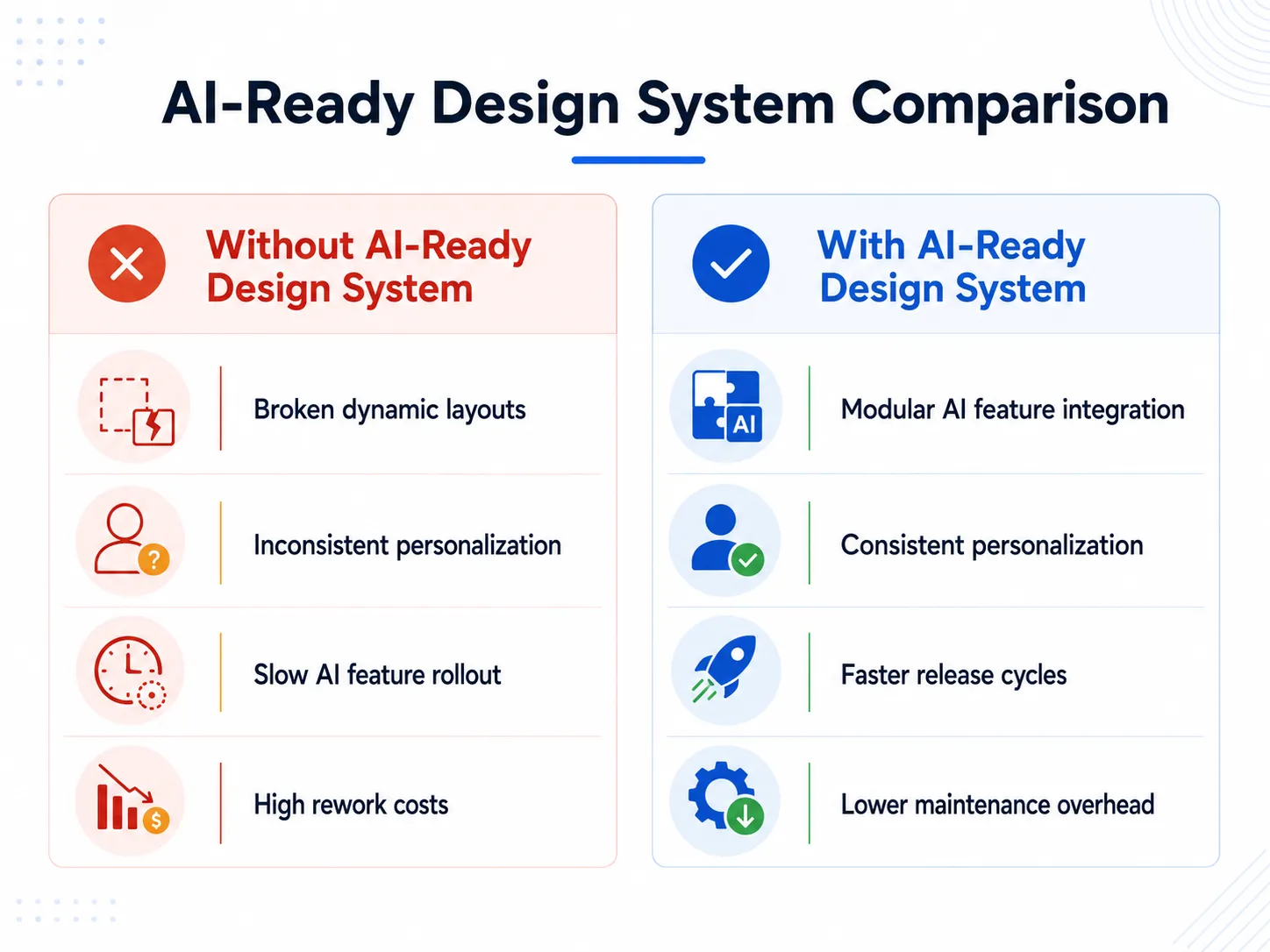
If the Flutter UI foundation is inconsistent or poorly structured, AI integration becomes harder. The common issues include:
- Dynamic content breaking components built only for static layouts
- Personalized dashboards exposing inconsistent UI patterns
- Conversational interfaces requiring reusable, composable components
- AI-generated content creating layout, truncation, or fallback issues
- Teams rebuilding AI interface patterns separately across different screens
But if the design system is modular, well-governed, and built with variability in mind, AI-led interface patterns can be integrated with less rework. Dynamic content areas can follow defined layout rules. Conversational flows can use reusable components. Recommendation blocks can be designed with fallback states. Personalized dashboards can stay consistent because they are built from the same governed UI foundation.
A proprietary design system gives enterprise Flutter apps structure. An AI-ready design system makes that structure future-ready. The two are no longer separate considerations.
What to Look for in Your Next Enterprise Flutter Resources?
Moving from the problem to the hiring decision, the capabilities that matter most are not always the ones listed on a resume. Here is how to evaluate them.
Design System Experience
Can this Flutter developer build and maintain structured UI systems, alongwith the screens?
Look for candidates who have built or significantly contributed to a component library used across multiple teams or products. Ask them to walk you through a design token structure they have created. Ask how they handled theming for multiple brands in a single codebase. Ask what their governance process looked like for adding new components.
Sample Interview question: "AI responses often stream in real-time or suffer from high latency. How do you manage loading states, skeleton screens, and UI layout shifts (CLS) under these conditions?"
Enterprise Architecture Thinking
Can this developer create reusable, scalable Flutter foundations across teams and products?
Look for experience with clean architecture patterns, state management at scale (Riverpod, BLoC), and modular feature structure. A developer who has only worked on single-team projects may not have confronted the coordination challenges that come with multi-team component ownership.
Sample Interview question: "How would you structure a Flutter component library so that two product teams can contribute to it independently without breaking each other's work?"
AI-Ready UI Planning
Can this developer design component systems that support personalization, dynamic content, and future AI integration?
Look for candidates who understand the difference between a static component and a flexible one, like components built with variable slot patterns, fallback states, loading skeletons, and content-length tolerance. Ask how they would design a dashboard widget that might be populated by either static data or AI-generated recommendations.
Sample Interview question: "What is your strategy for implementing UI error boundaries and fallback states when an AI service returns an invalid payload, an empty response, or throws a 500 error?"
The Business Value of Making the Right Decision
Hiring for design system capability creates measurable business value.
Figma’s 2026 analysis notes that Freshworks credited its new design system with:
- 28% reduction in customer service costs
- Improved time-to-resolution on support tickets
- Better consistency across product experiences
For enterprise Flutter teams, this reinforces one point: a design system is not only a UI asset. It can influence the quality of support, product operations, and the consistency of the user experience.
The right Flutter resource helps create business value in several ways:
- Predictable Content Mapping: Because AI interacts with standardized layout "slots" rather than fragmented screens, it can reliably push dynamic content into any part of the Flutter application instantly.
- Centralized Model-to-UI Mapping: Mapping an LLM's JSON payload to the UI happens once at the component level. If the AI data schema changes, updating a single component updates the AI integration across the entire app.
- Semantic Tool-Calling for AI Agents: A system mindset establishes a clean, predictable component vocabulary, making it significantly easier to map UI elements directly to an AI Agent’s function-calling capabilities.
- Cleaner Flutter AI Integration: Modular, documented components make it easier to add AI-driven personalization, dynamic content areas, and conversational patterns.
- Better Design-Engineering Alignment: Designers and developers work from the same source of truth, making reviews faster and feedback more specific.
The right Flutter hire does not just improve the execution of development but also the product's long-term economics and adaptability.
Evaluate Flutter Developers for the System, Not Only the Screens
Flutter development competency still matters, but it is no longer enough for enterprise hiring. The framework has matured, the talent pool has grown, and basic cross-platform delivery is now the baseline.
What separates high-impact Flutter hires from average ones is their ability to build something that outlasts a single feature cycle: a proprietary, modular, AI-ready design system that scales across teams, supports personalization, and gives the product a stable foundation for AI-driven interface changes. Enterprise Flutter success depends on the system behind the screens.
























Sign in to leave a comment.