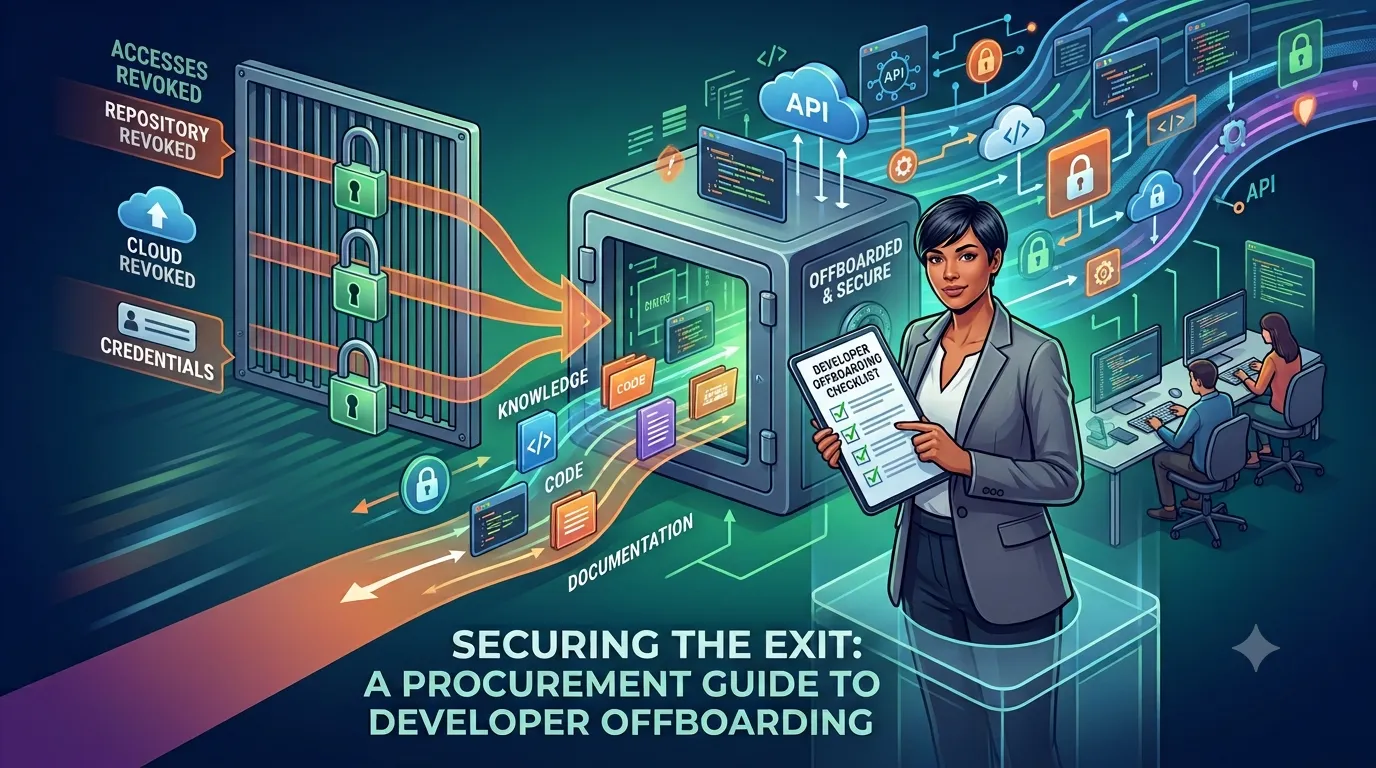

When a staff augmentation engagement ends, the security focus changes. At first, the goal is to grant access. Ultimately, the goal is to take it back cleanly. In the beginning, augmented developers need broad access to do their work. This includes repositories, cloud environments, sprint boards, deployment pipelines, documentation systems, and communication tools. But once the engagement closes, those permissions must be removed.
This happens through a clear developer offboarding process and is not considered a sign of distrust toward the developer. It is a standard vendor control that applies to every person who works in a technical environment. The same care used during onboarding should apply in reverse when the work ends. That means identity checks, scoped access, confidentiality agreements, and role-based permissions, used to remove access, not just grant it
Organizations that already follow a structured process for hiring and managing dedicated developers should treat offboarding as the final stage of that same engagement lifecycle, not as a separate administrative task.
The need for structured offboarding is also becoming more urgent as third-party access becomes a larger part of enterprise security exposure. SecurityScorecard’s 2025 Global Third-Party Breach Report found that 35.5% of breaches in 2024 were linked to third-party access. For procurement teams, the takeaway is clear: vendor governance cannot stop at onboarding or contract signing. It must extend to documented offboarding.
This guide explains why procurement should be involved, where offboarding gaps usually appear, and what a procurement-ready developer offboarding checklist should include.
Why Vendor Management Must Be Involved in Developer Offboarding?
Developer offboarding often gets treated as an IT or engineering task, but that framing captures only part of the process. IT can revoke system access. Engineering teams close branches, review pull requests, and collect handover notes. Legal reviews the confidentiality and intellectual property clauses. Procurement, by contrast, ties these workstreams together through the vendor relationship, contract terms, billing status, and closure documentation.
This is why procurement should not disappear once the developer has been onboarded. Its role continues until the engagement is formally closed. Throughout that period, procurement helps verify that the final working day has been confirmed, the Statement of Work is complete, and all deliverables have been accepted. It can also confirm whether the contract needs to be extended, whether any invoices remain pending, and whether the vendor has finished its side of the offboarding process.
Without this coordination, different teams may close different parts of the engagement at different times. The contract may end before access is removed. Access may be revoked before knowledge transfer is complete. Final billing may stay open while deliverables are still under review. A procurement-led offboarding process reduces this friction. Each stakeholder gets a defined role, and the engagement closure stays auditable.
Where Offboarding Risks Usually Appear?

Offboarding risks are rarely caused by bad intent. They usually come from fragmented ownership, informal access provisioning, and unclear exit timelines.
This is especially common in fast-moving engineering environments. Augmented developers can be quickly added to sprint boards, repositories, staging environments, internal channels, and documentation tools. These permissions are valid during delivery. The issue begins when no one maintains a complete record of what was granted.
The following gaps are the most common.
Untracked Tool Access
Project tools are often provisioned outside a formal access register. This can include Jira, Azure DevOps, GitHub, GitLab, Confluence, Notion, Slack, Teams, testing dashboards, or monitoring tools. When access is not logged during onboarding, offboarding depends on memory. That increases the chance of missed accounts.
Shared Credentials
Some legacy environments still depend on shared credentials, deployment keys, test database passwords, or shared API tokens. Even when this setup is temporary, it creates offboarding complexity. If a shared credential was used during the engagement, it should be reviewed and rotated at exit.
Active Repository Permissions
Repository permissions may remain active after the engagement ends if access reviews are not tied to the exit process. This does not mean the developer is a concern. It means repository access should follow the same lifecycle as the contract.
Pending Pull Requests
A developer may have open pull requests, unmerged branches, or partially reviewed code at the time of exit. These items need proper closure. Engineering should decide whether each pull request should be merged, rejected, reassigned, or documented for future review.
Incomplete Knowledge Transfer
Some project knowledge sits outside the codebase. It may include module logic, deployment dependencies, environment quirks, known bugs, API behavior, or undocumented decisions.
If knowledge transfer happens too late, internal teams may inherit code without enough operating context.
Unclear Intellectual Property Closure
Code ownership should be clear throughout the engagement. Still, procurement should reconfirm this at exit. This is especially important when final sprint work, documentation, scripts, or configuration changes are delivered close to the end of the engagement.
Delayed Vendor-Side Confirmation
The client can remove internal access, but the vendor may still need to confirm its side of closure. This may include confirmation of resource release, asset handling, confidentiality acknowledgment, and final documentation.
SecurityScorecard’s 2025 report also notes that third-party breach figures are likely conservative because third-party involvement is often underreported or misclassified. This makes structured exit controls even more important.
A Procurement-Ready Developer Offboarding Checklist
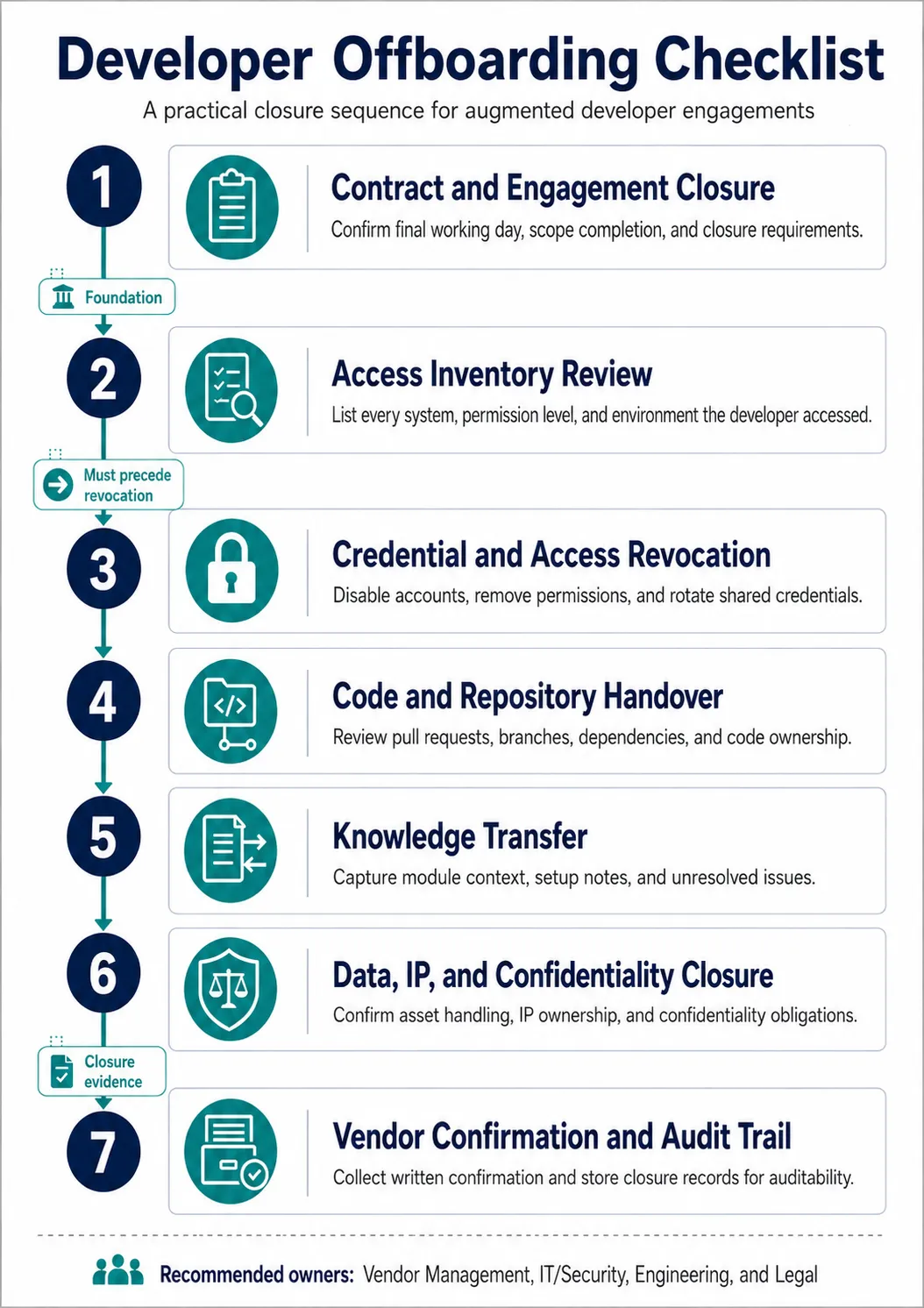
A strong developer offboarding checklist should cover seven areas. Each area needs an owner, a deadline, and evidence of completion.
1. Contract and Engagement Closure
Start with commercial and contractual closure. Procurement should confirm the engagement status before technical teams begin final deprovisioning.
Their checklist should include:
- Confirm the developer’s final working day in writing.
- Review whether the contracted scope is complete.
- Validate final deliverables against the Statement of Work.
- Identify any deferred or reassigned work.
- Confirm whether a replacement resource is needed.
- Review open invoices and billing terms.
- Record formal engagement closure in the vendor system.
This step prevents confusion between a temporary pause, a resource change, and a formal exit.
2. Access Inventory Review
Access review should begin with the inventory maintained during onboarding.
The checklist should include:
- List every system the developer accessed.
- Review permission levels for each system.
- Flag admin, deploy, or elevated access.
- Check Single Sign-On and VPN access.
- Review cloud consoles and service accounts.
- Check repositories, forks, and branches.
- Review CI/CD tools and deployment systems.
- Check documentation and project management tools.
Offboarding should not begin with the question, “What did this developer access?” That information should already exist.
3. Credential and Access Revocation
Credential and access removal should happen on or before the final working day.
The checklist should:
- Disable Single Sign-On access.
- Remove VPN access.
- Remove repository permissions.
- Revoke cloud console access.
- Review service accounts created during the engagement.
- Remove CI/CD pipeline access.
- Remove project management access.
- Remove communication tool access.
- Revoke access to documentation systems.
- Rotate shared credentials and API keys.
This step should be documented with timestamps. Those records form the audit trail for procurement, IT, security, and compliance teams.
4. Code and Repository Handover
Engineering should review all active code contributions before the engagement closes.
The checklist should:
- Review all open pull requests.
- Merge, reject, or reassign pending pull requests.
- Identify active branches with incomplete work.
- Confirm all completed work is committed.
- Document deployment dependencies.
- Record known bugs and technical debt.
- Update backlog items with enough context.
- Confirm code ownership under the client’s IP terms.
The objective is repository hygiene. All completed and pending work should remain visible, reviewable, and transferable.
5. Knowledge Transfer
Knowledge transfer should occur before access is completely removed.
The checklist should:
- Prepare a formal handover document.
- Conduct an exit walkthrough with engineering.
- Explain module-specific logic.
- Document edge cases and known limitations.
- Record environment setup steps.
- Update API or integration notes.
- Document deployment instructions.
- Share testing notes and unresolved issues.
This step protects continuity. It also allows the outgoing developer to exit professionally, with their work properly documented.
6. Data, IP, and Confidentiality Closure
Procurement and legal should confirm that data and intellectual property obligations are complete.
The checklist should:
- Confirm client-owned assets are handled as agreed.
- Review data return or deletion requirements.
- Reconfirm confidentiality obligations.
- Validate intellectual property ownership.
- Confirm restricted documentation access is removed.
- Record any required vendor-side acknowledgment.
The wording here matters. This is not about suspicion. It is about standard compliance discipline.
7. Vendor Confirmation and Audit Trail
The final step is the written vendor confirmation.
The checklist should:
- Obtain written offboarding confirmation.
- Confirm the developer has been released from the engagement.
- Store access removal records.
- Store handover documents.
- Record final deliverables.
- Save IP and confidentiality confirmations.
- Document lessons for future engagements.
This creates a clean closure record for procurement. It also protects the vendor relationship by removing ambiguity.
How to Make Offboarding Easier Before the Engagement Starts?
The best offboarding processes are designed before onboarding. Organizations that manage staff augmentation security well do not wait until the final week. They build exit controls into the engagement lifecycle from day one.
- Start with granular access logs. Every system, permission level, and credential should be recorded when access is granted. This makes revocation faster and more accurate at exit.
- Use individual accounts wherever possible. Shared credentials should be avoided because they make clean revocation harder. If shared access is unavoidable, it should be temporary and documented.
- Define handover expectations in the Statement of Work. Knowledge transfer should not be treated as a courtesy. It should be a clear deliverable with expectations for format, timing, and completeness.
- Assign an internal offboarding owner during onboarding. This person should coordinate procurement, IT, engineering, legal, and the vendor when the engagement ends.
- Keep documentation updated throughout the project. Handover quality drops when documentation is written only in the final week.
- Conduct periodic access reviews during longer engagements. Quarterly reviews can help remove unnecessary permissions before they become offboarding issues.
This prevention-first approach reduces exit pressure. It also makes the entire vendor lifecycle easier to govern.
Ending Note: Secure Offboarding Protects Delivery and Trust
A well-managed augmented developer offboarding process does not weaken trust. It protects it. It gives the client a secure closure, provides a clear audit trail, and engineers the context needed to continue work. It also allows the outgoing developer and vendor to exit the engagement with no residual ambiguity. The strongest staff augmentation partnerships do not treat offboarding as a last-day task. They define it at the beginning, track it during delivery, and execute it with discipline at closure.
For procurement teams, the real priority is not only ending the contract. It is about ensuring that access, code ownership, knowledge transfer, data handling, and vendor confirmation are closely aligned. That is what separates a mature staff augmentation engagement from a loosely managed vendor relationship. Secure offboarding protects systems, continuity, and professional trust on both sides.


























Sign in to leave a comment.