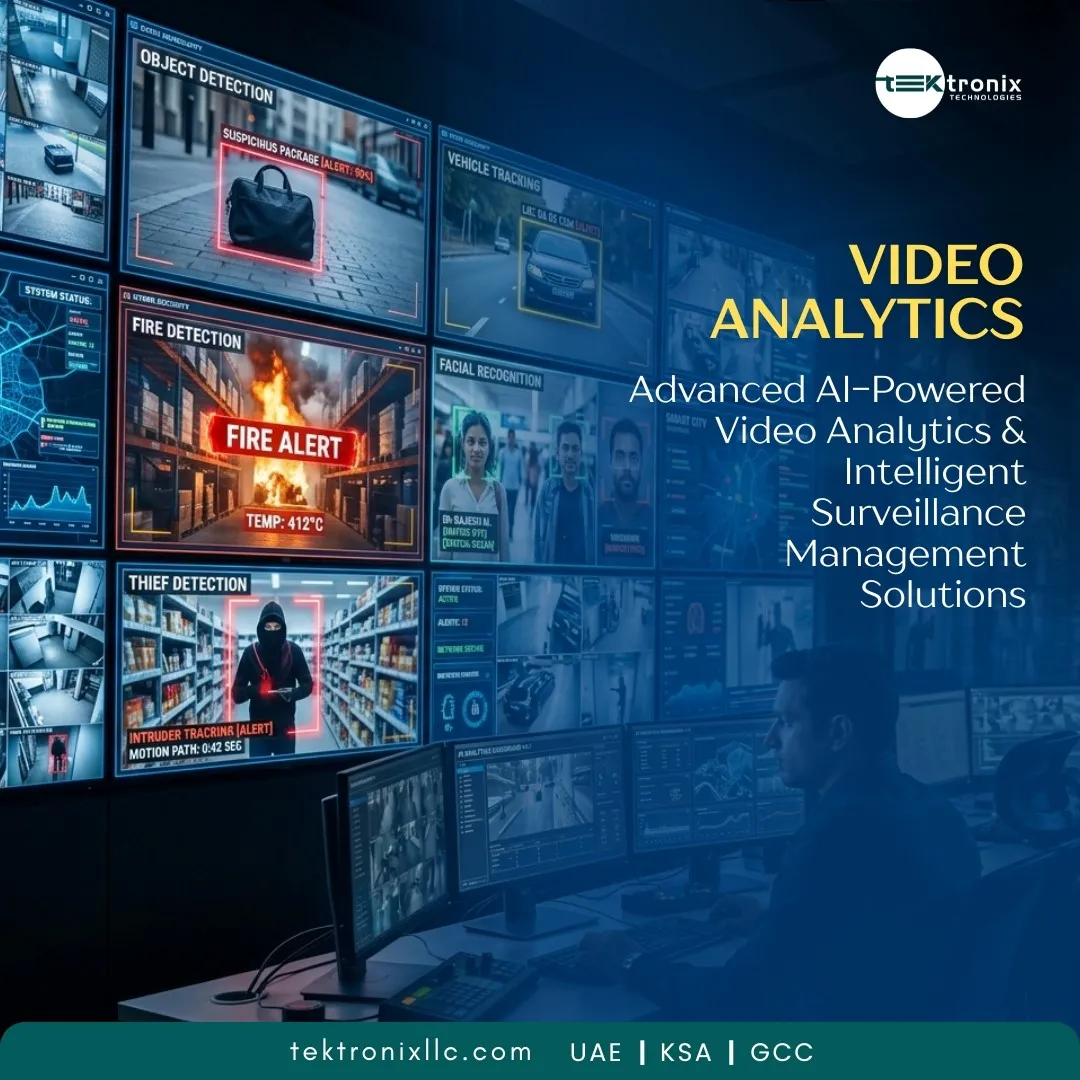

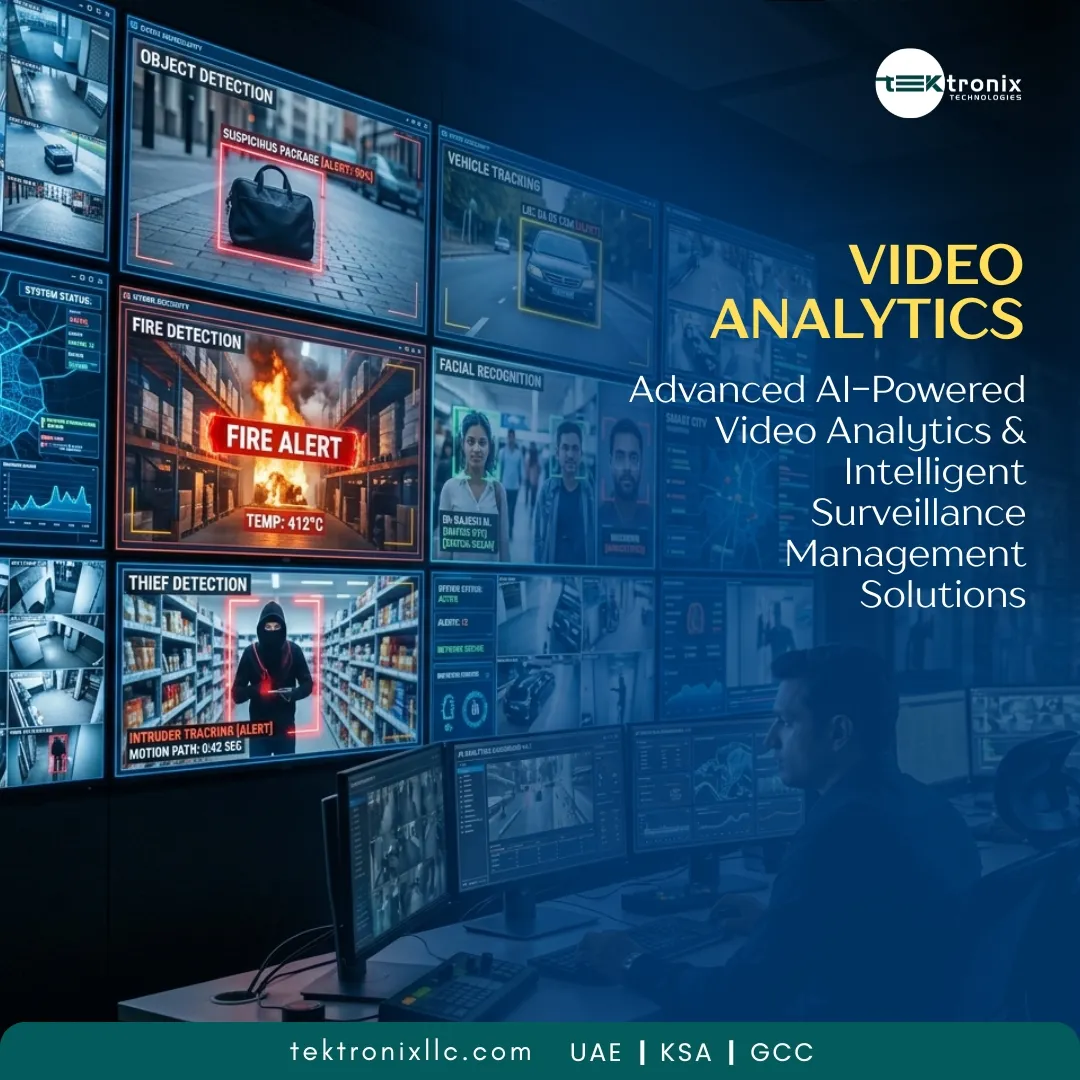
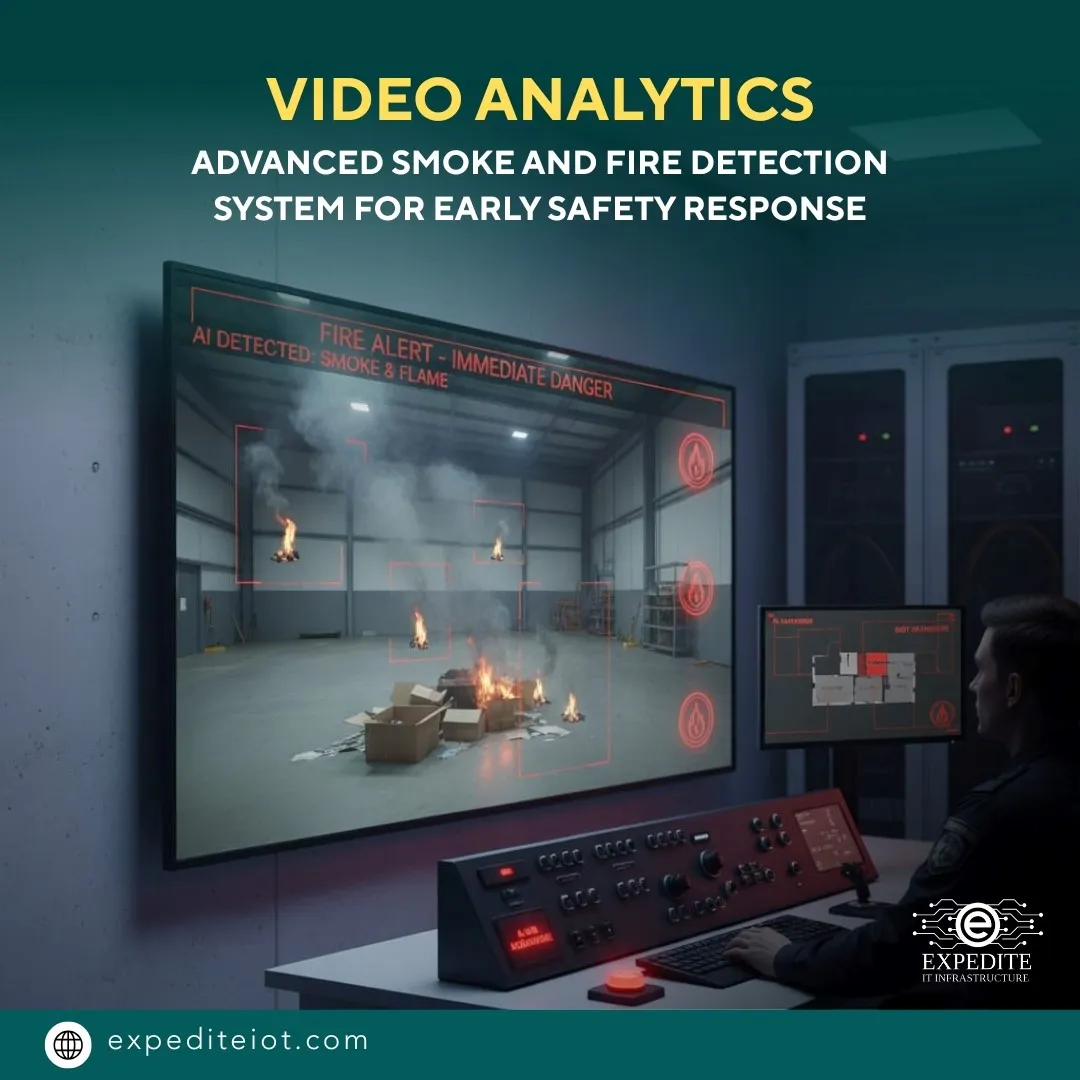
Intelligent Video Analytics is redefining how facilities across Bahrain and the broader Gulf Cooperation Council detect, classify, and respond to fire and smoke incidents before they escalate into life-threatening emergencies. Traditional heat and ionisation detectors remain reactive by design — they register a threat only after combustion has already begun. Tektronix LLC’s AI-driven fire and smoke detection platform harnesses computer vision and deep-learning algorithms embedded directly into the surveillance infrastructure to identify the visual signatures of fire and smoke at the earliest possible stage, providing critical seconds that save lives, protect assets, and limit operational disruption across the region’s most demanding environments.
The Limitations of Conventional Detection in GCC Environments
The GCC’s unique operating conditions — extreme ambient temperatures, humidity differentials between air-conditioned interiors and exposed industrial zones, and the prevalence of high-ceilinged warehouses and open petrochemical yards — expose the fundamental inadequacy of point-based smoke detectors. False activations triggered by dust, steam, or cooking vapour in facilities such as SABIC’s manufacturing plants or DEWA’s power generation sites not only disrupt operations but erode occupant trust in alarm systems over time, creating dangerous desensitisation. Tektronix LLC’s analytics-driven approach addresses these environmental variables through contextual scene understanding, distinguishing genuine combustion signatures from benign visual noise with a classification accuracy that consistently exceeds 97 percent in real-world GCC deployments.
AI-Powered Video Analytics: The Intelligence Behind Early Detection
Tektronix LLC’s AI-Powered Video Analytics engine processes live video feeds from existing IP camera infrastructure, applying convolutional neural network (CNN) models trained on tens of thousands of labelled fire and smoke events across diverse environmental conditions. Unlike rigid rule-based systems, the platform continuously refines its confidence thresholds through federated learning, meaning detection accuracy improves with every incident observed across the network of deployed sites. The AI models are optimised for edge inference on NVIDIA Jetson and Intel OpenVINO-compatible hardware, ensuring that critical alerts are generated locally without dependence on cloud round-trips — a decisive advantage in bandwidth-constrained industrial environments such as Aramco’s offshore platforms, ADNOC refinery complexes, or Bahrain’s Sitra industrial estates. Certified under ISO/IEC 27001:2022 data handling protocols, the platform also satisfies the UAE Federal Decree-Law No. 45 of 2021 on Personal Data Protection and Bahrain’s PDPL requirements for video data governance.
How the Detection Algorithm Works
The detection pipeline operates across three sequential stages. First, a background subtraction module isolates moving foreground objects from static scene elements, focusing computational resources on areas of change. Second, a multi-class classifier evaluates candidate regions against trained fire and smoke feature maps, assessing colour temperature gradients, edge diffusion patterns, and flicker frequency signatures simultaneously. Third, a temporal coherence filter validates that detections persist across a configurable number of consecutive frames before triggering an alert, virtually eliminating single-frame noise events. This three-stage architecture underpins the platform’s industry-leading precision and is the technical foundation that delivers fire and smoke video analytics solutions capable of operating reliably in the harshest GCC conditions.
Video Analytics Software: Integration-Ready Architecture
The Video Analytics Software layer provided by Tektronix LLC is architected for seamless integration into existing security ecosystems. Open API connectors interface natively with Genetec Security Centre, Milestone XProtect, and Lenel OnGuard VMS platforms, ensuring that fire and smoke alerts surface within the same operator console already managing access control and perimeter security events. Integration with Building Management Systems (BMS) from Honeywell, Johnson Controls, and Siemens enables automated suppression system activation, elevator recall, and ventilation shutdown commands to be issued within milliseconds of a confirmed detection event. This interoperability is particularly valuable for NEOM’s gigaproject facilities and DIFC’s mixed-use towers in Dubai, where convergent security operations demand unified situational awareness across physical, cyber, and environmental threat vectors.
Video Analytics Solutions Across Key GCC Verticals
Tektronix LLC’s Video Analytics Solutions for fire and smoke detection serve a diverse portfolio of critical environments across the GCC. In petrochemical and energy facilities — including Aramco upstream assets and ADNOC’s refining and distribution network — the platform monitors vast outdoor yards and high-bay processing buildings where traditional sensors cannot achieve adequate coverage density. In logistics and warehousing hubs along Bahrain’s Khalifa Bin Salman Port and Dubai’s Jebel Ali Free Zone, early smoke detection in racking environments protects high-value inventory and supply chain continuity. For healthcare campuses, data centres, and government ministerial buildings, the platform provides the non-disruptive, camera-based coverage that physical sensor installations in sensitive spaces cannot. Each deployment is preceded by a detailed site risk assessment aligned to NFPA 72, EN 54, and Gulf Standards Organisation (GSO) fire detection standards.
Real-Time Hazard Detection: Milliseconds Matter
The defining advantage of camera-based Real-Time Hazard Detection over conventional thermal or ionisation sensors is temporal: AI video analysis can identify the visual precursors of fire — early-stage smoke wisps, localised heat shimmer, and smouldering material colour shifts — up to eight minutes before airborne particle concentrations reach the threshold required to trigger a conventional detector. In environments such as the King Abdulaziz International Airport terminal expansion or Bahrain International Airport’s cargo handling facilities, this detection lead time is the difference between a controlled suppression response and a facility-wide evacuation. Tektronix LLC’s platform achieves a verified alert-to-notification latency of under three seconds from visual event onset to operator dashboard alert and integrated system command execution.
Automated Emergency Response: From Detection to Action
True Automated Emergency Response capability means that the platform does not merely alert humans — it executes a pre-programmed response protocol in parallel. Upon confirmed detection, the system simultaneously triggers audible and visual alarm zones specific to the affected area, sends geo-tagged push notifications to designated emergency coordinators’ mobile devices, activates the relevant suppression zone via relay output to the fire suppression panel, locks down emergency exit routes to prevent occupant re-entry into the hazard area, and dispatches automated notifications to Civil Defence authorities in accordance with the protocols of Bahrain’s National Fire Brigade, Dubai Civil Defence, and the Saudi Civil Defence Directorate. This closed-loop response architecture eliminates the human latency gap that characterises manual detection-to-response workflows, directly reducing the risk to life and property during the critical first minutes of a fire event.
Reduced False Alarms: Operational Continuity Preserved
One of the most commercially significant benefits of Tektronix LLC’s platform is dramatically Reduced False Alarms. In industrial and hospitality environments, conventional detection systems can generate dozens of nuisance activations per month, each triggering costly operational shutdowns, emergency service call-outs, and reputational damage. By combining multi-spectral visual classification with temporal coherence validation and scene context awareness — for example, recognising that steam from a kitchen extraction hood or dust from a cement mixing operation is not combustion — the platform achieves false alarm rates below 0.5 percent in certified test conditions. For anchor clients such as Four Seasons Hotel Bahrain Bay, Riyadh’s King Abdullah Financial District (KAFD), and Sharjah Airport International Free Zone (SAIF Zone), this translates directly into uninterrupted operations, lower insurance premiums, and demonstrable compliance with Civil Defence false alarm penalty frameworks.
Detailed Incident Reporting: Accountability and Forensics
Beyond detection and response, Detailed Incident Reporting capabilities transform raw event data into structured intelligence for post-incident analysis, insurance documentation, and regulatory compliance. Each triggered event is automatically packaged into a timestamped report containing pre-event and post-event video clips, detection confidence scores, camera location metadata, response action logs, and operator acknowledgement timestamps. These structured reports satisfy the evidentiary requirements of Bahrain’s National Fire Brigade investigation procedures, Saudi Arabia’s Presidency of State Security post-incident protocols, and international insurance underwriter requirements for property damage claims. Integration with CMMS (Computerised Maintenance Management Systems) platforms further enables automatic work order generation for post-fire facility inspections, accelerating return-to-operations timelines.
Video Analytics in Bahrain: Tailored for the Kingdom’s Regulatory Environment
Tektronix LLC’s practice for Video Analytics in Bahrain is shaped by deep familiarity with the Kingdom’s civil defence, data protection, and ICT regulatory frameworks. Fire safety requirements under the Supreme Council for Environment and the Bahrain Civil Defence Directorate mandate documented early warning systems in all Category A and B occupancy classifications, and our platform’s compliance evidence packages are structured to satisfy these requirements directly. Our local project engineering team maintains active relationships with the Information and eGovernment Authority (iGA) and Bahrain EDB-approved system integrators, ensuring that video data handling, storage, and access controls meet national standards. Completed deployments span Manama’s financial district towers, Riffa’s residential and commercial complexes, and Muharraq’s logistics and industrial facilities, providing Tektronix LLC with a proven Bahrain-specific implementation playbook that minimises deployment risk for new clients.
Video Analytics in GCC: Scaling Across Five Markets
Delivering Video Analytics in GCC markets at scale requires both technical standardisation and local regulatory fluency. Tektronix LLC’s regional delivery model maintains in-country engineering and support presence in the UAE, Saudi Arabia, Bahrain, Qatar, and Oman, enabling us to navigate the distinct civil defence approval processes, GSO fire standards implementations, and national data localisation requirements of each jurisdiction simultaneously. Our platform architecture supports multi-site centralised monitoring through a single pane-of-glass dashboard, allowing enterprise clients such as GCC-wide retail chains, hospitality groups, and government ministries to manage fire and smoke detection compliance across hundreds of sites from a unified operations centre. With over 18 years of regional experience and partnerships with globally certified vendors including Axis Communications, Bosch Security Systems, and Hanwha Vision, Tektronix LLC is uniquely positioned to deliver fire and smoke video analytics at any scale the region demands.
Conclusion
The convergence of AI-driven computer vision with physical safety systems represents one of the most consequential advances in built environment protection of the past decade. For Bahrain and GCC enterprises operating in high-stakes environments — from petrochemical refineries to financial towers, from logistics parks to healthcare campuses — the question is no longer whether to adopt intelligent fire and smoke detection, but how quickly it can be deployed. Tektronix LLC’s proven platform delivers faster detection, automated response, dramatically fewer nuisance activations, and the forensic documentation quality demanded by regulators and insurers alike. Backed by certified engineering expertise, established regional partnerships, and a decade-plus deployment track record across the GCC, we are ready to transform your facility’s fire safety posture from reactive to predictive. Contact Tektronix LLC today to schedule a site assessment and receive a tailored fire and smoke video analytics proposal.
FAQs
1. How does AI-Powered Video Analytics detect fire earlier than traditional sensors?
AI-Powered Video Analytics identifies the visual signatures of early-stage combustion — including smoke diffusion patterns, localised colour temperature shifts, and flame flicker frequencies — before airborne particle concentrations reach the threshold required to activate conventional ionisation or photoelectric detectors. This visual-first approach enables detection up to eight minutes earlier than point-based sensors in high-ceiling or open-plan environments, providing critical additional evacuation and suppression response time. Tektronix LLC’s platform achieves this through multi-stage CNN inference combined with temporal coherence validation, ensuring detections are both rapid and reliable.
2. What makes Video Analytics Software compatible with existing security systems?
Tektronix LLC’s Video Analytics Software is designed from the ground up for integration interoperability. Open REST and SDK-based APIs enable bi-directional communication with leading VMS platforms including Genetec, Milestone, and Lenel OnGuard, as well as BMS systems from Honeywell, Siemens, and Johnson Controls. Existing IP camera infrastructure from ONVIF-compliant manufacturers is fully supported, meaning clients can activate fire and smoke detection analytics across their current camera estate without capital expenditure on replacement hardware. This integration-first philosophy significantly reduces total cost of ownership and accelerates deployment timelines.
3. How does the platform achieve Reduced False Alarms in industrial GCC environments?
Reduced False Alarms are achieved through a combination of multi-spectral visual classification, scene context awareness, and temporal coherence filtering. The AI model is trained to distinguish genuine combustion signatures from visually similar phenomena — such as steam, dust clouds, exhaust emissions, and direct sunlight reflection — that routinely cause nuisance activations in conventional systems. Configurable sensitivity zones allow operators to apply stricter classification thresholds in high-false-alarm-risk areas such as industrial process lines or kitchen extraction zones, achieving false alarm rates below 0.5 percent across Tektronix LLC’s certified GCC deployment base.
4. What does Automated Emergency Response look like in a typical GCC facility deployment?
Upon a confirmed detection event, Automated Emergency Response sequences execute within milliseconds without requiring human operator intervention. A typical protocol includes: zone-specific audible and visual alarm activation, geo-tagged mobile alerts to designated emergency coordinators, relay-output commands to fire suppression panels and BMS for suppression activation, ventilation shutdown, and elevator recall, automated Civil Defence notification via integrated API, and simultaneous video clip capture for incident documentation. All response sequences are fully configurable to each client’s operational requirements and tested against Bahrain Civil Defence, Dubai Civil Defence, and Saudi Civil Defence Directorate approval protocols prior to go-live.
5. How does Detailed Incident Reporting support regulatory compliance in Bahrain and the GCC?
Detailed Incident Reporting generated by Tektronix LLC’s platform is structured to satisfy the evidentiary and documentation standards of GCC civil defence investigation procedures, insurance underwriter requirements, and data protection regulatory frameworks including Bahrain’s PDPL and the UAE Federal Decree-Law No. 45 of 2021. Each report contains timestamped pre- and post-event video, detection confidence scores, camera and zone metadata, response action logs with operator acknowledgement records, and chain-of-custody certification. These outputs can be exported in PDF and CSV formats for direct submission to National Fire Brigade investigators, property insurers, or regulatory auditors, significantly reducing the administrative burden on facility safety teams following an incident.
Intelligent Video Analytics, Video Analytics Solutions, Video Analytics Software, Video Analytics Services, Fire and Smoke Detection, PPE Detection, Left Object Detection
























Sign in to leave a comment.