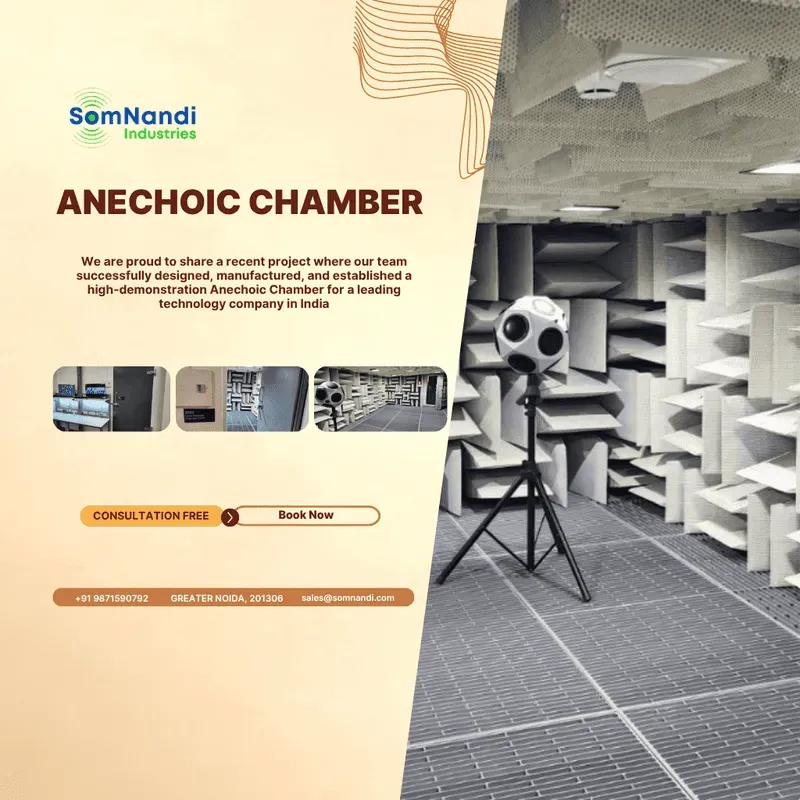

In acoustic science and precision engineering, few structures are as fascinating — or as technically demanding — as the anechoic chamber. Derived from the Greek word meaning 'without echo', an anechoic chamber is a room specifically designed to absorb all sound reflections and block external noise, creating one of the quietest environments achievable on Earth. These remarkable spaces are the backbone of acoustic research, product development, and noise testing across industries as diverse as automotive engineering, aerospace, consumer electronics, and audio production. SomNandi Industries, a trusted name in industrial noise control headquartered in Greater Noida, India, has emerged as a leading specialist in anechoic chamber design, fabrication, and installation — delivering precision-built chambers that meet the most rigorous international standards including ISO 3744, ISO 3745, and ANSI S12.55.
What Is an Anechoic Chamber and How Does It Work?
An anechoic chamber is a specially constructed soundproof room whose interior walls, ceiling, and floor are completely lined with high-performance sound-absorbing materials — most commonly fiberglass or mineral wool acoustic wedges. These wedges are precisely shaped and arranged to trap and convert incident sound waves into heat energy, eliminating all sound reflections within the space. The result is a free-field acoustic environment: sound behaves as if it were travelling through open, unobstructed space, with no reflections, reverberation, or standing waves to distort measurements.
There are two principal variants. A full anechoic chamber absorbs sound from all six surfaces — walls, ceiling, and a grated floor suspended above an absorbent base — making it the most complete echo-free environment achievable. A semi-anechoic chamber absorbs sound from the walls and ceiling but features a hard, reflective floor that simulates real-world ground-reflection conditions; this type is widely used for automotive and industrial machinery testing. SomNandi Industries designs and builds both configurations, customised to client specifications and testing requirements.
Core Principles of Anechoic Chamber Design
Achieving a truly echo-free environment demands a multi-layered engineering approach. The anechoic chamber design process at SomNandi Industries integrates four critical engineering disciplines:
1. Acoustic Wedge Geometry & Material Selection
The wedge-shaped absorbers that line an anechoic chamber are not arbitrary in shape. Their geometry — depth, taper angle, and spacing — is carefully calculated based on the target frequency range. Deeper wedges absorb lower frequencies more effectively, while shorter wedges suffice for high-frequency absorption. SomNandi Industries uses advanced anechoic wedge panels and acoustic foam modules engineered to deliver absorption across the full 20 Hz to 20 kHz audible spectrum, achieving up to 80 dB sound rejection in semi-anechoic configurations.
2. Structural Isolation & Room-Within-a-Room Construction
External vibration and low-frequency noise can penetrate even well-lined rooms if the structural shell is not isolated. A professional anechoic chamber design employs a room-within-a-room construction principle — the inner chamber is mounted on vibration isolators, decoupled from the outer structural shell by resilient mounts and isolation joints. This prevents ground-borne vibration, HVAC noise, and structural-borne sound from contaminating the test environment. SomNandi Industries' multi-disciplinary engineering team — combining civil, architectural, electrical, and instrumentation expertise — ensures that every chamber achieves the required background noise level for its intended application.
3. Ventilation, Lighting & Access Design
An anechoic chamber must be functional as well as acoustically perfect. Ventilation systems must be designed to deliver adequate airflow and thermal control without introducing mechanical noise into the test space. Lighting must achieve the required illumination levels (typically 300 LUX) without generating vibration or electromagnetic interference. Acoustic access doors with precision seals maintain the chamber's isolation while enabling safe, convenient entry. SomNandi Industries integrates all these subsystems into a unified anechoic chamber design, using Autodesk Inventor 3D modelling and AutoCAD for full system visualisation before fabrication begins.
4. ISO Compliance & Acoustic Validation
Every anechoic chamber delivered by SomNandi Industries is designed to comply with ISO 3744, ISO 3745, and ANSI S12.55 measurement standards, ensuring the chamber qualifies as a valid free-field testing environment. Post-installation acoustic validation — including background noise level measurement and free-field uniformity testing — is conducted by the company's acoustic engineers to certify that the chamber meets its specified performance criteria before handover to the client.
Types of Anechoic Chambers Designed by SomNandi Industries
SomNandi Industries engineers a comprehensive range of anechoic chamber types to serve diverse industry needs:
| Chamber Type | Key Feature | Primary Use |
| Full Anechoic Chamber | 6-surface absorption including grated floor | Audio R&D, aerospace, precision acoustic research |
| Semi-Anechoic Chamber | 5-surface absorption with hard reflective floor | Automotive NVH testing, industrial machinery |
| NVH Test Chamber | Vibration isolation + acoustic treatment | Vehicle components, engine and drivetrain testing |
| Audiometric Chamber | Ultra-low background noise (<20 dBA) | Hearing tests, audiological research |
| Mini / Portable Chamber | Compact modular construction | Component-level noise emission testing |
| Engine Test Cell | Full acoustic lining with ducting & exhaust management | Engine development, dyno testing |
Industrial Applications of Anechoic Chambers
The application breadth of a professionally designed anechoic chamber spans virtually every engineering and research domain that relies on accurate acoustic measurement:
- Automotive & NVH Testing — Engineers use anechoic chambers to test engines, motors, exhaust systems, and complete vehicles for noise, vibration, and harshness — ensuring products meet quality and regulatory comfort standards before market release.
- Aerospace & Defence — Aircraft components, satellite assemblies, and radar equipment require controlled acoustic and electromagnetic environments for precise testing of noise emission and signal integrity.
- Consumer Electronics — Smartphones, laptops, speakers, and household appliances are tested in mini anechoic chambers to verify noise emission compliance and product quality — including the landmark Foxconn mobile phone NVH test chamber supplied by SomNandi Industries.
- Audio & Video Production — Professional recording studios rely on full anechoic chambers for ultra-clean audio capture and equipment calibration, free from any background noise or reflected sound.
- Industrial Noise Testing — Factories and production facilities use noise test chambers to accurately measure the sound power levels of compressors, blowers, generators, and heavy machinery.
- Audiometric & Hearing Research — Audiometric chambers provide the controlled, echo-free environment required for hearing assessments, audiometer calibration, and auditory research.
- R&D Laboratories — Product development teams across electronics, medical devices, and instrumentation rely on anechoic chambers for benchmarking, competitive analysis, and pre-compliance testing.
Key Features of SomNandi Industries Anechoic Chambers
- Up to 80 dB sound rejection across the 20 Hz to 20 kHz frequency range in semi-anechoic configurations.
- ISO 3744, ISO 3745, and ANSI S12.55 compliant design and validation on every chamber delivered.
- Room-within-a-room structural isolation eliminating ground-borne vibration and external noise intrusion.
- Advanced anechoic wedge panels and acoustic foam modules for maximum broadband sound absorption.
- 3D CAD design using Autodesk Inventor — clients receive full visualisations and assembly drawings for approval before fabrication.
- Integrated ventilation, 300 LUX lighting, wiring, switchboards, and acoustic access doors within a unified design.
- Customisable chamber dimensions, configurations, and acoustic performance targets to suit specific testing requirements.
- ISO 9001:2015 certified quality management from design through to installation and acoustic commissioning.
- End-to-end turnkey delivery — site survey, feasibility study, design, fabrication, installation, and post-installation validation.
Why SomNandi Industries Is India's Leading Anechoic Chamber Design Specialist
Since its founding in 2000, SomNandi Industries has built an enviable reputation for acoustic engineering excellence across India. The company's anechoic chamber design capability is underpinned by a multi-disciplinary engineering team that brings together acoustic science, civil and structural engineering, mechanical design, electrical systems, and precision instrumentation — ensuring every chamber is optimised as a complete, integrated testing environment, not simply a lined room.
The company's track record includes supplying NVH test chambers to global electronics manufacturers such as Foxconn, demonstrating the ability to deliver precision acoustic environments that satisfy the most exacting international quality standards. Whether the requirement is a compact audiometric booth, a full-scale automotive NVH test facility, or a complex engine test cell with integrated acoustic treatment and exhaust management, SomNandi Industries provides a complete turnkey solution — from the initial site noise survey and feasibility study through to final acoustic validation and certification.
Conclusion
Anechoic chamber design is one of the most technically sophisticated disciplines in applied acoustics — demanding precision in material selection, structural engineering, system integration, and acoustic validation. For organisations across India and beyond that require a world-class anechoic chamber for research, product testing, or compliance purposes, SomNandi Industries offers the engineering expertise, manufacturing capability, and quality systems to deliver exceptional results.
























Sign in to leave a comment.