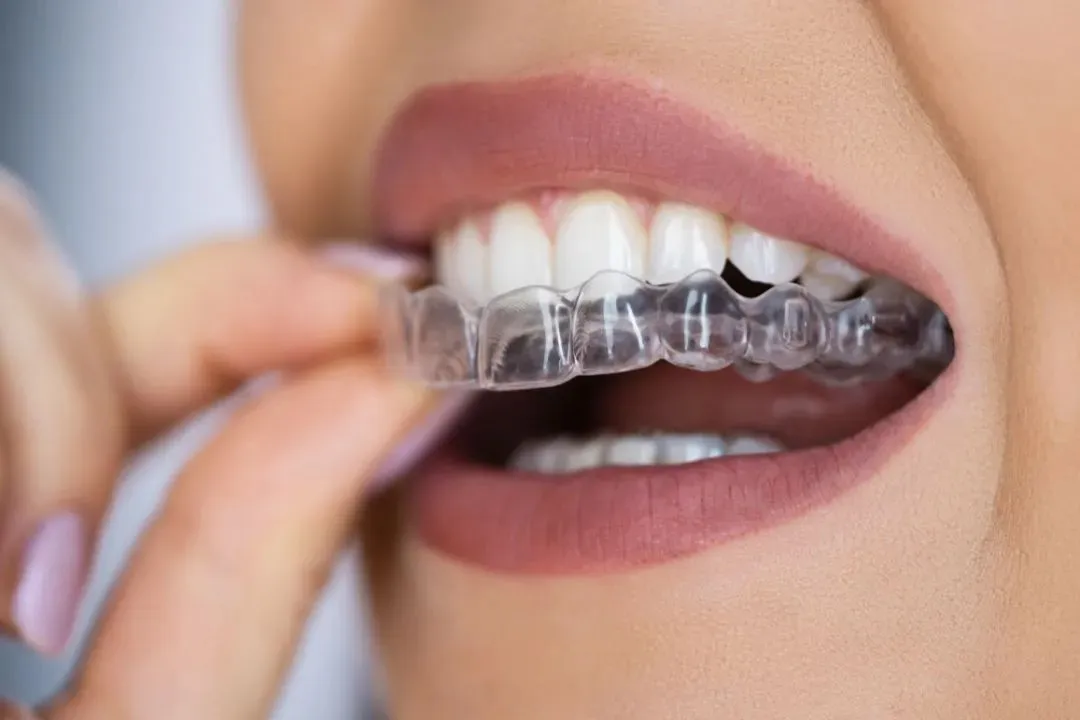

Are You a Candidate for Clear Aligners?
Clear aligners have changed orthodontics for a lot of adults who would never have considered fixed braces. No metal brackets, no wires, no obvious appliance. If your teeth are crowded, gapped, or not quite where they should be, there's a good chance aligners can help — but suitability depends on the clinical picture, not just preference. Here's what to know before booking a consultation at Fitzroy Dental Practice in London.
What Are Clear Aligners and How Do They Work?
Clear aligners are custom-made, removable trays worn over the teeth. Each tray is slightly different from the last, applying controlled force to specific teeth to move them gradually into a new position. Swap to the next tray every one to two weeks, and the teeth follow.
The movement works through bone remodelling — the same biological process that drives all orthodontic tooth movement. Pressure on one side of a tooth stimulates bone to resorb; the side under tension lays down new bone. Sequential aligners guide this step-by-step.
Invisalign is the most widely used clear aligner system. It uses proprietary SmartTrack material and digital treatment planning software that generates a full simulation of the projected outcome before treatment begins. Other systems exist but vary considerably in planning capability and clinical scope.
How Do Clear Aligners Compare With Fixed Braces?
| Feature | Clear Aligners | Fixed Braces |
|---|---|---|
| Removable | Yes | No |
| Visibility | Low | High |
| Eating restrictions | Minimal | More common |
| Oral hygiene access | Easier | More complex |
For most patients who qualify, aligners are the more convenient option. The trade-off is compliance — they only work when worn.
Are You a Candidate for Clear Aligners?
Most adults and older teenagers with mild to moderate alignment issues are candidates. Common presentations that respond well include crowded teeth, gaps between teeth, mild overbites, crossbites, open bites, and relapse after previous orthodontic treatment.
Severe skeletal discrepancies — where the jaw position itself is the problem rather than the tooth position — typically require fixed appliances or orthognathic surgery. A clinician can identify this at assessment; it's not something you can determine from photos or online tools.
What Dental Conditions Can Clear Aligners Correct?
Clear aligners handle a wider range of issues than many patients expect. Crowding, spacing, crossbite, overbite, underbite, and open bite can all be addressed, depending on severity. The more complex the case, the more important clinical experience and treatment planning quality become.
Can Adults Have Clear Aligners?
Yes, and adults make up a large proportion of clear aligner patients. Bone is denser in adults than in adolescents, which can mean slightly slower movement, but treatment is entirely viable. Many adult patients specifically seek aligners because fixed braces aren't compatible with professional or social circumstances.
Can Teenagers Have Clear Aligners?
Teenagers can be good candidates, with caveats. Compliance matters more with aligners than with fixed braces — a teenager who consistently forgets to reinsert them after meals won't make progress. Invisalign's teen-specific product includes compliance indicators and additional replacement aligners for lost trays. Suitability is assessed on a case-by-case basis.
What Is the Best Clear Aligner Option in the UK?
The honest answer: it depends on the case and the provider more than the brand. Invisalign has the broadest clinical evidence base, the most developed planning software, and the widest range of attachment options for complex movements. Other aligner systems can be appropriate for simpler cases.
What matters more than the brand is who's doing the treatment planning. Clear aligners are a clinical tool, not a consumer product. The quality of the diagnosis, the accuracy of the digital simulation, and the monitoring throughout treatment are what drive outcomes.
How Does Invisalign Compare With Other Clear Aligner Systems?
| Treatment Factor | Invisalign | Other Clear Aligners |
|---|---|---|
| Digital planning | Yes | Varies |
| Attachments available | Yes | Varies |
| Clinical supervision | Yes | Varies |
| Treatment scope | Broad | Varies |
Direct-to-consumer aligner companies that skip the clinical assessment step are a risk. Without a proper bite assessment and monitoring, tooth movement can occur in ways that damage root structure or compromise the bite. Fitzroy uses Invisalign with full clinical supervision throughout.
What Happens During a Clear Aligner Consultation?
The consultation covers a clinical examination of tooth position and bite, intraoral digital scans, photographs, and a treatment discussion. You won't leave with aligners — you leave with a clear picture of whether you're suitable, what treatment would involve, and what it's likely to cost.
If you proceed, the digital scan data feeds into a 3D simulation of the planned tooth movement. You can see the projected outcome before committing to treatment. Refinements to the plan can be made at this stage.
What Digital Technology Supports Treatment Planning?
Intraoral scanners eliminate the need for physical impressions and produce highly accurate digital models. The planning software generates the aligner sequence and allows your clinician to adjust movements at specific teeth before manufacture. This precision matters — poorly planned tooth movements don't just fail to achieve the result, they can cause harm.
What's It Like Getting Invisalign at Fitzroy Dental Practice, and How Long Does It Take?
Treatment follows a straightforward sequence: consultation, digital scan and planning, aligner manufacture (typically two to three weeks), then the active treatment phase. At the end, retention is essential — teeth will drift back without a retainer worn long-term.
How Long Does Invisalign Treatment Usually Take?
Minor corrections are often complete in six to nine months. Moderate cases typically run 12–18 months. Complex cases vary based on the extent of movement required. These are indicative ranges — your clinician will give a more specific estimate once the scan data is reviewed.
What Factors Affect Treatment Duration?
Case complexity is the biggest variable. Beyond that: how consistently the aligners are worn, biological response (some patients move teeth faster than others), and whether refinement aligners are needed at any point. Wearing aligners for 20–22 hours per day rather than 20 is the single biggest thing patients control.
How Often Are Review Appointments Needed?
Typically, every six to ten weeks, depending on the stage of treatment. These appointments check progress, assess aligner fit, and allow for any adjustments to the plan. Skipping monitoring appointments is not advisable — issues caught early are much simpler to correct.
Do You Need Invisalign Before Composite Bonding?
Not always. This is a clinical question, not a rule.
If teeth are well aligned, composite bonding can proceed without any orthodontic preparation. But if there's crowding, rotation, or uneven spacing, placing bonding before alignment can mean using more material to compensate, achieving a less symmetrical result, and potentially having to redo the bonding if orthodontics is attempted later.
Why Is Invisalign Sometimes Recommended Before Composite Bonding?
Aligning teeth first reduces the amount of composite needed, improves symmetry, creates a more predictable aesthetic result, and often means less tooth preparation. For patients considering a smile makeover involving bonding, the sequence matters.
When Can Bonding Be Done Without Aligners?
When the existing alignment is within an acceptable range for the aesthetic outcome being planned, orthodontic preparation isn't necessary. Your dentist assesses this at consultation — it's not a decision patients need to make in advance.
What Are the Benefits of Clear Aligners?
The practical advantages are well established: discreet appearance during treatment, ability to eat without restrictions, easier brushing and flossing, and no emergency appointments for broken brackets. For patients who play contact sports, no fixed appliance is a genuine safety advantage.
The compliance requirement cuts both ways. Removability is convenient, but aligners only work when worn. Patients who are consistent get excellent results. Those who aren't tend to extend their treatment timelines or require additional refinement stages.
What Responsibilities Come With Wearing Clear Aligners?
Aligners should be worn for 20–22 hours per day. Remove them to eat and drink anything other than water, then reinsert them. Not wearing them long enough is the most common reason treatment takes longer than planned.
Cleaning is straightforward: rinse aligners under cool water when removed, clean with a soft brush, and avoid hot liquids, which warp the plastic. Keep track of your trays — lost aligners slow progress and cost money to replace.
How Do I Pick an Orthodontist or Clear Aligner Provider in London?
Look for a GDC-registered clinician with demonstrable experience in orthodontic treatment and clear aligner cases specifically. Ask to see cases similar to yours. Check that the practice uses digital scanning and provides proper clinical monitoring throughout treatment — not just a set of trays and a review at the end.
Proximity matters for clear aligner treatment because monitoring appointments are ongoing. A central London practice is practical for patients travelling from across the city; Fitzroy's Fitzrovia location is straightforward to reach.
Why Consider Fitzroy Dental Practice for Clear Aligners?
Fitzroy provides comprehensive orthodontic assessments using intraoral scanning and digital planning, with Invisalign as the primary clear aligner system. Treatment is monitored throughout by GDC-registered clinicians. The practice is at 14 Fitzroy Square, Fitzrovia, London W1T 6AH.
How Much Do Clear Aligners Cost in London?
Cost depends on case complexity, treatment duration, and the number of refinement stages required. Minor correction cases cost less than comprehensive treatments. A written treatment plan with confirmed pricing is provided following the consultation — there's no way to quote accurately without the scan data.
Frequently Asked Questions About Clear Aligners
Are you a candidate for clear aligners? Most adults with mild to moderate alignment issues are. An intraoral scan and clinical assessment at consultation confirm suitability.
What is the best clear aligner option in the UK? Invisalign has the broadest evidence base and most developed planning tools. The quality of the clinical provider matters as much as the brand.
What's it like getting Invisalign at Fitzroy, and how long does it take? Treatment involves a consultation, digital scan, custom aligner manufacture, and regular monitoring visits. Minor cases: six to nine months. Moderate cases: 12–18 months.
Do I need Invisalign before composite bonding? Not always — it depends on your existing alignment. Your dentist assesses this at the consultation.
Can clear aligners fix crowded teeth? Yes, from mild to moderately severe crowding. Severe cases may need fixed appliances.
Can clear aligners correct bite problems? Yes — overbite, underbite, crossbite, and open bite can all be addressed, depending on severity and cause.
How long should you wear clear aligners each day? 20–22 hours. Remove only for eating, drinking (except water), and cleaning.
























Sign in to leave a comment.