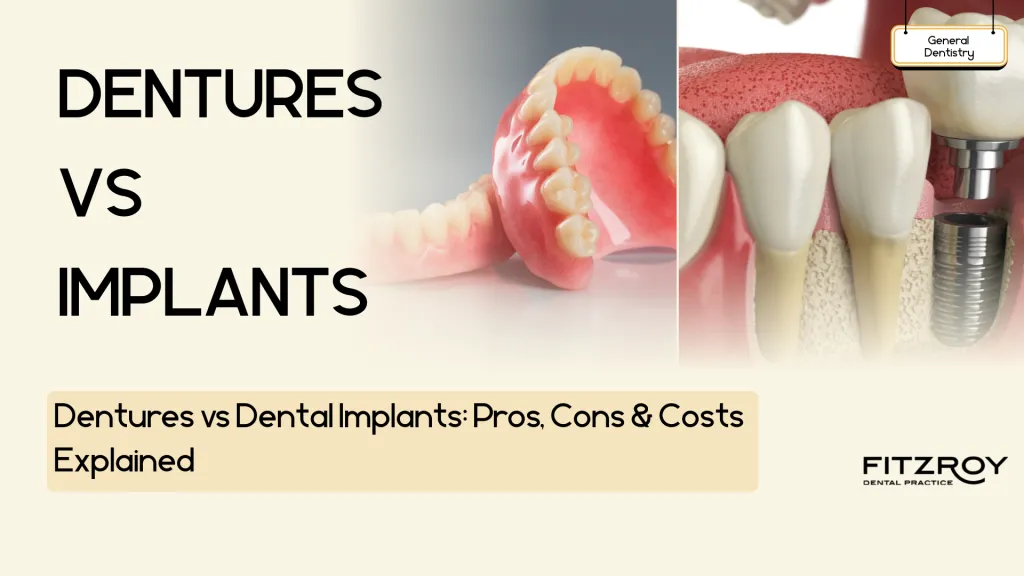

Replacing missing teeth is one of the most significant decisions you can make for your long-term oral health and confidence. Two of the most widely chosen solutions are dentures and dental implants, and there is now a third option sitting between them: implant-supported dentures. Each has real advantages, real limitations, and a different price tag. This guide covers what you need to know to walk into a consultation with a clear picture of your choices.
What Are Teeth Dentures, and How Do They Work?
Dentures are removable prosthetics designed to replace missing teeth and the surrounding gum tissue. They come in three main forms: full dentures for patients who have lost an entire arch; partial dentures that fill gaps between remaining teeth; and flexible dentures made from thermoplastic resin, which tend to be more comfortable and less visible than traditional acrylic options.
Modern dentures are custom-made using digital or physical impressions of your mouth, with teeth crafted from high-grade acrylic, porcelain, or composite. Fitting typically takes a few appointments, impressions, a trial fitting, and adjustments before the final appliance is handed over.
Dental implants work quite differently. A titanium post is placed surgically into the jawbone, and a crown, bridge, or other restoration is fixed on top. They do not come out for cleaning. Over several months, the implant fuses with the surrounding bone, a process called osseointegratio,n creating a stable, permanent foundation that functions like a natural tooth root.
Implant-supported dentures sit between the two. Two to four implant posts are placed in the jaw, and a specially made denture clips onto them. The denture is still removable for cleaning, but the stability it offers is a world apart from a conventional suction-held appliance.
Do Dentures Hurt? What Is the Adjustment Period Actually Like?
New dentures almost always cause some discomfort at first. This is normal, not a sign that something has gone wrong.
As the gum tissue adapts, sore spots tend to develop along the edges of the appliance. Your dentist will usually ask you back within the first fortnight to identify and ease any pressure points. Most patients adapt fully within four to eight weeks, though eating takes practice. Start with soft foods in small pieces and build up gradually.
Well-made, well-fitted dentures should not hurt in the long run. If discomfort continues beyond the adjustment period, or your dentures start to feel loose, get in touch with your dentist sooner rather than later. Ill-fitting appliances can accelerate bone loss in the jaw and cause persistent gum soreness.
Dental implants involve surgery, so some swelling, bruising, and tenderness in the days afterwards are expected. This usually settles within a week to ten days. Once healed, implants feel completely natural, with no pressure on the gum, no movement, and no adjustment period.
Dentures Before and After: What Results Can You Actually Expect?
Private dentures have improved a great deal. High-quality appliances can be colour-matched to your remaining teeth, shaped to suit your face, and made with a translucency that looks genuinely convincing. Dentures before and after comparisons often show remarkable changes, a full, natural-looking smile restored in cases of significant tooth loss.
Dental implants are still the aesthetic benchmark, though. Each implant crown is individually crafted and fixed in place, no plate, no clasp, no risk of shifting mid-conversation. More importantly, implants preserve the bone beneath them. When a tooth root is lost, the jawbone in that area gradually shrinks. Over the years, this can give the face a sunken appearance that many long-term denture wearers recognise. Implants stimulate the bone just as a natural root does, so that resorption does not happen.
For keeping dentures looking good, remove them at night, brush with a soft brush and denture cleaner, and soak them in a cleansing solution. If staining builds up, a dental hygienist can clean them professionally. Avoid standard toothpaste and anything designed to whiten natural teeth, as both can scratch and damage the acrylic surface.
How Much Do Dentures and Dental Implants Cost in London?
NHS dentures are available under Band 3 treatment at a standard charge of £319.10 (from April 2024). Private dentures in London range from roughly £700 to £2,500 or more, depending on the type, material, and complexity of the case. Flexible and implant-retained options sit towards the higher end.
Dental implants require a larger upfront investment. At Fitzroy Dental Practice in Fitzrovia, implant treatment starts from £1,600 per tooth. The variation in prices across London reflects differences in implant system quality, the clinician's experience, and whether additional work, such as bone grafting, is needed.
Fitzroy offers 0% interest-free finance over 12 months with no deposit, which makes treatment more manageable to budget for. And when you factor in the ongoing costs of denture relining, adhesives, and eventual replacement appliances, implants often work out better value over ten to twenty years.
Implant-supported dentures land in the middle financially. You pay for the implant posts and an overdenture rather than a full fixed bridge, a meaningful stability upgrade over conventional dentures at a lower overall cost than a complete implant reconstruction.
Which Lasts Longer: Dentures or Dental Implants?
Conventional dentures need relining roughly every three to five years as the jaw changes shape, and replacing them entirely every seven to ten years. With each cycle of bone resorption, the fit worsens, which is why patients who have worn dentures for a long time often find them increasingly difficult to keep in place.
Dental implants have a strong long-term track record. Clinical data show a success rate of 80–95% over fifteen years in healthy patients, dropping to around 80–85% over seven years for those with a history of gum disease. A thorough gum health assessment before placement is therefore essential. With good home care and regular hygienist visits, the implant post itself can last a lifetime. The crown on top may eventually need replacing, typically after fifteen to twenty years.
The main threat to long-term implant success is peri-implantitis, an inflammatory condition affecting the tissue around the implant post. It is largely preventable with consistent oral hygiene and professional maintenance, which is why twice-yearly hygienist visits are recommended for implant patients.
What Are Implant-Supported Dentures, and Who Are They Best For?
Implant-supported dentures suit patients who want noticeably more stability than a conventional denture provides, without the commitment or cost of a full fixed implant bridge.
Two to four implant posts are placed in the jaw, usually at the front of the arch, where bone density tends to be greatest, and a purpose-made denture clips securely onto them. The difference in day-to-day function compared with a suction-held denture is significant. Eating, speaking, and general confidence all tend to improve.
This option works well for patients who have experienced some bone loss but still have enough bone to support a small number of implants. It also offers a natural upgrade pathway: some patients start with an overdenture and later transition to a fixed bridge as circumstances allow. Fitzroy offers implant-retained dentures as a dedicated treatment, and your implant specialist will confirm during consultation whether this route suits your clinical situation.
Which Option Is Right for You?
The right answer depends on your bone density, gum health, medical history, budget, and how quickly you need treatment. There is no universal correct answer.
Patients with significant bone loss may need a graft before implants are an option. Those with active gum disease will need this treated first. For some, conventional dentures or an implant-retained overdenture will be the most appropriate long-term solution. For others, particularly those missing one or two teeth with healthy bone, a dental implant gives the most natural, durable, and bone-preserving result available.
At Fitzroy Dental Practice, our implant specialists carry out a thorough assessment, including CBCT imaging, before recommending any treatment. We will tell you honestly which options are clinically suitable, what each one involves, and what the realistic costs and timelines look like. No pressure, no upselling, just a clear picture of what is possible for your mouth.
To book a free consultation, visit us at 14 Fitzroy Square, Fitzrovia, London W1T 6AH, or get in touch via fitzroydentist.co.uk.
Frequently Asked Questions: Dentures vs Dental Implants
| FAQs | Answers |
|---|---|
| Do dentures hurt to wear every day? | Some discomfort is normal in the first few weeks. Well-fitted dentures should not cause ongoing pain; if they do, book an adjustment. |
| What are the most affordable dentures available in London? | NHS Band 3 dentures are £319.10. Private options start from around £700, varying by type and material. |
| How much do dental implants cost in London? | At Fitzroy Dental Practice, implants start from £1,600. 0% interest-free finance is available over 12 months with no deposit required. |
| What are implant-supported dentures, and are they right for me? | They are overdentures that clip onto implant posts, offering implant-level stability with the convenience of a removable appliance. A consultation will confirm whether you are a suitable candidate. |
| How long do dentures and dental implants last? | Dentures typically need replacing every seven to ten years. Dental implants, with proper care, can last a lifetime. Clinical success rates reach 80–95% at fifteen years. |
| What are the best dentures for eating and speaking naturally? | Implant-retained dentures offer the most stability for daily use. Among conventional options, flexible partial dentures tend to be the most comfortable for eating and speaking. |
| Can I see real patient results before deciding? | Yes, Fitzroy Dental Practice's gallery page shows before and after results across a range of tooth replacement and cosmetic treatments. |
| Can I see real patient results before deciding? | Yes, Fitzroy Dental Practice's gallery page shows before and after results across a range of tooth replacement and cosmetic treatments. |
| How do I find the best dental implant specialist in London? | Look for a GDC-registered clinician with dedicated implant training and a high volume of cases. Fitzroy's implant team is based in Fitzrovia, central London. |
| Are dental implants available on the NHS? | Implants are not routinely provided on the NHS. They are available in limited exceptional circumstances only. Most patients pursue implant treatment privately. |
| How do you whiten dentures at home safely? | Use a dedicated denture-cleansing solution. Never use standard toothpaste or whitening products designed for natural teeth, as they will scratch the acrylic surface. |





















Sign in to leave a comment.