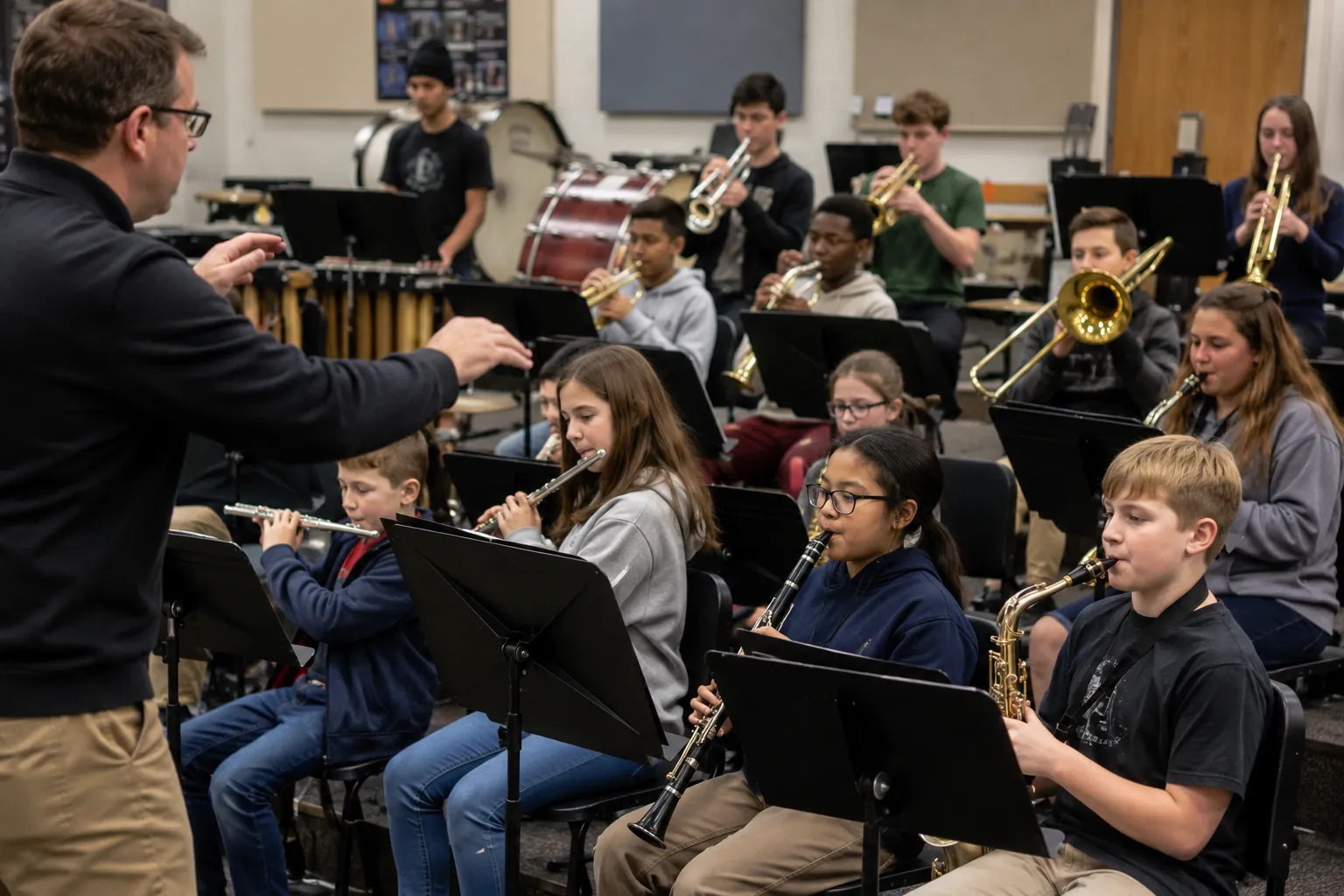

You know that feeling when you're standing in front of your band and you've got everything from your first-year trumpet player who's barely getting through the notes to your senior jazz player who's been in this program since sixth grade? Yeah, that's the reality we're all living with.
I've been directing bands for a while now, and one of the biggest challenges that keeps me up at night is figuring out how to keep everyone engaged without making the experienced kids bored or overwhelming the newer players. It's like trying to serve a meal where half your guests are vegetarian, a quarter are gluten-free, and the rest just want a simple sandwich. You want everyone to leave the table happy.
The good news? It's totally doable. You just need a different approach than what you might've learned in your college conducting courses.
Start with the Right Arrangement
Here's the thing nobody tells you: not all arrangements are created equal, and some are way better than others for mixed-ability groups.
When I'm looking for music, I'm specifically hunting for arrangements that have flexibility built in. What does that actually mean? It means the core melody and harmony can work even if some parts are simplified or missing. Think of it like a recipe—the main flavors should still come through even if you're leaving out an ingredient or two.
I avoid pieces where everything is essential. If your lead trumpet has a high D that nobody else can play and they're out sick that day? You're sunk. But if your arrangement is structured so that multiple people can carry the melody, or so that simplified versions still make sense, suddenly you've got options.
The percussion section is where I really see this pay off. A good arrangement for a mixed group will have parts that range from "keep a steady beat on the snare drum" to "here's a complex syncopated rhythm." Everyone gets to participate. Everyone feels like they're contributing something real.
The Layer-and-Build Method
I use what I call the "layer-and-build" approach when I'm either selecting or arranging music. Here's how it works in practice:
Identify your core sound—usually that's your melody and your bass line. These are non-negotiable. Everyone who can play a reasonable note needs to be able to handle these parts at some level. If your melody line is so high that only three people in the room can hit it, you've already lost.
Next, add your harmonic support. This is where your mid-range players shine. They're not carrying the show, but they're filling in the colors and making sure the chords are solid. This is where you can write parts that are interesting but not impossibly difficult.
Finally, top it with your flourishes—the counter-melodies, the complex rhythms, the solos that let your advanced players do their thing. These are the parts that make people in the audience go "wow, they're really good." But here's the key: the arrangement should still work without them. If your lead alto sits one out, the band keeps moving.
Write What You Actually Need (And Edit What You Don't)
I know a lot of directors who feel like they're stuck with whatever arrangement they buy. That's just not true. You have more power than you think.
If you've got a section that's written for seven first clarinets and you've only got four? Rewrite it so those four parts are interesting and effective. If you've got a run that's technically impossible for your section, you've got options: simplify it for some players, move it to a different section, or break it up across more people. This is your band. You get to make it work.
I spent about twenty minutes last month rewriting a euphonium solo for one of our pieces. The original was beautiful, but it was outside the range of comfort for the kid we had. I moved some notes around, kept the melody intact, and honestly, it sounded better. I'm not trying to be a hero—I'm trying to help my students succeed.
That's the thing about mixed-ability groups: sometimes you need to do the work that makes everyone shine.
Don't Shy Away from Challenging Your Good Players
Here's where a lot of directors go wrong. They see they've got mixed abilities and they water everything down so nobody feels left behind. Then the kids who are ready for something harder get bored and check out.
Your strong players need something to reach for. Maybe that's a divisi part. Maybe it's a rhythmically complex section. Maybe it's a higher dynamic level where they really have to control their sound. Give them a reason to show up.
I had a pianist last year who was miles ahead of where she needed to be. So instead of just having her play the same parts everyone else was playing, we worked on some really sophisticated voicings in our jazz arrangements. She felt challenged. She stayed engaged. And our jazz band sounded so much better because of it.
The Honest Talk About Seating and Confidence
You can have the perfect arrangement, but if your weaker players are constantly comparing themselves to your strongest ones, it's going to mess with their heads.
I'm not saying hide anyone. But strategic seating matters. Maybe your best trumpet sits on the end instead of in the middle of the section. Maybe your second clarinet isn't playing in the front row where they can see exactly what the first clarinet is doing. It's not about shame—it's about letting people focus on their own growth instead of constantly feeling like they're chasing someone else.
And talk to them about it. I'll pull a kid aside and say, "I'm moving you over here because I want you to build confidence on this part. When you nail this, you're going to feel so good." They get it. Most people understand that growth takes small steps.
Getting Help When You Need It
If you're really struggling with arrangements for your specific group, don't be afraid to bring in outside help. A good music education consultant or experienced arranger can listen to your ensemble and create something that's actually tailored to who you have in the room right now. There's no shame in that. It's actually smart.
When someone who specializes in this stuff comes in and really listens to your band, it changes everything. They hear things you can't hear because you're too close to it. They understand the dynamics between different ability levels and know how to structure arrangements so everyone succeeds. Dr. Ward Miller's consulting services are exactly the kind of resource that can help if you need that outside perspective—someone who gets what you're dealing with.
The Bottom Line
Mixed-ability bands aren't a problem you need to solve. They're just a reality, and honestly, they're one of the best things about public school music. You get to watch kids grow from complete beginners into confident musicians. You get to help them find their place.
The arrangement is just a tool. Use it right, and everyone gets to be successful.




























Sign in to leave a comment.