
Artificial intelligence has become a regular part of university life, but Australian university AI policies are far from consistent. Many students assume that if ChatGPT is allowed at one university, the same rule applies everywhere. That assumption can quickly lead to academic integrity problems. Research comparing the policies of major Australian universities shows that each institution has taken a different approach, making it essential for students to understand the rules before starting any assessment.
Why AI Rules Differ Across Universities
Australian universities responded to generative AI at different speeds and with different priorities. Rather than adopting a national standard, each university developed policies that matched its own teaching philosophy and assessment strategy.
Some institutions believe AI should be integrated into learning where appropriate. Others focus on protecting assessments that measure independent thinking. A third group gives individual lecturers the authority to decide what is acceptable within their own subjects.
Think of it like road rules in different countries. While the goal is always safe driving, the details change depending on where you are. The same applies to AI. Students cannot rely on what worked in another subject or another university because every assessment may have its own requirements.
Three Universities, Three Very Different Approaches
The research highlights three distinct models used by Australia's leading universities.
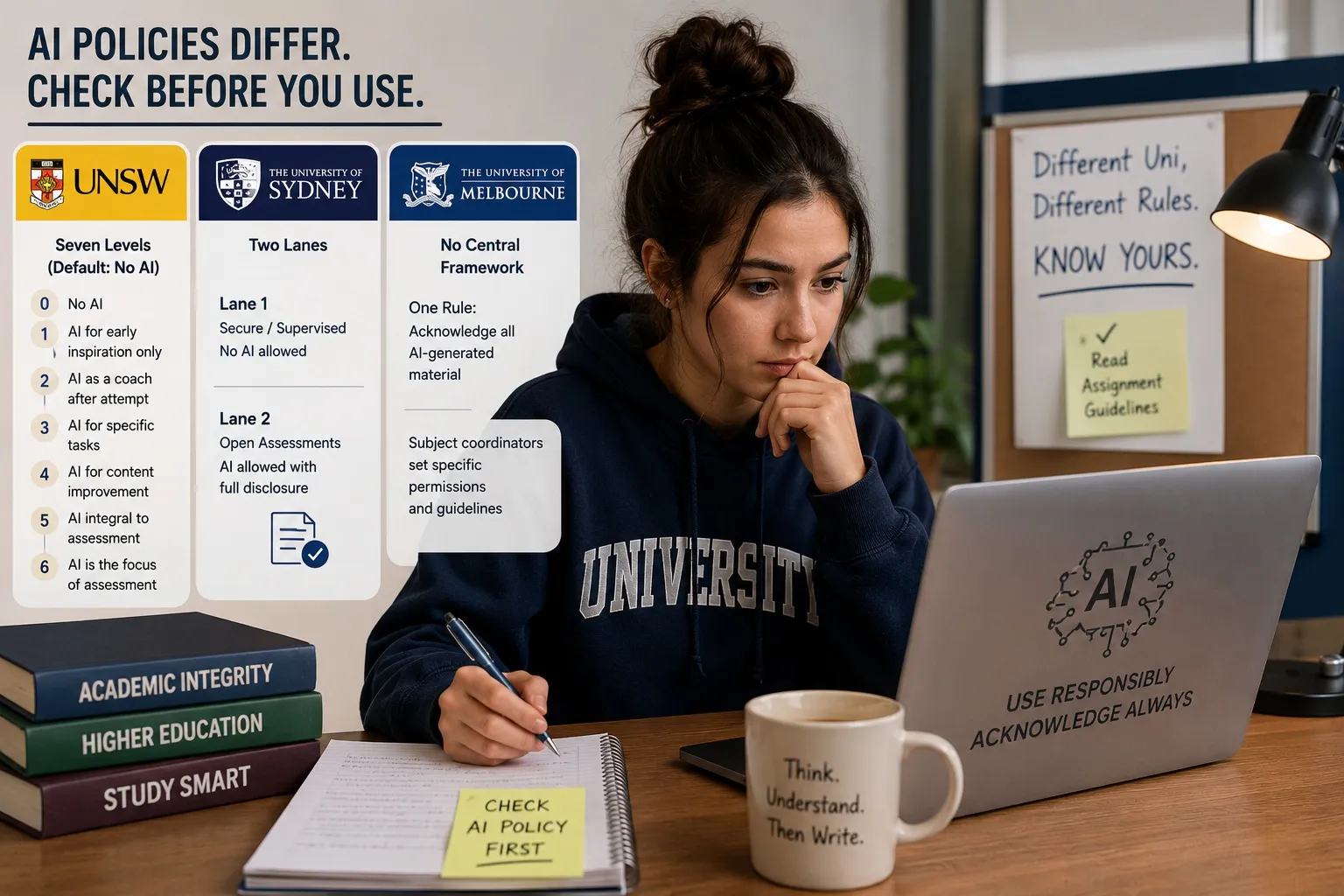
The University of New South Wales (UNSW) has created one of the most detailed systems. Instead of a simple "allowed" or "not allowed" rule, each assessment falls into one of several AI assistance categories. Some assignments prohibit AI completely, while others allow brainstorming, editing, coaching, or even AI-assisted work where using the technology is part of the learning outcome. Importantly, if an assessment does not specify its AI level, the default position is that AI is not permitted.
The University of Sydney (USYD) takes a much simpler route by dividing assessments into two categories. Secure assessments, such as supervised exams, do not allow AI use. Open assessments, including many essays and reports, allow generative AI provided students clearly disclose how they used it. Instead of asking whether AI was used, the focus shifts to whether its use was transparent and within the assessment guidelines. The University of Melbourne follows a different philosophy altogether. Rather than creating a university-wide framework, it leaves AI decisions to individual subject coordinators. The only universal requirement is that AI-generated material must be acknowledged whenever it contributes to assessment work. This means one subject may actively encourage ChatGPT, while another may prohibit it completely.
Disclosure Matters More Than Ever
One trend appears across every policy model: transparency has become just as important as the technology itself.
Students often worry about whether using AI is considered cheating. The research suggests the real issue is usually undisclosed or unauthorised use rather than AI itself. Universities increasingly expect students to explain which tools they used and how those tools contributed to the final submission.
Keeping simple records of prompts, brainstorming sessions, or editing assistance can make disclosure much easier later. It also demonstrates that AI supported the learning process rather than replacing independent thinking.
When assignments become challenging, students often need guidance on research methods, referencing, or structuring complex reports. Within the boundaries set by university policies, resources such as Expertsmind.com's subject expert network can provide academic guidance across engineering, business, management, and many other disciplines without replacing the student's own work.
Smart Habits for Responsible AI Use
The safest strategy is surprisingly straightforward.
Read every assessment brief as soon as it becomes available instead of waiting until submission week. AI rules may differ not only between universities but also between subjects and even between assignments within the same course.
If the instructions are unclear, contact your lecturer or course coordinator before using ChatGPT or another AI tool. Asking a quick question early can prevent much larger problems later.
Students should also remember that AI works best as a learning assistant rather than a replacement for critical thinking. Brainstorming ideas, improving grammar, organising notes, or refining structure often fits within permitted use. Asking AI to complete the assignment for you usually does not.
The Future of AI Policies in Higher Education
The research suggests Australian universities are unlikely to adopt one national AI policy anytime soon. Institutions continue experimenting with different models as technology evolves and assessment methods change.
What is becoming consistent, however, is the emphasis on accountability. Students are expected to understand assessment-specific rules, disclose AI use honestly, and demonstrate genuine learning regardless of which tools they use.
Those habits will remain valuable even as university policies continue to evolve. Technology will change, new AI tools will appear, and assessment methods will adapt. Students who carefully read assignment instructions and use AI responsibly will be better prepared than those who assume the rules are the same everywhere.
The biggest lesson is simple: before opening ChatGPT, open your assessment brief. That single habit can protect your academic integrity while allowing you to benefit from AI in the ways your university actually permits.




























Sign in to leave a comment.