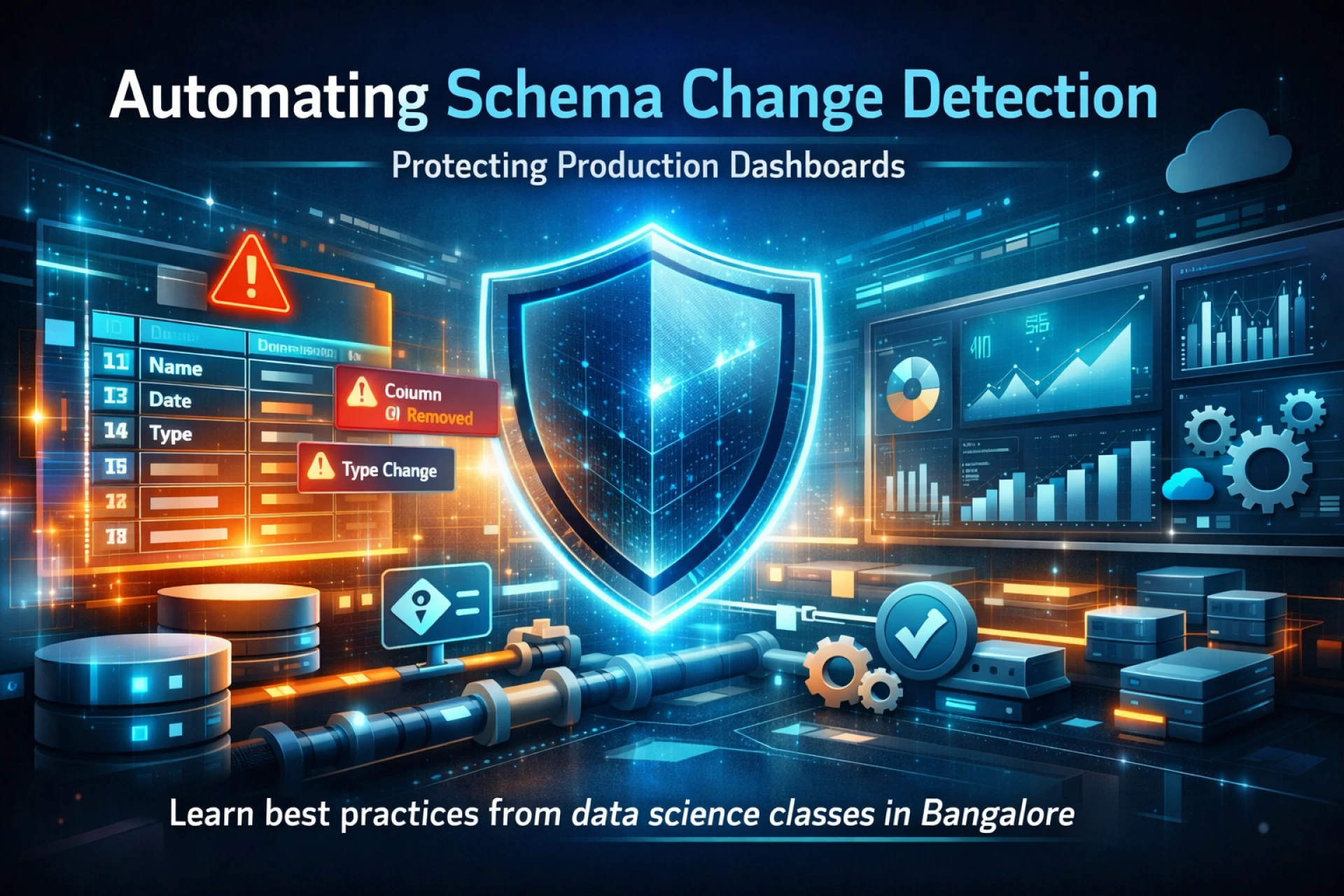

Production dashboards depend on stable table and column definitions across data sources. Schema change detection automation helps teams identify schema drift early and reduce dashboard failures in production. Many professionals learn these controls in data science classes in Bangalore as part of broader work on reliable reporting. The topic fits teams that maintain data pipelines, reporting layers, and business dashboards.
Schema Drift Effects on Dashboards
Schema drift starts when the live database schema no longer matches the defined, version-controlled schema. Production edits, incomplete releases, and inconsistent migrations create this drift. Dashboards break when queries call missing columns, renamed fields, or incompatible data types.
Adding columns disrupts metric logic when systems map fields by position or expect a fixed list of fields. Removing columns breaks calculated fields, filters, and joins that require specific inputs. Data type changes fail the conversions and aggregations that dashboards use for totals and time series.
Automated detection reduces the time between a schema change and a team response. Drift detection reports compare the current database state with a prior snapshot or a target environment and summarize differences. Teams can use this early warning approach to keep dashboard updates controlled and intentional.
Many training paths connect these ideas to standard data operations work. Many course outlines inside data science training in Bangalore cover data quality checks, release discipline, and basic monitoring patterns that support reliable dashboards. The same topics appear in data science classes in Bangalore that focus on reporting and data modeling in practical settings.
Core detection workflow
A practical workflow starts with a stored baseline schema for each key table that feeds dashboards. Atlas describes drift detection as a regular comparison between an intended and an actual schema, with diffs that show deviations. That comparison works best when teams keep the intended schema under version control along with migration code.
Teams can extract schema metadata from the source system on a schedule and store the result as a structured snapshot. Liquibase provides drift detection reports that compare the current database state with a previous snapshot or a target environment. A snapshot approach supports consistent comparisons across development, staging, and production.
A detection job should classify changes into simple categories that align with the dashboard risk. DQOps lists standard checks that detect added or removed columns and detect changes in column types. The same source describes list-change detection that uses an unordered or ordered hash of column names to detect changes over time.
A team should attach a clear severity label to each change type. Atlas notes that drift can cause query failures, violated constraints, and unexpected behaviour, leading to outages. That risk supports a “breaking change” label for removed columns, renamed columns, and incompatible type changes. Many learners practice this categorization during data science classes in Bangalore because the process supports stable analytics outputs.
Alerting and response controls
A detection system needs alert rules that reach the correct owners quickly. Atlas describes notifications that can use Slack and webhooks when a tool detects drift. Liquibase describes actions that can trigger notifications to a team and halt a CI/CD process when drift affects a critical table or column.
Alert content should stay short and specific. Atlas provides detailed information, including HCL or SQL representations of the change and visual ERD support for review. A well-formed alert should include the table name, changed fields, old type, new type, and a list of dependent dashboards when that mapping exists.
Teams follow a clear response path for each severity level. Integrate.io outlines protocols with immediate notification, data quarantine, manual review, and incident documentation. Response plans send breaking changes to data engineering and minor additions to backlog review.
Controls should support safe handling during releases. Microsoft describes “schema drift” in data flows as a way to build more resilient pipelines when incoming data structures change. Teams can combine resilient pipeline logic with detection so dashboards receive consistent fields even during controlled evolution. Many programs under data science training in Bangalore include these operational patterns because they connect modeling work with production support.
Metrics and governance practices
Teams should track a small set of metrics that clearly describe reliability. Atlas lists drift-monitoring benchmarks, including detection speed, scope coverage, alert integration, and depth of drift history. These categories help teams measure both technical coverage and response readiness.
A team can also track incident count and field addition or deletion rates to identify unstable sources. Integrate.io describes incident count as a metric for how frequently schema changes occur across data sources. Tracking field additions and deletions measures churn and flags instability that weakens dashboards and data models.
Governance practices control drift and ensure predictable dashboard behavior. DQLabs recommends automated observability tools. These tools alert to changes and prioritize tasks through data lineage. Version control also tracks schema updates to maintain consistency across environments.
Tool choice matters less than consistent execution across the data stack. Collibra states that its observability product can automatically alert on schema changes, detect columns, and infer data types across formats. Teams can apply the same principle with other tools when the system continuously checks schemas and logs changes as events. Organisations often reinforce these controls during data science classes in Bangalore because dashboard reliability requires disciplined routines rather than ad hoc fixes.
Conclusion
Automated schema change detection protects dashboards by comparing a baseline schema with current metadata and by reporting clear diffs. Liquibase and Atlas describe snapshot comparisons, drift reports, and alert integrations that support early warning and controlled response. Version control, alert rules, and documented response steps improve detection speed, incident tracking, and governance consistency. Many teams build these habits during data science classes in Bangalore and data science training in Bangalore, so stable dashboards remain a normal production outcome.



























Sign in to leave a comment.