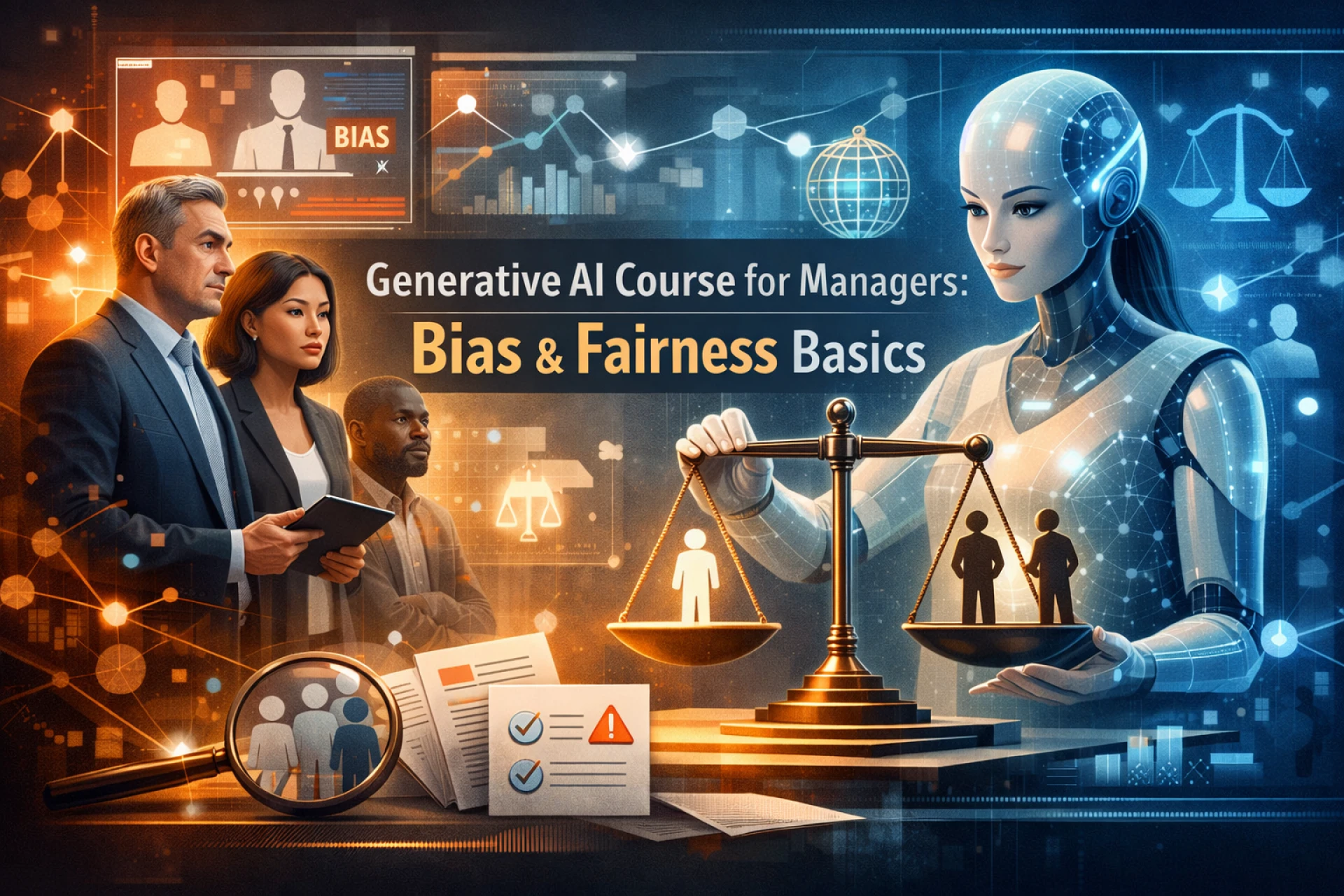

Generative AI systems often produce uneven results across groups, so teams need clear controls to mitigate bias and ensure fairness. Many leadership teams cover these controls through a Generative ai course for managers that links model risks to business decisions. Gen AI for managers programs also connect fairness goals to policy, oversight, and reporting. An agentic AI course also helps teams manage multi-step systems that create content and take actions across tools and workflows.
Define bias and fairness goals
Teams need clear definitions of “bias” and “fairness” before selecting metrics or tools. NIST lists “fair with harmful bias managed” as a trustworthiness characteristic, and NIST links trustworthiness to ongoing risk management practices. NIST also organizes risk work through four functions that teams can apply across the AI lifecycle: Govern, Map, Measure, and Manage.
OECD principles connect fairness to human rights, non-discrimination, equality, and respect for the rule of law across the full AI system lifecycle. OECD also calls for human agency and oversight mechanisms that match the context and current technical practice. These statements help organizations define fairness goals in plain terms, such as equal access, consistent quality, and non-discriminatory outcomes.
A Gen AI course for managers often treats fairness as a product requirement instead of a research topic. An agentic AI course also treats fairness as a system property that depends on tool choices, permissions, and routing logic, rather than a single model.
Map bias sources in generative AI
Teams need a map of where bias enters a generative AI system so teams can control each risk point. Describing this process can empower managers to identify and address bias, fostering confidence in their ability to manage AI risks effectively.
Data selection often introduces bias because the training and reference data reflect gaps, biases, and social trends. According to NIST, AI systems tend to be dependent on changing data, and that change may introduce unpredictable changes to trustworthiness. Data sources, data limits, and data updates require robust documentation within teams to facilitate fairness review.
System design also creates bias through task definitions, safety rules, and ranking logic. OECD calls for transparency and meaningful information about capabilities, limits, and factors that lead to outputs, and this guidance supports structured documentation. Agentic AI frameworks help here by forcing explicit choices about tool access, step ordering, and human review points.
An agentic AI course often covers these mapping topics because agentic systems can amplify small biases through repeated steps. Gen AI for managers material also links mapping work to ownership, sign-off, and cross-team coordination.
Measure fairness with tests and monitoring
Teams need measurement plans that align with the specific AI use case, user groups, and potential levels of harm to ensure relevant fairness assessments. NIST defines risk as a composite measure of likelihood and impact, helping managers prioritize fairness metrics that matter most in their context. This framing supports targeted measurement and effective risk mitigation.
Fairness tests have to be straightforward so teams can repeat them and compare releases. Group slices may be defined using teams, tasks may be defined, the same prompt may be run across groups and results compared using comparable results in terms of quality of output, refusal rates, error rates and tone. Direct group labels that are unavailable or unsuitable can also provide organizations with the opportunity to track complaint and escalation rates as a measure of operational fairness.
The OECD also calls for mechanisms that allow people to challenge AI outputs, so measurement plans need an aligned review path and response time target. OECD also calls for traceability for datasets, processes, and decisions across the lifecycle to support analysis and inquiry. Agentic AI frameworks support traceability when teams log tool calls, tool outputs, routing choices, and final responses in a consistent format.
Microsoft frames responsible AI around principles that include fairness, reliability and safety, privacy and security, transparency, accountability, and inclusiveness, and this set helps teams keep measurement balanced across goals. Microsoft also describes fairness work as a combination of principles, practices, and tools that mitigate bias and promote inclusivity. A Generative ai course for managers often uses a similar checklist, so teams measure fairness alongside security and privacy.
An agentic AI course can also add tests for action quality, such as whether the system selects different tools or different steps for similar users. This focus fits the agentic AI course content because multi-step systems can create new error patterns that a single-prompt test misses.
Manage bias through governance and controls
Governance sets the rules that teams follow during design, rollout, and daily operations. NIST positions governance as cross-cutting because governance informs and integrates with mapping, measurement, and management activities. NIST also released a Generative Artificial Intelligence Profile to help organizations identify the risks posed by generative AI and align actions with organizational goals and priorities.
Organizations can manage bias by assigning clear roles to model owners, data owners, evaluators, and reviewers, thereby improving accountability. Teams can also use model cards, data notes, and change logs to support traceability and audits that connect outputs to design choices. OECD also calls for systematic risk management across each phase of the lifecycle, and this requirement supports regular reviews rather than one-time checks.
Controls need direct links to the measured gaps. Teams can update training data, tighten retrieval sources, adjust safety rules, refine prompt templates, and set human review for high-impact topics based on measured outcomes. Agentic AI frameworks also support controls through permission limits, tool allowlists, step caps, and escalation rules for sensitive actions.
Gen AI managers should link controls to procurement and vendor oversight when utilizing third-party models or data to mitigate risks. Explicit responsibility for risk measurement across providers and deployers is essential. An agentic AI course also emphasizes vendor checks for tool plugins and external systems, ensuring fairness and safety profiles are maintained despite external dependencies.
Conclusion
Organizations manage bias and fairness in generative AI by defining fairness goals, mapping bias sources, measuring outcomes over time, and applying governance controls across the lifecycle. OECD principles support this work through guidance on human rights, transparency, oversight, accountability, and traceability. Many teams package these practices inside a Generative ai course for managers, and teams often extend the same structure through Agentic AI frameworks for multi-step systems. An agentic AI course provides a consistent way to apply these controls to systems that plan actions, call tools, and generate content at scale.






























Sign in to leave a comment.