
AI development in 2026 demands more than isolated models or quick pilots. Businesses need end-to-end AI development that starts with strategy, aligns with real problems, integrates with existing systems, and scales reliably. This article explains each stage of the AI development process, from solution design and application development to integration, deployment, and governance. It helps decision-makers understand what good AI development services look like and how to choose partners who deliver long-term, measurable business value without complexity or wasted effort. Continue reading to learn more.
In 2026, AI will no longer be a “future initiative.”
It’s already shaping how businesses build products, serve customers, reduce costs, and make decisions. The real question most leaders are asking now isn’t whether to use AI, but how to do it right.
This is where AI development services matter more than ever.
Not tools.
Not demos.
Not isolated experiments.
What businesses need today is end-to-end AI development, from strategy and data readiness to real-world deployment and scaling.
This article breaks down what modern artificial intelligence development services actually look like in 2026, how they connect to business outcomes, and how to choose the right AI development company for the journey ahead.
Why AI Development in 2026 Is a Different Game
Just a few years ago, AI projects often failed for predictable reasons:
- No clear business goal
- Poor data quality
- Models that worked in labs but not in production
- AI built separately from core systems
In 2026, expectations are higher, and so are the stakes.
AI is now expected to:
- Integrate seamlessly with existing platforms
- Deliver measurable ROI
- Scale securely across teams and geographies
- Support ongoing learning and improvement
This shift has pushed companies away from one-off AI projects and toward enterprise AI development services that are strategic, production-ready, and deeply integrated.
Step 1: AI Strategy Consulting - Where Everything Should Begin
The biggest mistake companies still make?
Jumping straight into building models.
Strong AI strategy consulting starts with clarity:
- What business problem are we solving?
- Where will AI create real leverage?
- What data do we already have, and what’s missing?
- How will success be measured?
Good AI strategy isn’t about algorithms.
It’s about alignment, with business goals, teams, processes, and timelines.
The best AI development services help organizations:
- Identify high-impact use cases
- Prioritize AI investments
- Define technical and operational readiness
- Avoid overengineering and under-delivering
Without this foundation, even the most advanced AI solution development struggles to scale.
Step 2: AI Solution Development That Solves Real Problems
Once strategy is clear, execution begins.
AI solution development in 2026 is practical and outcome-driven. It focuses on building systems that actually work in real environments, not just proof-of-concepts.
This includes:
- Predictive models for operations and demand
- Recommendation engines
- Intelligent automation
- Natural language processing systems
- Computer vision solutions
- Decision-support systems
What separates strong AI software development services from weak ones is context.
AI doesn’t live alone. It must:
- Work with your workflows
- Respect business rules
- Support human decision-making
- Adapt as conditions change
This is where custom AI development services become critical, because no two businesses, datasets, or constraints are truly the same.
Step 3: AI Application Development - Turning Intelligence into Usability
A powerful AI model is useless if people can’t use it.
That’s why AI application development has become a core part of modern AI initiatives.
This layer focuses on:
- User interfaces
- Dashboards
- APIs
- Embedded intelligence inside existing products
In 2026, the most successful AI systems feel invisible. They don’t demand attention, they simply improve outcomes.
Leading AI product development services ensure that AI:
- Fits naturally into daily workflows
- Is explainable and trustworthy
- Enhances productivity instead of complicating it
This is also where AI connects closely with software product engineering solutions, ensuring reliability, performance, and maintainability at scale.
Step 4: AI System Integration Services , The Hidden Deal Breaker
Many AI initiatives fail not because of poor models, but because of poor integration.
AI system integration services are often underestimated, yet they determine whether AI becomes a real capability or a siloed tool.
Integration typically involves:
- ERP, CRM, and legacy systems
- Cloud platforms
- Data pipelines
- Security and access controls
- Monitoring and logging tools
In 2026, AI must live inside the enterprise ecosystem.
The strongest enterprise AI development services treat integration as a first-class priority, not an afterthought.
Step 5: AI Implementation Services - From Build to Reality
Building AI is one thing.
Making it work reliably in production is another.
AI implementation services focus on:
- Model deployment pipelines
- Performance monitoring
- Bias and drift detection
- Governance and compliance
- Change management for teams
This stage is where many organizations realize AI is not a “set it and forget it” system.
Successful implementation requires:
- Continuous feedback loops
- Collaboration between engineering, data, and business teams
- Clear ownership and accountability
This is also where digital transformation services and AI truly intersect, because AI changes how decisions are made, not just how software is built.
Step 6: AI Deployment Services - Scaling with Confidence
In 2026, AI is expected to scale:
- Across departments
- Across geographies
- Across use cases
AI deployment services ensure that systems remain:
- Stable under load
- Secure under scrutiny
- Cost-efficient as usage grows
Deployment today often includes:
- Cloud-native architectures
- Edge AI for real-time use cases
- Model versioning and rollback
- Automated retraining pipelines
This is where choosing the right AI development company makes a long-term difference. Scaling AI requires engineering discipline, not just data science talent.
End-to-End AI Development: Why It Matters
Many vendors offer pieces of the puzzle.
Few deliver end-to-end AI development.
End-to-end means:
- Strategy → Build → Integrate → Deploy → Scale
- One accountable partner
- Fewer handoffs
- Clear ownership
For businesses, this reduces:
- Risk
- Delays
- Cost overruns
- Internal coordination burden
The best partners combine artificial intelligence development services with deep experience as a software product engineering company, ensuring AI fits into real products, not just experiments.
How to Choose the Right AI Development Partner in 2026
When evaluating AI development services, ask these questions:
- Do they start with strategy or technology?
- Can they explain AI in simple business terms?
- Do they understand enterprise constraints?
- Have they deployed AI at scale, not just built models?
- Can they integrate with existing systems?
- Do they think beyond MVPs?
A reliable AI development company doesn’t promise magic.
They promise clarity, discipline, and progress.
The Bigger Picture: AI as a Business Capability
In 2026, AI is no longer a project, it’s a capability.
Organizations that succeed with AI:
- Treat it as part of core operations
- Invest in long-term architecture
- Align AI with business strategy
- Partner with teams that understand both technology and outcomes
When done right, AI becomes a quiet advantage, working in the background, improving decisions, and compounding value over time.
That’s the real promise of modern AI development services.
FAQs
What are AI development services?
AI development services help businesses design, build, integrate, and scale AI solutions aligned with real operational and business goals.
They go beyond models to focus on usability, integration, and long-term value.
How do AI development services work?
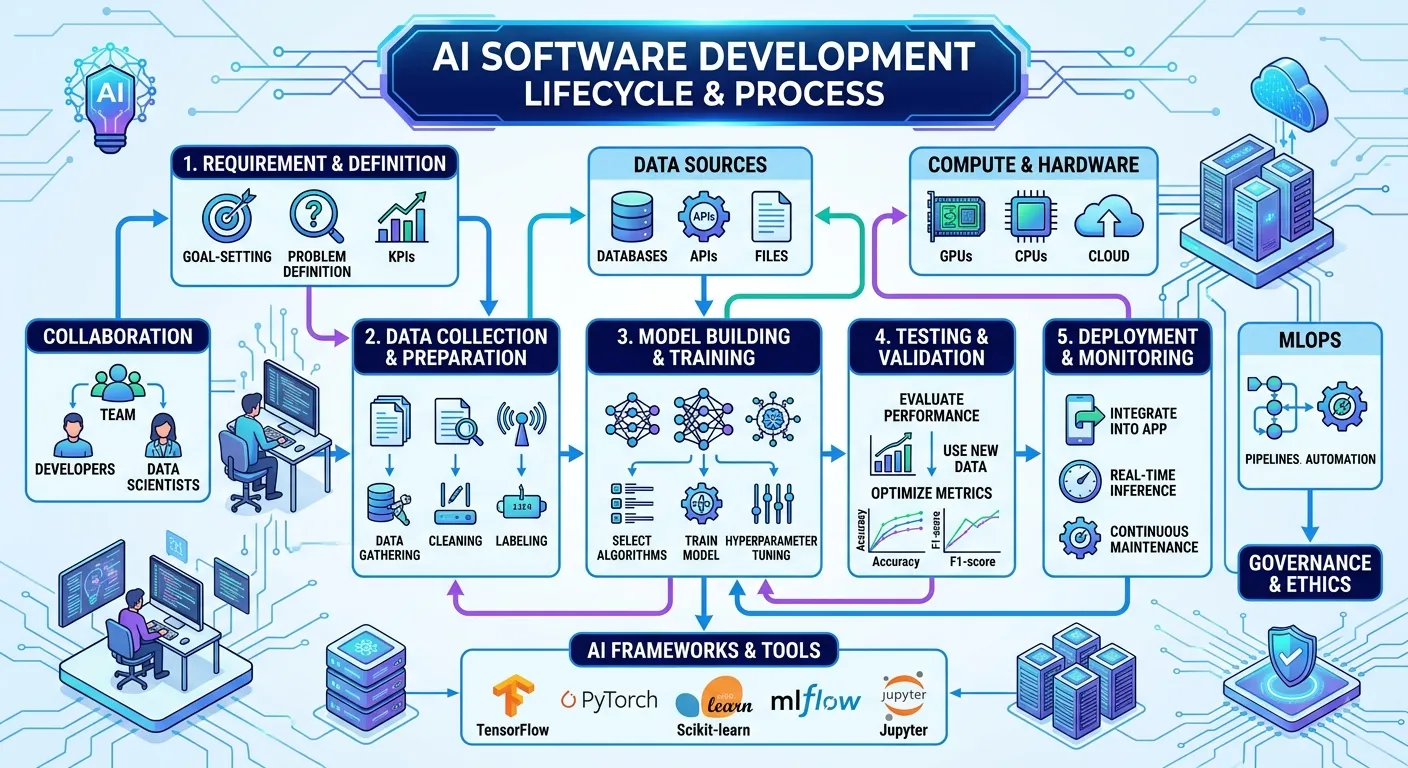
They typically start with strategy, move into solution design and development, then focus on integration, deployment, and scaling.
The goal is to turn AI into a reliable business capability, not a one-time experiment.
What is the AI development process in 2025?
In 2025, the process is end-to-end: strategy, data readiness, solution development, application design, integration, deployment, and monitoring.
Each step is tightly connected to business outcomes and scalability.
How much do AI development services cost?
Costs vary widely based on complexity, integrations, data readiness, and scale.
Most enterprises invest progressively, starting with high-impact use cases and expanding over time.
How long does AI solution development take?
Initial solutions can take a few months, while enterprise-scale systems evolve over longer timelines.
AI is iterative by nature, improving continuously after deployment.
What industries use AI development services?
AI is used across industries like healthcare, finance, manufacturing, retail, logistics, and SaaS.
Any business dealing with data, decisions, or scale can benefit from AI.
What is end-to-end AI development?
End-to-end AI development covers everything from strategy to deployment and scaling.
It ensures one accountable approach, fewer handoffs, and AI that works reliably in real business environments.























Sign in to leave a comment.