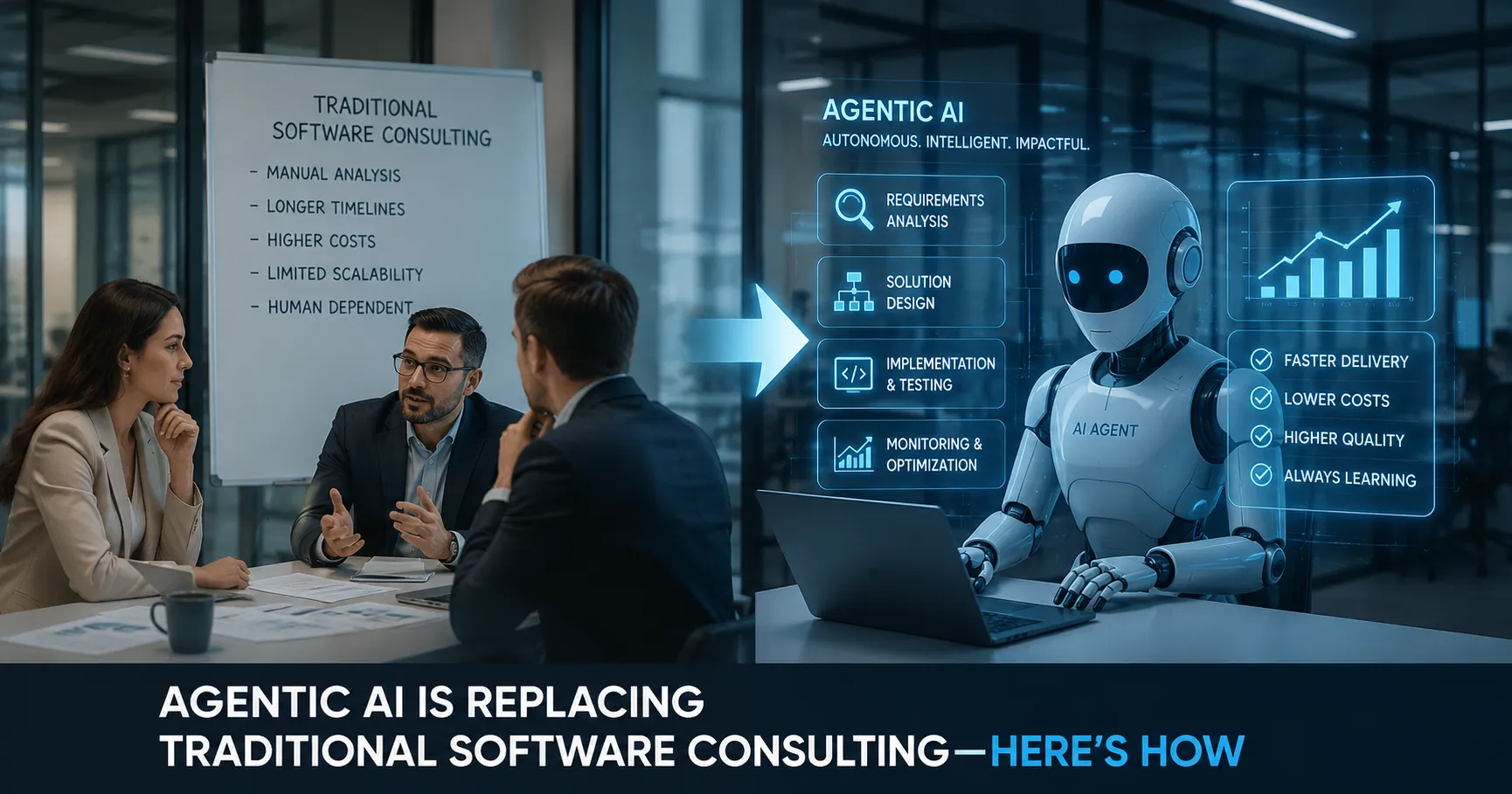

For decades, software consulting followed a predictable model: businesses identified a problem, hired consultants, waited weeks for analysis, and then implemented recommendations through development teams. This cycle worked in a world where change was slower and systems were simpler.
But today, that model is breaking.
The rise of agentic AI consulting is shifting consulting from a human-driven advisory service into an autonomous execution layer embedded inside enterprise systems. Instead of waiting for human consultants to analyze and respond, businesses are now using AI systems that continuously observe, decide, and act.
This is not just an upgrade—it is a replacement of core consulting functions.
Modern organizations are increasingly investing in AI software consulting services that don’t just suggest solutions but actively implement them using intelligent AI agents.
We are entering a phase where consulting is no longer a project. It is a living system powered by AI automation in enterprises and driven by real-time intelligence.
What Is Agentic AI Consulting (And Why It Matters)?
At its core, agentic AI consulting refers to AI systems that operate as autonomous decision-making agents within a business environment.
Unlike traditional AI tools that respond to prompts, agentic systems can:
- Observe enterprise data continuously
- Break down goals into tasks
- Execute workflows independently
- Learn from outcomes and improve decisions
This makes agentic AI consulting fundamentally different from traditional advisory models. Instead of consultants telling businesses what to do, AI systems actually do it.
This shift is the foundation of modern AI software consulting services, where intelligence is embedded directly into enterprise workflows instead of being delivered as reports or PowerPoint decks.
Why Traditional Software Consulting Is Becoming Obsolete
To understand the rise of agentic AI consulting, we need to break down why traditional consulting is losing relevance.
1. Slow Decision Cycles in a Fast Digital Economy
Traditional consulting follows a slow, linear process—data collection, analysis, interviews, and then recommendations. This often takes weeks or months, which no longer matches today’s fast-moving business environment.
By the time insights are delivered, market conditions may already have changed. This creates a gap between decision-making and execution.
In contrast, AI automation in enterprises enables real-time analysis and decision-making using live data. This is why companies are shifting toward AI software consulting services, where insights are continuous rather than delayed.
2. High Dependency on Human Labor
Traditional consulting depends on large teams of analysts, architects, and managers. While effective, this structure leads to higher costs, slower execution, and communication delays.
Every task goes through multiple layers of human effort, which slows down overall delivery.
With AI software consulting services, much of this workload is now automated. AI systems can analyze data, generate insights, and even execute actions instantly. This reduces dependency on manual work and is a key reason agentic AI consulting is gaining adoption.
3. Static Deliverables vs Continuous Intelligence
Traditional consulting delivers fixed outputs like reports, presentations, and roadmaps. These quickly become outdated in fast-changing environments. Businesses today need continuous updates, not one-time recommendations.
With enterprise AI transformation, companies are moving toward continuous intelligence systems powered by AI. Instead of static documents, they get real-time optimization driven by AI automation in enterprises and AI agents for business processes, which constantly adapt to changing conditions.
How Agentic AI Consulting Actually Works in Enterprises
To understand how agentic AI consulting replaces traditional consulting, we need to look at how these systems function inside real organizations.
Step 1: Continuous Data Ingestion
AI agents continuously collect and combine data from multiple enterprise systems to understand business activity in real time. This replaces traditional consulting, which depends on slow, historical data analysis.
Core highlights:
- Collects data from CRM, ERP, customer interactions, and workflows
- Works on real-time data instead of static reports
- Builds a live enterprise intelligence layer
- Supports faster decisions in AI automation in enterprises
Step 2: Goal Decomposition
AI agents automatically break business goals into smaller, actionable tasks instead of waiting for human instructions. This is a key function of AI agents for business processes.
Key points:
- Converts high-level goals into clear tasks
- Example: “Improve retention” → churn analysis + targeting + engagement
- Enables faster execution in agentic AI consulting
Step 3: Autonomous Execution
AI agents don’t just analyze—they act. They execute tasks directly across systems, reducing dependency on human teams.
Core highlights:
- Sends automated actions and messages
- Adjusts pricing and workflows
- Optimizes systems in real time
- Strengthens AI software consulting services
Step 4: Feedback Learning Loop
Every action is tracked and improved over time, making the system smarter with continuous learning.
Key takeaways :
- Monitors outcomes of every action
- Improves future decisions automatically
- Enables self-learning AI automation in enterprises
- Makes systems continuously adaptive
Enterprise AI Transformation: The Core Business Shift
Organizations are no longer “experimenting” with AI—they are restructuring around it. Enterprise AI transformation refers to the complete redesign of business operations using AI-first architecture.
This includes:
- AI-driven decision systems
- Automated IT operations
- Intelligent customer journeys
- Predictive business modeling
Instead of relying on external consulting firms, enterprises are embedding intelligence directly into systems using AI software consulting services.
Example: Retail Enterprise Transformation
A retail company using AI automation in enterprises can:
- Predict inventory demand
- Automatically reorder stock
- Adjust pricing dynamically
- Personalize marketing campaigns
All of this happens without manual consulting cycles. This is the power of enterprise AI transformation—systems that think and act in real time.
AI Agents for Business Processes: The New Digital Workforce
One of the most disruptive components of this shift is the rise of AI agents for business processes. These agents are emerging as a new layer of digital workforce within enterprises, designed to operate continuously without interruption.
They function like digital employees that never sleep, constantly monitoring systems, processing data, and executing tasks in real time.
Key Capabilities:
- Automating repetitive tasks
- Managing customer service workflows
- Generating reports and insights
- Handling IT operations
- Monitoring system health
Unlike traditional automation tools, these agents understand context and can make decisions. This is why businesses adopting AI software consulting services are seeing massive productivity gains.
AI Automation in Enterprises: From Support Tool to Core Infrastructure
Earlier, automation was mainly used as a support function to assist basic operations. However, AI automation in enterprises has now evolved into core infrastructure that drives critical business functions across the organization.
It now powers key areas such as finance operations, HR workflows, supply chain optimization, cybersecurity monitoring, and customer engagement systems. Instead of relying heavily on large consulting teams for ongoing management and optimization, enterprises are increasingly building AI-driven ecosystems that can operate and improve themselves over time.
This shift is significantly reducing dependence on traditional consulting models and accelerating the move toward autonomous, AI-powered enterprise operations.
The Evolution of AI Software Consulting Services
The consulting industry itself is transforming.
Modern AI software consulting services now focus on:
- Designing AI-first architectures
- Deploying intelligent agents
- Automating enterprise workflows
- Integrating predictive analytics
- Building self-learning systems
Unlike traditional IT consulting, which focuses on implementation, AI consulting focuses on autonomy and intelligence. Many organizations also combine this with software development consulting services to build scalable AI-native platforms.
Role of AI Business Consulting in This New Era
While AI systems are becoming more powerful, they still need clear business direction. This is where AI business consulting plays an important role in guiding successful enterprise AI transformation.
It helps organizations identify the right AI opportunities, prioritize automation use cases, build a clear transformation roadmap, and align AI systems with business goals. Instead of random adoption, it ensures AI is applied in a structured and meaningful way.
Without proper guidance, AI adoption can become scattered and inefficient. That’s why AI software consulting services are essential to make sure AI delivers real, measurable business impact.
Custom AI Software Development Company: Building the Backbone
Enterprises often collaborate with a custom AI software development company to design and build AI systems tailored specifically to their business requirements. These companies focus on turning AI strategy into real, working systems that can operate at scale inside complex enterprise environments.
They develop AI agents designed for specific workflows, build enterprise-grade automation systems, integrate AI solutions with legacy infrastructure, and ensure that everything is secure, scalable, and performance-optimized. This allows businesses to move beyond planning and actually deploy AI into day-to-day operations.
- Develop AI agents for specific business workflows
- Build enterprise automation systems for large-scale use
- Integrate AI with existing legacy infrastructure
- Ensure scalability, performance, and security
- Convert strategy into working AI systems
- Bridge the gap between consulting and engineering execution
Software Development Consulting Services in the AI Era
Traditional software development consulting services are evolving quickly with the rise of AI. Instead of only designing systems, consultants now help build and implement intelligent, AI-driven solutions that improve how enterprises operate.
Today, the focus is on co-building AI-native applications, integrating machine learning pipelines, automating development workflows, and optimizing cloud infrastructure using AI. This shift makes software delivery faster, smarter, and more scalable.
At SISGAIN , we focus on delivering advanced AI software consulting services that help businesses modernize their systems and adopt AI-driven development practices with ease.
- Co-building AI-native applications
- Integrating machine learning pipelines
- Automating development workflows
- Optimizing cloud infrastructure with AI
The role is no longer just advisory—it is evolving into an AI systems architect approach where consulting and engineering work together to build intelligent enterprise solutions.
Challenges in Adopting Agentic AI Consulting
Despite its advantages, adopting agentic AI consulting is not simple and comes with several real-world challenges that enterprises must carefully manage during transformation.
1. Legacy System Complexity
Many enterprises still depend on outdated legacy systems that are difficult to integrate with modern AI technologies. This creates friction in connecting old infrastructure with new autonomous AI systems.
2. Data Fragmentation
AI systems require clean, unified, and high-quality data to function effectively. However, in most organizations, data is scattered across multiple platforms, making integration and accuracy a major challenge.
3. Skill Shortage
There is a significant shortage of professionals who understand AI agent orchestration and enterprise-level AI implementation. This slows down adoption and limits scalability.
4. Security and Governance Risks
Since AI agents can act autonomously, there is always a risk of unintended actions. Without strong governance and monitoring systems, security and compliance issues can arise.
This is why AI software consulting services are essential for ensuring safe, structured, and controlled enterprise AI transformation.
The Future: Fully Autonomous Consulting Ecosystems
The next phase of agentic AI consulting is moving toward fully autonomous enterprise ecosystems where AI systems don’t just support operations—they independently run and optimize them in real time.
We are heading toward a future where AI systems manage entire departments, continuously refine business performance through self-optimizing models, generate strategies automatically based on real-time data, and enable constant enterprise evolution without waiting for traditional consulting cycles.
In this shift, traditional consulting firms will either transform into AI platform companies that build and manage these systems or gradually be replaced by them as automation becomes the default operating model. The consulting industry is not disappearing—it is being fundamentally redefined by AI software consulting services and enterprise-wide AI transformation.
Final Thoughts: The End of Consulting as We Know It
The rise of agentic AI consulting represents one of the biggest structural shifts in modern business. What once required entire consulting teams can now be achieved through autonomous systems powered by AI automation in enterprises and AI agents for business processes, enabling faster execution and smarter decision-making at scale.
Businesses that embrace enterprise AI transformation early will gain significant advantages in speed, efficiency, and competitive dominance, while those that delay risk depending on outdated consulting models in a rapidly evolving digital landscape.
The future clearly belongs to organizations that successfully combine intelligence, automation, and execution into a unified system powered by AI software consulting services, and this future is no longer distant—it is already unfolding today.
























Sign in to leave a comment.