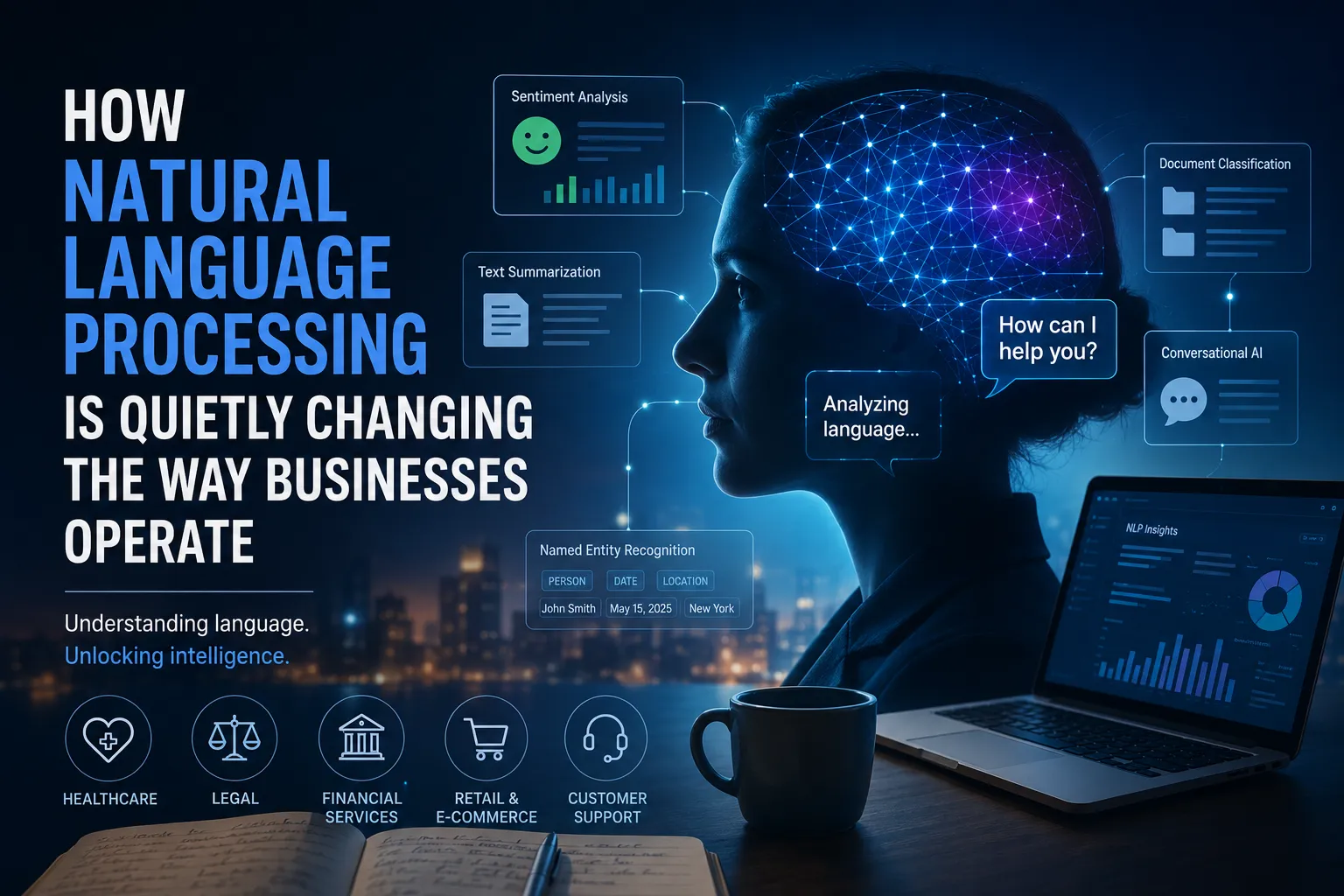

There's a moment when you're chatting with a customer support bot, or watching your email client auto-suggest a reply, or asking your phone to set a reminder — and somewhere in the back of your mind, you think: how does this actually work? That invisible layer of intelligence that lets machines understand, interpret, and respond to human language? That's natural language processing at work. And right now, it's evolving faster than most people realize.
Over the past few years, NLP has shifted from an academic curiosity into something businesses are actively integrating into their day-to-day workflows. It's not just Silicon Valley giants anymore. Mid-sized companies in healthcare, legal, finance, and retail are leaning on language AI to handle tasks that used to require entire teams of people.
What Natural Language Processing Actually Does
At its core, NLP is the branch of artificial intelligence that deals with how computers understand and generate human language. This includes everything from breaking down a sentence grammatically (called parsing) to understanding the emotional tone behind a review (sentiment analysis) to translating documents across languages in real time.
The applications span a surprisingly wide range. Businesses use NLP for:
- Document classification — routing incoming emails or support tickets to the right department without human triage
- Named entity recognition — automatically extracting key information like names, dates, and locations from contracts or reports
- Sentiment analysis — gauging how customers feel about a product from reviews, social posts, or survey responses
- Text summarization — condensing long documents into readable briefs
- Conversational AI — powering chatbots and virtual assistants that handle thousands of interactions simultaneously
Each of these functions sounds simple in isolation, but the underlying technology is deeply complex. Language is messy, contextual, and constantly evolving. Getting a machine to understand sarcasm, regional slang, or domain-specific jargon is genuinely hard — and the companies that have cracked this problem are enabling meaningful productivity shifts across industries.
Why More Businesses Are Turning to NLP Solutions
There's a practical reason NLP adoption has accelerated: the cost of building and training language models from scratch is prohibitive for most organizations. That's why third-party natural language processing services have become so attractive — businesses can plug into pre-built, battle-tested infrastructure rather than investing years in custom development.
Beyond cost, there's the issue of specialization. A general-purpose language model trained on internet text will struggle with medical terminology, legal language, or financial jargon.
Specialized NLP providers build models that are trained on domain-specific data, which makes them dramatically more accurate in context. A healthcare company trying to extract diagnoses from clinical notes needs something trained on clinical language — not something that learned from Wikipedia.
Scalability is another driver. NLP doesn't get tired. It doesn't call in sick. It can process 50,000 customer messages in the time it takes a human agent to read ten. For businesses dealing with large volumes of unstructured text data, that kind of throughput is a genuine operational advantage.
The Technical Landscape: Where Things Stand in 2025
NLP has been transformed by large language models (LLMs). The release of models like GPT, BERT, and their successors fundamentally changed what's possible. Previous approaches to NLP relied on rule-based systems and statistical methods that required extensive manual tuning. Modern transformer-based models learn context and relationships in language far more fluidly.
What this means in practice is that NLP systems today can handle tasks that would have been impractical five years ago — multi-document summarization, long-context reasoning, nuanced question answering across large knowledge bases. These aren't future possibilities; they're tools organizations are using right now.
That said, there are real limitations worth understanding. LLMs can hallucinate — confidently stating incorrect information. They can amplify biases present in training data. They require careful prompt engineering to produce consistent results. The National Institute of Standards and Technology (NIST) has published guidance on AI risk management that's worth reading for any organization deploying AI systems at scale, including NLP tools. It provides a practical framework for evaluating reliability, transparency, and safety.
Practical Considerations Before Adopting NLP Services
If you're evaluating NLP solutions for your organization, a few things are worth thinking through carefully.
Data privacy and compliance should be near the top of the list. NLP systems often process sensitive content — customer communications, internal documents, healthcare records. Understanding where your data goes, how it's stored, and who can access it is essential. Depending on your industry, you may have regulatory obligations that constrain your options significantly.
Model accuracy on your specific data matters more than benchmark scores. Many vendors advertise impressive performance on standard datasets, but those numbers may not hold up when applied to your company's particular language, terminology, or document types. Always test with a representative sample of your own data before committing.
Integration complexity varies widely. Some NLP services offer clean APIs that slot into existing workflows with minimal engineering lift. Others require significant customization. Before signing on, map out exactly how the output of the NLP system will feed into your downstream processes — whether that's a CRM, a ticketing system, or a reporting dashboard.
Explainability is an emerging priority. As organizations rely more heavily on automated text analysis, questions arise about why the system made a particular classification or recommendation. This matters most in regulated industries, where decisions affecting people need to be traceable and auditable. MIT's research resources on responsible AI and language technologies are a useful reference for teams grappling with these questions in technical contexts.
Sector Spotlights: Where NLP Is Making the Most Difference
Healthcare is probably where the stakes are highest. Clinical documentation is notoriously burdensome — physicians spend enormous amounts of time on notes, coding, and administrative paperwork. NLP is helping extract structured data from unstructured clinical text, suggest diagnostic codes, flag potential drug interactions in case notes, and route referrals more accurately. The efficiency gains are real, but so are the risks if systems make errors.
Legal is another high-value domain. Contract review, due diligence, regulatory compliance — these processes involve enormous volumes of text that historically required expensive human hours. NLP-assisted review can accelerate the process significantly, flagging unusual clauses, identifying missing provisions, or surfacing relevant case precedents from large document libraries.
Financial services use NLP heavily for fraud detection (analyzing communications for anomalous language patterns), earnings call analysis (sentiment and topic extraction from investor calls), and customer service automation. The ability to process news and financial filings at scale is also valuable for risk monitoring.
E-commerce and retail leverage NLP for review analysis, search relevance, and personalization. Understanding what customers are saying — and what they mean — at volume is a competitive advantage.
The Human Element Isn't Going Away
It's worth pushing back on the idea that NLP replaces human judgment entirely. The better framing is augmentation. NLP handles the volume and the initial triage; humans handle edge cases, context, and the calls where nuance actually matters.
The most effective deployments treat NLP output as a first draft — a starting point that reduces cognitive load rather than a final answer that removes humans from the loop. A support agent who doesn't have to read 200 tickets to find the five that need attention is more productive and more effective. A lawyer who gets a first-pass contract review in minutes instead of days has more time to focus on the analysis that actually requires legal expertise.
The organizations getting the most value from natural language processing are the ones who've thought carefully about which parts of their workflow benefit from automation and which parts genuinely need human intelligence. That's not a technology question — it's a process design question.
The technology is ready. The harder work is building the workflows, training the people, and establishing the governance frameworks that let NLP deliver on its real promise: not replacing human communication, but making sense of it at a scale we couldn't manage before.


























Sign in to leave a comment.